
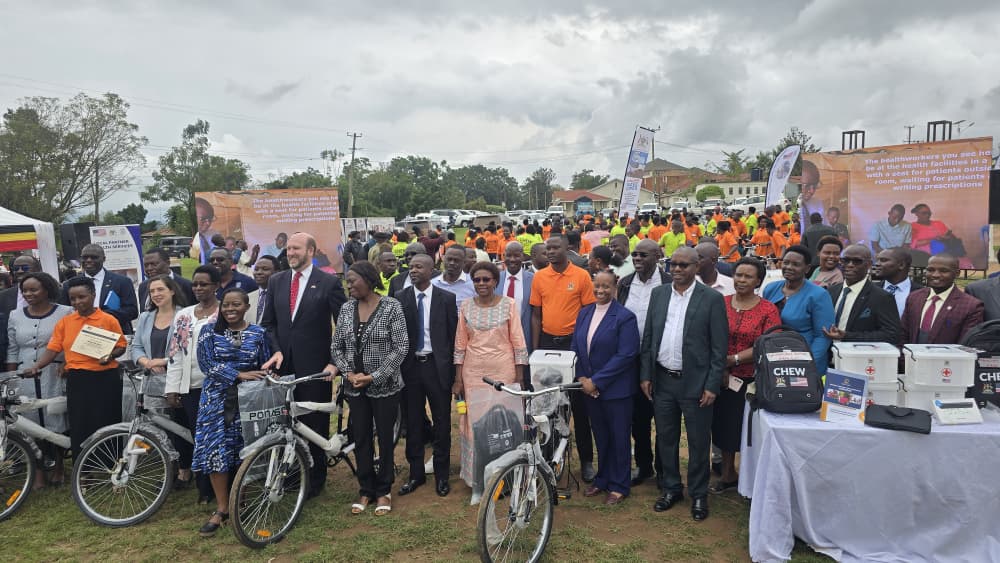
In a major step to strengthen rural healthcare system, 138 newly trained Community Health Extension Workers (CHEWS) have been deployed in Mbarara, bringing medical services closer to households and bridging the gap between communities and health facilities.
The graduates, who completed a six-month intensive training program, received their deployment kits during a ceremony attended by a high-level delegation, including US Ambassador to Uganda William W. Popp, Health Minister Dr Jane Ruth Aceng, and Ministry of Health Permanent Secretary Dr. Diana Atwine.
Speaking at the event, Dr Aceng said the initiative is designed to revolutionize healthcare at the community level.
“To ensure they can perform their duties effectively, each health worker has been equipped with a specialized toolkit, including bicycles for navigating rugged village terrain, comprehensive medicine kits for treating common ailments such as malaria and diarrhea, and digital tablets for real-time information storage and data transmission,” she explained.
Dr Atwine described the deployment as a launch of a frontline health force.
“This is not just a graduation; it is the deployment of a frontline force,” she said, adding that the digital tablets would enable the government to track disease outbreaks in real time.
While celebrating the graduates’ achievements, both Dr Aceng and Dr Atwine cautioned them against overstepping their professional boundaries.
“You have been trained to promote health, prevent disease, and provide basic care. You are the link, not the destination. Do not disguise yourselves as doctors or nurses; refer cases beyond your training to the nearest health center,” Dr. Aceng said.
The CHEWS are tasked with hygiene promotion, nutrition education, and monitoring chronic conditions such as hypertension and diabetes.
The program is intended to complement the existing Village Health Teams (VHTs), offering a more professional and sustainable approach by providing formal training and stipends.
The ceremony also highlighted Uganda’s strengthened partnership with the United States. Following a recent Memorandum of Understanding, the US government has pledged $2.3 billion (about Shs8 trillion) over the next five years to support the country’s health sector. A significant portion of this funding will go toward training and deploying 14,000 CHEWS nationwide.
Ambassador Popp underscored the importance of the initiative: “By targeting 14,000 extension workers, we are ensuring that even the most remote Ugandan is not more than a few kilometers away from life-saving health information and basic care. A healthy population is the foundation of a prosperous nation.”
Among the graduates, Moses Tumwebaze shared his experience: “Before this training, I didn’t know how to properly use a blood pressure machine. Now, with my bicycle and my tablet, I can reach ten households a day and screen for sickness before it becomes a crisis.”
As the CHEWS return to their respective parishes, the Ministry of Health hopes the program will decongest major hospitals by preventing illnesses at the source.
Dr Aceng reminded the workers of their critical role: “Go out and serve. Your success will be measured not by how many people you treat, but by how few people in your community fall sick in the first place.”
