

Congratulations President Museveni on your Seventh. It does not come any bigger and better especially when it is most likely "one for the road" with General Muhoozi Kainerugaba looking more certain to step up than day and night.
When Yoweri Kaguta Museveni led the National Resistance Army (NRA) into Kampala in January 1986, he presented himself as part of a new political era. The promises were bold but simple in framing: restore democracy, end the cycles of violence, rebuild institutions, eliminate corruption, and transform Uganda into a self-sustaining modern state.
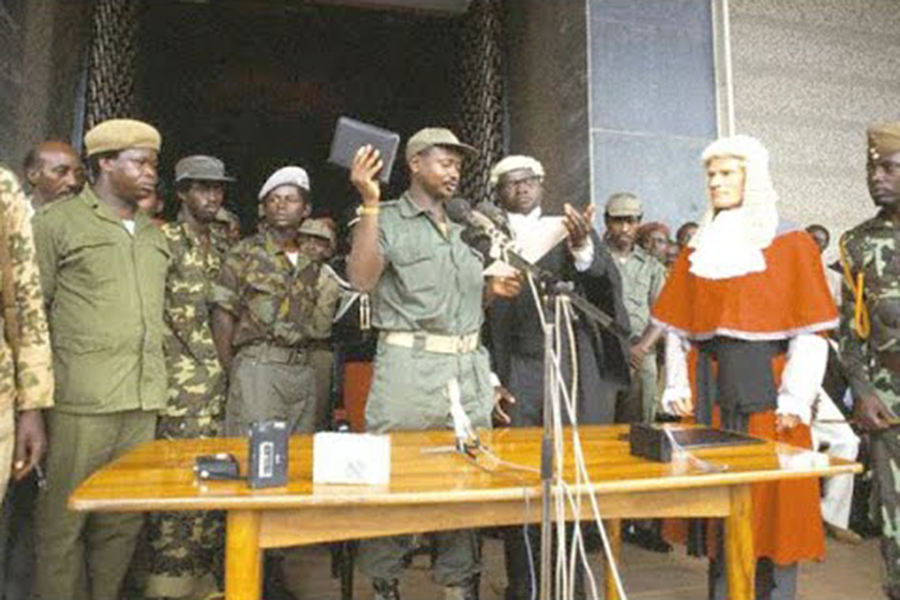
Indeed, the West was enthused, with President Bill Clinton leading the chorus of "new breeed of African leaders" in saluting what they saw in his promises. This was supposed to be the fundamental change promised at the steps of Parliament Buildings on January 26, 1986, with rag-tagged bush war combatants looking pensive and all.
For many Ugandans emerging from years of political instability, the moment marked hope more than hesitation.
Four decades later, Museveni remains at the centre of Uganda’s political order, preparing to extend his rule into a seventh term. The journey from bush war commander to long-serving president is often told through the lens of stability restored.
Uganda has not returned to the large-scale internal conflicts that defined earlier decades, and state institutions, however contested, have expanded in scope, reach, and complexity. Roads, energy infrastructure, telecommunications growth, and relative macroeconomic stability are frequently cited as pillars of the post-1986 era.
Yet alongside these achievements sits a persistent national debate: what happened to the original promises of transformation, accountability, and democratic renewal?
One of the earliest and most repeated commitments of the new government was the fight against corruption. In the late 1980s and early 1990s, the rhetoric around discipline in public service and accountability was strong.
Institutions such as the Inspectorate of Government were strengthened over time, and anti-corruption frameworks were expanded.
However, corruption has remained a recurring challenge across successive administrations, with periodic scandals involving public procurement, service delivery, and high-level governance.
The government has consistently responded with prosecutions and investigations in some cases, but public perception surveys and civil society assessments have often pointed to a gap between enforcement and deterrence. For many Ugandans, corruption is not viewed as an episodic problem but as a structural feature that continues to affect service delivery, investment confidence, and trust in institutions.
Another foundational promise of the 1986 movement was political transition and the avoidance of long-term personal rule. He quickly diagnosed the disease that continues to eat up African nations: leaders who do not want to leave power.
Museveni initially came to power under a system that limited political competition, arguing that stability required a phased approach to multiparty politics. Multiparty elections were eventually restored in 2005 following a referendum, but the political landscape has remained heavily dominated by the ruling National Resistance Movement (NRM), which he continues to lead.
Over time, constitutional amendments removing presidential term limits in 2005 and later lifting age limits in 2017 reshaped the framework of eligibility for leadership. Supporters of these changes have argued they provide continuity in leadership and allow voters to decide without artificial restrictions. Critics, however, view them as evidence of the gradual erosion of the original commitment to orderly leadership transition.
This brings the question of tenure into sharper focus. Museveni’s long stay in power has become one of the defining features of his presidency. While he has consistently argued that continuity has been necessary to safeguard stability and drive development, the length of his rule has also intensified national and international debate about leadership renewal and generational transition.
In economic terms, Uganda has recorded periods of strong growth since the late 1980s, particularly in the 1990s and early 2000s, supported by reforms in liberalisation, infrastructure investment, and donor engagement. The economy has diversified beyond agriculture into services, telecommunications, and energy production. However, structural challenges remain significant.
Youth unemployment and underemployment are among the most pressing concerns. With a rapidly growing population and a predominantly young demographic, job creation has not kept pace with labour market entry. Many young Ugandans remain in informal work, subsistence agriculture, or low-wage service roles. This has created a persistent gap between economic growth figures and lived economic reality for large segments of the population.
The government has in recent years promoted industrial parks, skilling programmes, and parish development initiatives as mechanisms for grassroots economic transformation. While these interventions have generated some localised impact, questions remain about scale, sustainability, and absorption capacity in the formal economy.
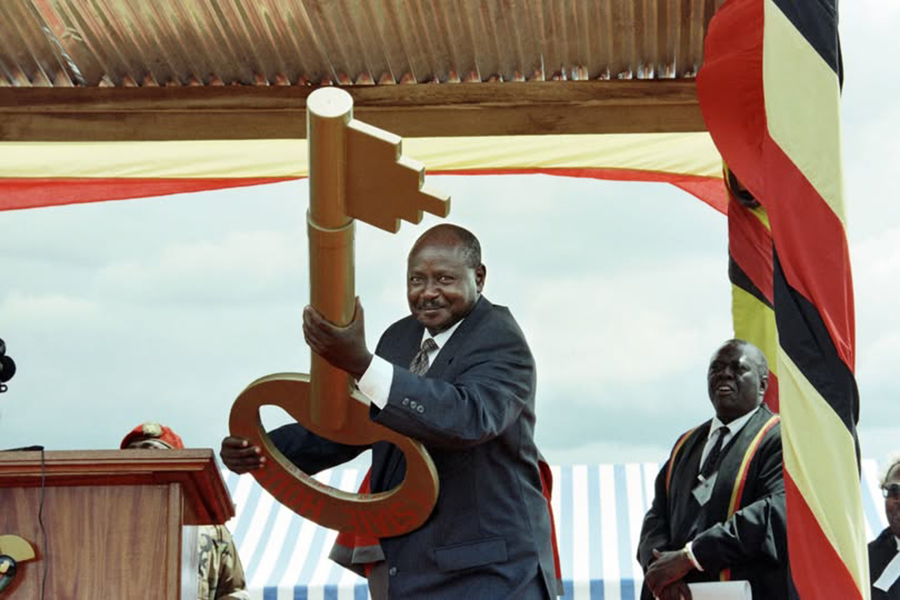
One of the most prominent development narratives of recent years has been Uganda’s classification as a lower middle-income country. Government messaging has framed this as a milestone achievement reflecting sustained macroeconomic progress. However, analysts and sections of the public have often approached this status with caution, arguing that it is based more on statistical thresholds than on broad-based income transformation.
The concern is not the classification itself, but whether it reflects meaningful change in household incomes, poverty reduction, and economic mobility. For many citizens, the middle-income label sits uneasily alongside persistent cost-of-living pressures, limited formal employment opportunities, and uneven regional development.
Security remains one of the most consistently cited achievements of the Museveni era. The restoration of relative stability after decades of conflict allowed for institutional rebuilding and economic activity to expand. Uganda has also played a regional security role in peacekeeping and conflict stabilisation missions, reinforcing its position as an influential actor in East Africa.
However, governance debates have increasingly focused not only on security of the state but on the quality of political and civic space. Issues around opposition activity, electoral competition, and civil liberties have remained part of the national discourse, particularly during election cycles.
The government maintains that political stability requires firm management of security risks, while critics argue that democratic space has narrowed over time.
As Museveni prepares for another term, the question of succession remains one of the most sensitive but unavoidable topics in Uganda’s political conversation. While no formal transition plan has been publicly institutionalised, discussions around generational leadership and political continuity have become more prominent, particularly as the president advances in age.
At the heart of this discussion is not just individual succession, but institutional succession: whether Uganda’s political system is evolving toward predictable and peaceful transfer of power beyond personalities. In long-serving administrations, this question often becomes central to long-term stability and investor confidence.
For Museveni, the legacy debate is increasingly dual-layered. On one hand, he is credited with restoring stability, expanding infrastructure, and anchoring Uganda within regional geopolitics. On the other, his presidency is evaluated against unresolved questions around governance reform, corruption control, economic inclusion, and the pace of political transition.
As the new term begins, Uganda stands at a familiar but complex crossroads. The promises that defined 1986 have not disappeared; they have evolved into more demanding expectations shaped by a younger population, a more connected economy, and a more contested political environment.
The defining test of this period may not simply be delivery of new projects or continuation of existing programmes, but whether the foundations laid over nearly four decades can support a transition into a more institutionally driven state. One that is less dependent on the longevity of a single leader, and more on the strength of systems designed to outlast him.
Mr Museveni, congratulations once again on this, probably, your final term!