
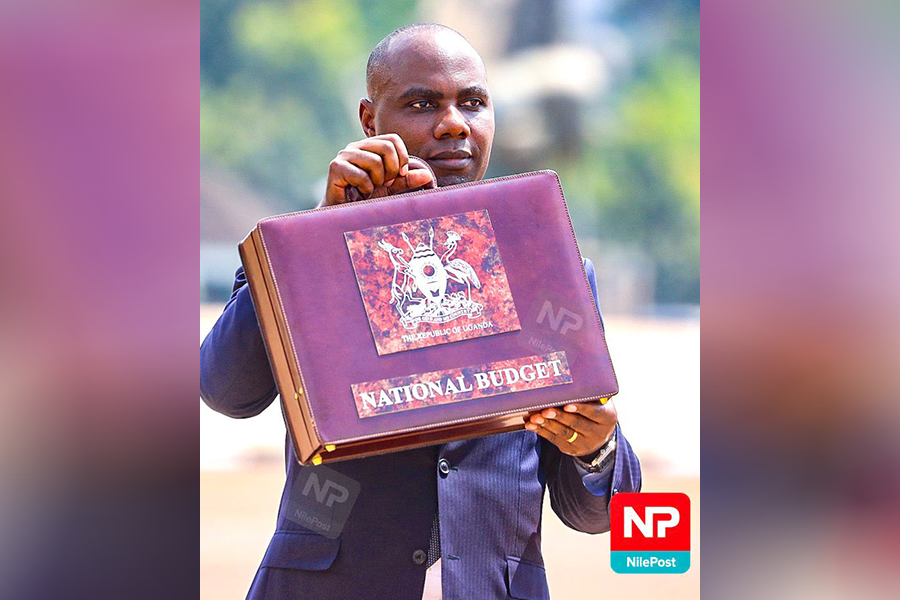
Uganda’s economy continues to demonstrate “remarkable resilience and dynamism” and is set for stronger expansion as the country prepares to begin commercial oil production, Finance Minister Henry Musasizi has said.
Presenting the FY 2026/27 National Budget at Kololo Ceremonial Grounds on Thursday, Musasizi said economic fundamentals remain strong despite global geopolitical tensions, trade disruptions and continued uncertainty in international markets.
He said economic growth for FY 2025/26 is estimated at 6.4 percent, up from 6.3 percent in FY 2024/25, while the size of the economy is projected to reach about $69.3 billion (Shs250.4 trillion) by June 2026.
In purchasing power parity (PPP) terms, Uganda’s Gross Domestic Product is estimated at USD 197.1 billion, while GDP per capita is projected at $1,420 (about Shs 5.1 million per person), reflecting gradual improvements in average income levels.
Musasizi said Uganda’s economic trajectory is expected to shift more sharply in FY 2026/27, when growth is projected to jump to 10.2 percent with the commencement of commercial oil production—marking what would be the country’s return to double-digit expansion since the economic reforms of the 1990s.
“This will mark Uganda’s first return to double-digit growth since the reforms of the 1990s. Most importantly, a larger economy will create more jobs, raise household incomes, expand opportunities for business, and generate the resources required to invest in quality education, healthcare, infrastructure, security and other public services that improve the lives of Ugandans,” he said.
Export growth and sector performance
The Finance Minister highlighted strong export performance as a key driver of economic expansion, noting that exports of goods and services have grown by about 204 percent over the last five years.
Total export earnings reached $18.04 billion in the 12 months to March 2026, compared to $5.93 billion in the same period of 2022.
Uganda’s major exports include gold, coffee, cocoa, fish products, steel, sugar and a growing range of manufactured goods.
Coffee exports alone generated $2.46 billion in the year ending March 2026, up from USD 1.84 billion the previous year, underscoring the continued importance of agriculture-based foreign exchange earnings.
These gains come at a time when global commodity markets have remained volatile, with institutions such as the World Bank previously warning that developing economies face uneven recovery patterns due to inflationary pressures and shifting global demand.
Employment gains and labour structure
Musasizi also pointed to notable improvements in job creation, particularly in the formal private sector.
He said employment in private formal establishments increased by 245 percent, rising from about 672,300 workers in FY 2016/17 to more than 2.3 million workers in FY 2024/25.
Uganda now has over 503,000 public sector employees and an estimated 10.5 million people engaged in the informal sector, which continues to dominate national employment.
“This growth in jobs confirms that Uganda’s economy is not only growing but also creating productive jobs for Ugandans,” he said, attributing the gains to government interventions in industrialisation, wealth creation and private sector development.
On public finances, Musasizi said domestic revenue collections are projected to rise from Shs 35.7 trillion in FY 2025/26 to Shs 45.6 trillion in FY 2026/27, equivalent to 15.9 percent of GDP.
The additional revenue is expected to finance government priorities under the agro-industrialisation agenda, tourism development, mineral-based industrialisation, science and innovation, and major infrastructure projects.
On public debt, he said Uganda’s total debt stock stood at USD 34.86 billion (about Shs 126.19 trillion) as of December 2025.
External debt accounts for $15.84 billion, while domestic debt stands at USD 19.02 billion, putting the debt-to-GDP ratio at about 53 percent.
Despite concerns about rising debt levels, Musasizi maintained that Uganda’s debt remains sustainable, arguing that borrowed funds have been channelled into long-term productive investments such as roads, electricity generation, water systems, education, healthcare, industrial parks and digital infrastructure.
Policy direction and long-term strategy
The FY 2026/27 budget is anchored on the theme: “Full Monetisation of Uganda’s Economy through Commercial Agriculture, Industrialisation, Expanding and Broadening Services, Digital Transformation and Market Access.”
Government says the budget will prioritise wealth creation, job expansion, export growth and industrialisation, aligned with the country’s Tenfold Growth Strategy, which aims to transform Uganda into a $500 billion economy in the long term.
The projected oil-driven growth surge is expected to mark a significant turning point in Uganda’s economic trajectory, though economists continue to stress that sustaining such growth will depend on diversification, macroeconomic stability and effective management of oil revenues.
