

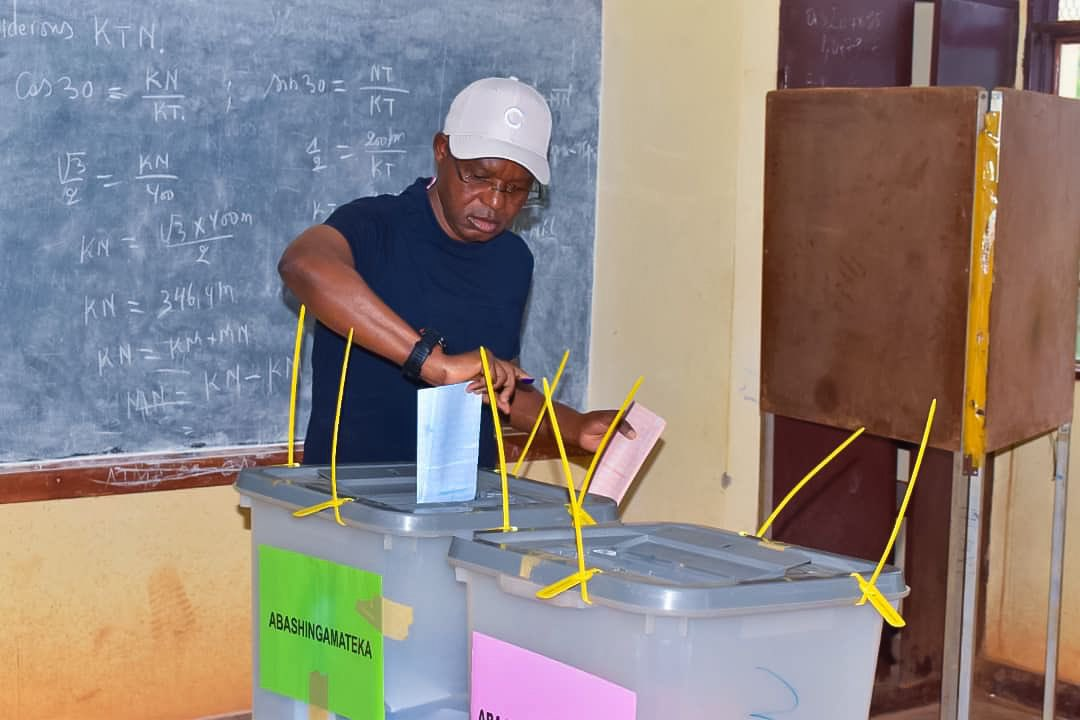
Burundians cast their ballots on Thursday in tightly controlled local and parliamentary elections widely seen as tilted in favour of the ruling CNDD-FDD party, whose leader President Évariste Ndayishimiye voted from his native village in Gitega province.
Despite the government’s efforts to project calm and high voter turnout, opposition leaders and independent observers say the electoral process is already undermined by systematic repression, economic crisis and the exclusion of key challengers.
The East African nation of 12 million is choosing lawmakers for the 123-member National Assembly, with 100 deputies directly elected and 23 seats co-opted based on ethnic and political quotas.
The elections are taking place without the participation of the main opposition party, the National Freedom Council (CNL), which was suspended by the interior ministry in 2023.
Its exiled founder, Agathon Rwasa, was ousted from the party leadership in a move critics described as orchestrated by the government to neutralise credible opposition.
In a symbolic gesture of confidence in the vote, President Ndayishimiye appeared alongside his wife and adult children to vote in Musama, in Giheta commune.
He hailed the “massive turnout” and described the moment as proof that “democracy is well and truly rooted in Burundi.”
Senate President Emmanuel Sinzohagera echoed this sentiment, telling reporters the early voter mobilisation showed “political maturity,” and urged political actors to “accept the verdict of the ballot boxes.”
But such official optimism contrasts sharply with growing discontent among opposition voices and civil society.
In interviews with local media, rival candidates and analysts accused the CNDD-FDD of exploiting state resources and repressing challengers to engineer a one-sided outcome.
Fuel shortages, ongoing since 2022, have paralysed daily life — and opposition parties claim that government fuel stockpiles have been diverted exclusively to ruling party cadres and campaign convoys.
In Ngozi province, district officials reportedly deployed state vehicles and public fuel supplies to transport Imbonerakure militia and CNDD-FDD supporters to rallies.
Meanwhile, the opposition says it cannot reach voters.
“We don’t have access to fuel, and we cannot meet the population,” said Anicet Niyonkuru, president of the CDP opposition party.
“It’s a blatant waste of public resources to support a single party.”
Patrick Nkurunziza of the opposition coalition Burundi Bwa Bose (Burundi for All) described the campaign as “very difficult” and marked by intimidation.
“Our members face threats, harassment, and even physical attacks,” he told AFP.
Both he and Niyonkuru said the CNDD-FDD’s domination stems not from popularity but manipulation of the state and a climate of fear.
The fuel crisis has compounded a broader economic meltdown in Burundi, where inflation now exceeds 40% a month.
Basic commodities are scarce, and a recent two-week power blackout — announced by the state electricity firm REGIDESO just days before the vote — has sparked outrage.
Citizens accuse the government of using the outage and intermittent internet disruptions to stifle independent media, limit election observation, and isolate voters.
According to the Burundian electoral code, state resources — including vehicles, fuel, and public funds — are not to be used for partisan purposes. But opposition figures say the law is being ignored.
“This is not a campaign; it’s a state operation,” one rival party official said, asking not to be named.
The CNDD-FDD has ruled since 2005, when President Pierre Nkurunziza came to power following years of civil war. His death in 2020 paved the way for Ndayishimiye, who was initially viewed as more moderate.
However, despite some early gestures of openness, critics say his administration has continued the authoritarian legacy.
Independent journalists and activists still face harassment and arrest, and international human rights groups remain largely locked out.
Rwasa, the former leader of the now-suspended CNL, had been the government’s most credible challenger in past elections.
After being sidelined through internal party upheaval and new legal restrictions that block him from standing as an independent, there is little doubt about the outcome of Thursday’s vote.
“Without the CNL, the CNDD-FDD is sure to win,” said a Burundian political analyst, who asked to remain anonymous for security reasons. “The few remaining candidates are there just to give the illusion of democracy.”
Still, the government has leaned heavily on symbols of normalcy. Burundians in Ethiopia were able to vote at the embassy in Addis Ababa, and the First Lady Denise Nkurunziza, widow of the late president, called voting “a patriotic duty.” In Gitega, voters turned out under the gaze of ruling party observers.
If the CNDD-FDD retains its expected majority in parliament, it will further cement its dominance across all branches of government.
Burundi's political structure places sweeping powers in the hands of the president, who also commands the military and oversees internal security.
For many citizens, though, these elections are not about choice but endurance.
“This is not just about who wins,” the Burundian analyst said. “It’s about whether elections in Burundi still mean anything at all.”