
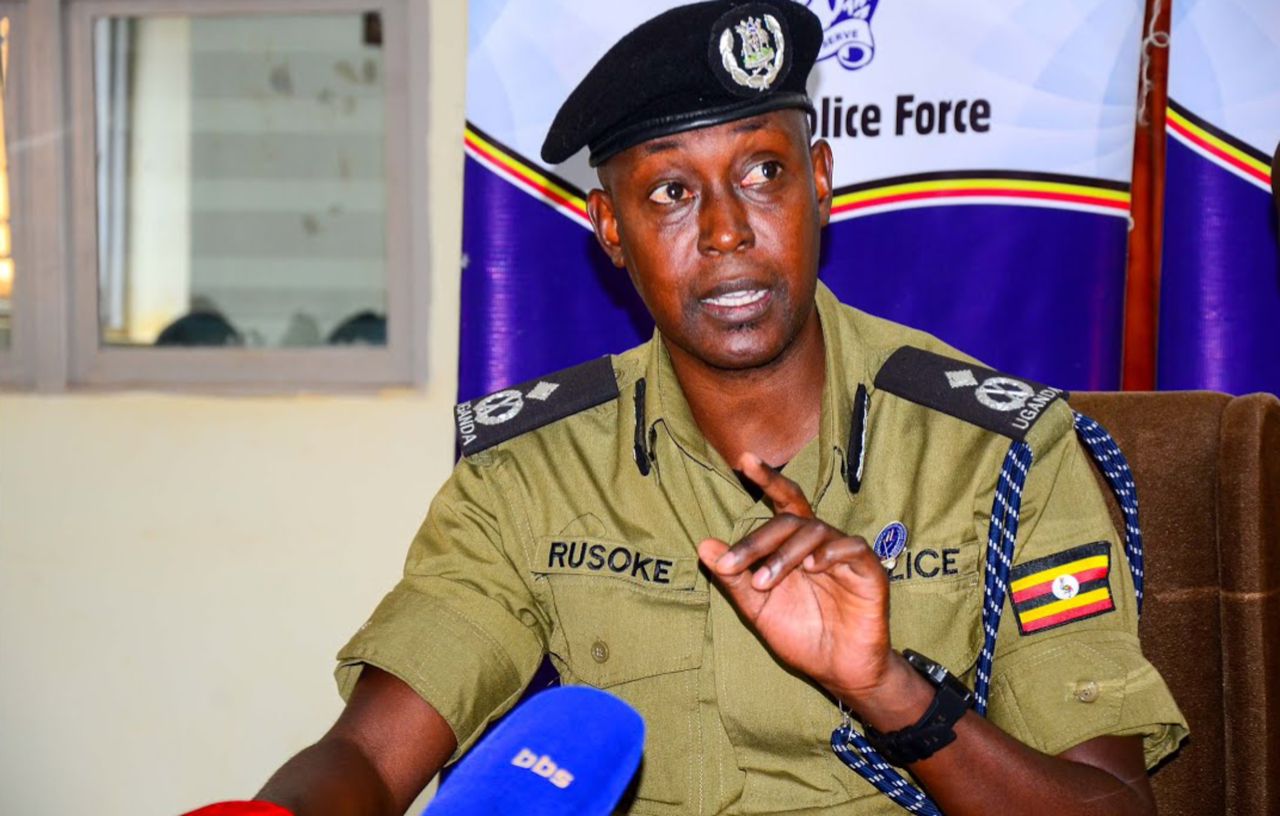
Uganda Police maintains that this year’s presidential campaigns are proceeding smoothly, despite growing public concern over repeated clashes between security forces and opposition supporters.
Police spokesperson ACP Kituuma Rusoke insists the overall environment remains calm, even as incidents in Kawempe, Lira and Mayuge continue to raise questions about enforcement practices and police conduct.
In an interview, Rusoke said the campaign period should be assessed holistically, arguing that disagreements are inevitable but security agencies are operating within established guidelines. He insisted that all candidates have fair access to voters and that most disruptions stem from non-compliance with agreed regulations rather than police bias.
Excerpts below;
On a scale of one to 10, how would you rate the campaigns so far in terms of smoothness?
I would put it at eight. But remember, campaigns must be judged holistically—from the beginning to the end.
Supporters and political actors in the opposition wouldn’t agree with you. Recent clashes between police and NUP supporters would make them score it much lower.
That’s their opinion, and this is mine. We are all viewing these events from different perspectives. From a security perspective, everything possible is being done to ensure peaceful elections. Secondly, every candidate has the opportunity to reach their supporters. Yes, along the way, sometimes disagreements occur with some candidates and their supporters.
What informs your operations for example, what happened in Kavule as NUP supporters headed to the Kawempe rally. Why not simply let them move freely?
Every participant knows that processions are not permitted. Candidates are expected to move from their point of origin to the campaign ground without moving with crowds. This was discussed and agreed upon. But some candidates violate it, which forces police as the custodian of security and enforcement to ensure compliance. We deploy reasonable capabilities to ensure that standard is observed.
What explains the incidents we saw in Kavule, where NUP supporters were dispersed?
Those are consequences of non-compliance. Compliance is voluntary, but if you refuse, security agencies are left with no choice but to enforce it.
You deployed canine units dogs. Was that appropriate?
Let me give a clear picture. The canine unit is one of our force enablers. It detects narcotics, assists in rescues, and is also trained for crowd control. So using it for crowd control is within operational standards. The handlers are trained, and the dogs used for such tasks are specifically trained for that capability.
Years ago, dogs deployed in demonstrations injured people, after which they were withdrawn.
I cannot speak to the exact decision then. But currently, canine remains one of the capabilities we have chosen to deploy, just like CCTV and anti-riot gear.
Why ban processions? Political rallies are often noisy and charged; excitement is expected.
We are following Electoral Commission regulations. Processions affect public order and often generate crime robberies, vandalism, attacks on mobile money outlets, and beatings. These have been recorded. We cannot look on while law and order slips out of our hands.
You follow all presidential candidates. If only some elements in a crowd commit crime, why disperse entire groups instead of arresting specific individuals?
That is a tactical decision. Sometimes, command on the ground determines that dispersing the crowd is necessary. But we also make targeted arrests. We have arrested individuals involved in specific crimes like those who attacked a police car in Lira, or those who beat police officers in Mayuge.
But many say your actions appear targeted.
They are issue-specific, not selective. We go for individuals who commit particular offences.
Police controls CCTV, and your officers also carry handheld cameras. But these recordings rarely come out. Why?
Sharing evidence is a matter of choice. We are under no obligation to release our evidence publicly. When necessary, we have shared some images like the attacked patrol vehicle. Where we choose not to share, it is because we don’t find it necessary.
In Makerere Kavule, near Kawempe, a stampede occurred. People fell into ditches. Was that necessary? Couldn’t you guide the crowd instead?
It was unfortunate the unintended consequence of a public order operation. No officer intended such an outcome. In public order management, such incidents sometimes occur. A projectile may land wrongly; someone may slip. What matters is addressing root causes to prevent such situations.
But I haven’t seen the police apologise.
I would be comfortable issuing a final communication after a full assessment of the situation. Let’s wait for that process.
Weeks ago, people wearing yellow beat NUP supporters in Western Uganda. We saw no arrests
I contacted investigating officers. They handled the cases registered by residents. Police acts on reports made by aggrieved persons.
But police watched helplessly in that incident
Let’s not rely only on social media videos. For something to be dismissed as AI, or confirmed as real, a forensic process must be followed. But police acted based on the reports registered.
Were any arrests made?
Yes. Individuals from the NUP camp were arrested.
The beaten people were arrested?
Let’s not be misled by selective video captions. What matters is: did anyone report a case and fail to be attended to? According to the reports I have, those who reported were listened to, and action was taken.
What happens in cells? Some suspects appear in court limping, on crutches.
I am not aware of such incidents. If someone feels mistreated, they can escalate complaints within our disciplinary mechanisms Professional Standards Unit or the command structure.
Women arrested in Western Uganda were mishandled by men.
Let me address use of force. If a suspect refuses to submit, force must be applied to subdue them. Force is allowed so long as it is not excessive. I have not yet seen specific complaints about that arrest.
Footage shows them being forcefully removed from a car.
You were not there. We cannot tell whether they were asked to submit. Only the officers on the ground and the suspects themselves can speak to that.
What problem does the state have with Olivia Lutaaya?
The charge was read to her in court. I will not discuss specifics because the matter is sub judice. She was suspected of an offence, arrested based on that suspicion, and brought before court.
She was previously pardoned for a similar offence. Does this make sense?
I cannot discuss the content of a matter before court.
The charge sheet mentions illegal drilling. Yet videos show similar activities by groups in yellow. Has police taken interest?
I have no information to that effect. I have seen the video. If action is taken, I will announce it. I speak only on matters I have been briefed on.
What constitutes illegal drilling?
It is an offence under the Penal Code. Permission from the Attorney General is required. I won’t go into deep legal specifics, but police analyses evidence and sends it to prosecution. If charges have merit, the file is sanctioned.
So, so far, no action has been taken on the other video?
I am not aware of any.
Do you care about how the public perceives the Uganda Police?
Yes. There are many acts we do that show professionalism. Just because a case was not handled yesterday does not mean it will not be handled.
An NBS investigation showed that people wearing NRM T-shirts who caused chaos during the NRM flagbearer’s nomination were never arrested.
Some were arrested. Some were taken to court. Arrests were made in Kansanga and on Kampala Road. People reported cases, and police acted.
Once you deliver suspects to court, do you follow up on court processes and provide updates?
It is not our practice to follow up or provide updates on court processes after we have delivered suspects to court. Court has its own communication arm to communicate its outputs. Our role is simply to appear in court and provide evidence when required—not to communicate outcomes of court proceedings.
Do you think something needs to be done to improve the public perception of the Uganda Police?
Whoever has an issue with how they perceive us can always volunteer that feedback and tell us where they feel discomfort. I respect opinions, and I thank you for that feedback. I will convey it to police management.
So, for now, Uganda Police is not doing anything to improve its public perception?
The work we do every day is geared towards fulfilling our responsibility as custodians of the law. The laws we enforce, the crimes we detect, the order we maintain, and the disciplinary action we take against officers when they transgress—these are all actions aimed at preserving our image.
You said it is up to the police to release or withhold footage from the field. Second, when disciplining officers, your tribunals are closed to the public. Doesn’t that show lack of transparency?
When a police officer appears before an internal disciplinary court, we may or may not open it to the public. That cannot be the yardstick for accountability. Accountability is the punishment of the officer, not parading him publicly. We often give general statistics on officers subjected to disciplinary action without taking each case through a video show. We are under no obligation to do that.
But how will the public know that you have disciplined an officer?
As I said, we provide statistics. We may not broadcast every individual case publicly.
Are there challenges the Uganda Police Force faces while policing electoral processes that the public may not know?
Whether the public knows or not, some challenges are in the public domain. The first challenge is compliance. The smoothness of an electoral process depends heavily on how stakeholders comply with agreed requirements. The moment a participant deviates and maintains that deviation with impunity, sparks begin.
Often, people only focus on operational excesses without considering root causes. Sometimes the root cause is deviation from regulations and agreed positions.
Secondly, elections are heated by nature. Conflicts sometimes emerge even in our absence, and police arrives only to put out the fire.
Thirdly, there is the cyber challenge false images, engineered perceptions, and deliberate manipulation of public opinion against security forces. Some participants are gullible and easily misled.When we encounter these issues, we absorb the shock and continue working.
When groups deviate from agreed routes or venues, why don’t you adjust instead of using force?
Why shouldn’t they also adjust? These are adults vying to run public affairs. There is no excuse for failing to comply with basic requirements. Elections are highly contested, but that does not justify non-compliance.
What is the worst that could happen if you let people move freely to the venue?
We cannot gamble with public order. Mass movements and processions affect safety, infrastructure, and other citizens. We must protect everyone. Elections are not a do-or-die matter.
Some of the guidelines we enforce were not created by police—they are set within a broader regulatory framework.
Don’t you sometimes make the situation worse? For example, someone opens a shop and suddenly gets hit by a stray bullet.
We are not making the situation worse. Without regulation, it would be far worse. Our goal is to control crowds and maintain order. Should we give up? We guide candidates to meet supporters in organised environments, where communication is clearer and security risks are reduced.
