
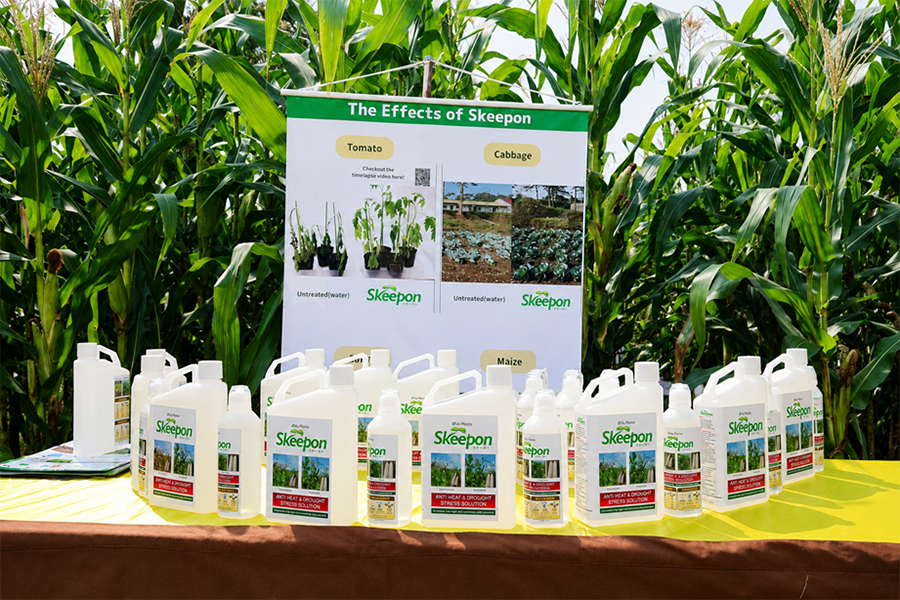
The government has officially launched the national rollout of Skeepon Technology (SKP), a climate-smart agricultural innovation designed to help crops withstand drought, erratic rainfall and heat stress, as authorities step up efforts to address the growing impacts of climate change on food production.
The technology was launched at the 2026 National Agricultural Show in Jinja by Prime Minister Robinah Nabbanja, with government reaffirming its commitment to using science and innovation to transform agriculture.
The programme is being implemented through collaboration between the Ministry of Agriculture, Animal Industry and Fisheries (MAAIF), the National Agricultural Research Organisation (NARO), the Office of the Prime Minister, and Japan-based biotechnology firm Ac-Planta Inc..
Officials said Uganda is increasingly facing prolonged dry spells, rising temperatures and unpredictable rainfall patterns that continue to threaten agricultural output, rural incomes and national food security.
Speaking at the launch, Nabbanja said government is prioritising practical innovations that directly respond to farmers’ challenges and strengthen resilience in the agricultural sector.
“Climate change continues to pose one of the greatest threats to our agricultural sector. Government will continue supporting technologies that improve resilience, increase productivity and enhance household incomes,” she said.
Skeepon Technology is described as a plant biostimulant that activates crops’ natural defence systems, enabling them to survive under water stress and high temperatures for up to three months while maintaining growth and productivity.
According to field trials conducted by NARO over two cropping seasons, maize yields increased by more than 30 percent, while vegetable yields rose by over 45 percent compared to untreated crops. Researchers also reported improved plant vigour and stronger drought tolerance.
The Director General of NARO, Dr Yona Baguma, said the results demonstrate the value of scientific research in solving real agricultural challenges.
“This innovation demonstrates the power of science in solving real problems facing our farmers,” he said, adding that it aligns with Uganda’s agro-industrialisation agenda.
The technology was originally developed by Ac-Planta Inc. in Japan and later validated in Uganda through joint research trials before approval for deployment.

Government said the product complements existing agricultural practices such as irrigation, fertilisers and improved seeds, while also benefiting rain-fed farming systems where most Ugandan farmers operate.
At an estimated cost of between Shs12,000 and Shs27,000 per acre, officials say Skeepon offers an affordable climate adaptation tool expected to improve farmer incomes through higher yields and reduced crop losses.
Government also announced plans to explore local formulation and manufacturing of the technology to reduce import costs and create jobs. Distribution will be coordinated through NARO Holdings Limited working with extension services, cooperatives, agro-input dealers and private sector partners.
The rollout is also linked to government programmes such as the Parish Development Model Parish Development Model, aimed at boosting household incomes and improving rural livelihoods.
Officials said the technology will support Uganda’s broader development targets under Vision 2040 and the National Development Plan framework by improving food security and strengthening agricultural exports.
Government has called on farmers, financial institutions, development partners and local governments to embrace climate-smart technologies as weather variability continues to disrupt traditional farming cycles.
More information about NARO and its programmes can be accessed through NARO Uganda website.
