
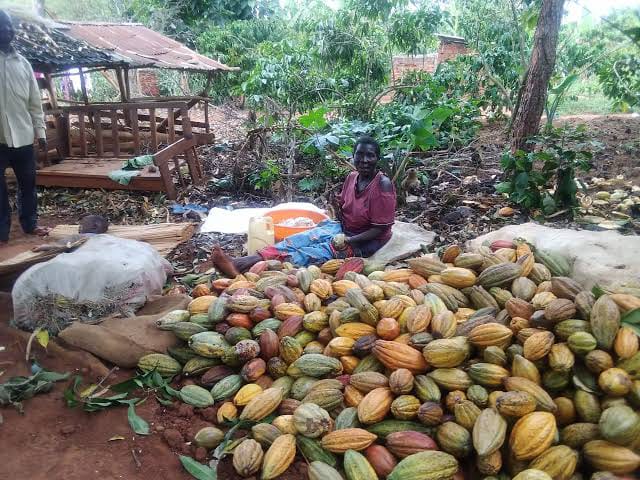
Leaders in Nebbi District have been urged to diversify agricultural support beyond coffee and invest in cocoa farming as an alternative high-value cash crop capable of improving household incomes and reducing farmers' exposure to crop losses.
Social change activist Emilio Odongo said more than 5,000 farmers in the district currently depend on coffee, despite the crop's vulnerability to pests, diseases and prolonged sunshine, which frequently destroys seedlings and threatens production.
He appealed to district leaders to lobby for government support for farmers already engaged in cocoa cultivation by providing them with seedlings and other inputs.
Currently, the district supports farmers with coffee seedlings as part of efforts to increase household incomes and reduce poverty.
According to Odongo, the district has focused heavily on coffee while overlooking cocoa, which he described as an equally viable cash crop with significant economic potential.
"We are missing out on a golden opportunity in cocoa farming. If we could grow cocoa alongside coffee, we would increase economic development and improve household incomes by investing in two high-value cash crops instead of relying on just one," Odongo said.
He noted that coffee is mainly grown in the sub-counties of Ndew, Atego, Jupangira, Erussi and parts of Nebbi Municipality, while cocoa can be cultivated across much of the district.
Odongo argued that cocoa is less susceptible to pests and diseases and is better able to withstand changing weather patterns.
"We have cocoa farmers who have formed an association. They have land available but only need support with seedlings because there is a ready market for cocoa beans, whose prices are significantly higher than coffee," he said.
According to figures cited by Odongo, fresh cocoa beans were selling for between Shs15,000 and Shs20,000 per kilogramme in June, compared with coffee cherries, which fetched between Shs3,000 and Shs3,500.
Dry cocoa beans reportedly earned farm-gate prices ranging from Shs20,000 to Shs25,000 per kilogramme, while premium certified organic cocoa attracted between Shs28,000 and Shs35,000.
By comparison, organic coffee parchment fetched between Shs12,000 and Shs15,000 per kilogramme.
Joshua Otimgiu, proprietor of Namthin Tree and Horticulture Sustainable Nursery Project, said demand for cocoa seedlings has continued to outstrip supply.
"There are very many farmers who are interested in planting cocoa. Since the beginning of the year, I have sold about 600,000 seedlings to farmers, which justifies the demand and value attached to cocoa farming," Otimgiu said.
He attributed the growing interest to the crop's higher market prices, relatively lower incidence of pests and diseases, and increasing government sensitisation on cocoa production.
"I think people are turning to cocoa farming because cocoa beans fetch more money, there are no known serious pest and disease challenges, and government is also carrying out a lot of sensitisation about cocoa farming," he said.
Otimgiu added that cocoa also presents attractive business opportunities for nursery operators, with a cocoa seedling selling for about Shs1,000, compared with approximately Shs500 for a Marsellesa coffee seedling and Shs300 for an Arabica SL14 seedling.
Nebbi Resident District Commissioner Robert Abak said the government, through the Ministry of Agriculture, remains committed to supporting organised farmer groups and individual farmers with agricultural inputs and financing.
"Right now, the government is supporting coffee farmers because we have seen increasing demand and a growing number of coffee growers. But we shall also push for other high-value cash crops," Abak said.
"We shall definitely push for cocoa seedlings to support farmers who are already growing the crop and encourage others to join cocoa farming."
Calls for greater investment in cocoa come as farmers and local leaders seek to diversify agricultural production and reduce dependence on a single cash crop amid changing climatic conditions and fluctuating commodity prices.
