

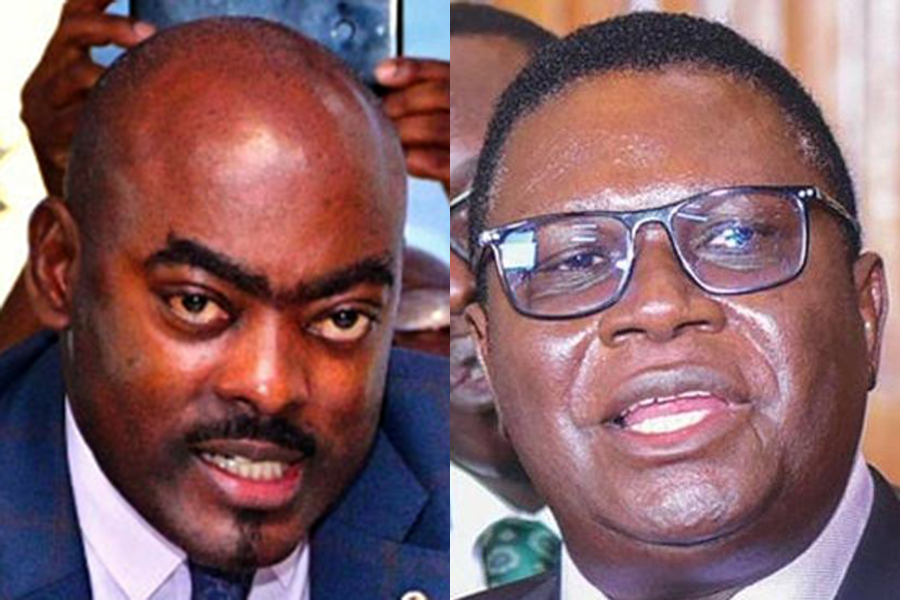
Former East African Legislative Assembly (EALA) Member of Parliament and Democratic Party (DP) Vice President Fred Mukasa Mbidde has formally informed party president Norbert Mao of his intention to contest for the DP presidency at the upcoming delegates’ conference.
The shock decision marks a sharp break from a political alliance that has defined the party’s internal power structure for more than a decade and a half.
The move follows 16 years of close cooperation between the two leaders, during which they worked in tandem to consolidate influence within the party, sideline internal rivals, and steer key strategic decisions.
Their alliance played a central role in securing Mbidde’s two terms in the East African Legislative Assembly, as well as the election of Gerald Siranda, DP Secretary-General, to the same regional parliament.
The pair also jointly engaged in negotiations linked to a cooperation arrangement with President Museveni and the ruling National Resistance Movement (NRM), which, according to party insiders, was expected to yield ministerial positions for both Mao and Mbidde.
While Mao later secured appointment into Cabinet, Mbidde’s anticipated ministerial elevation did not materialise, a development that has increasingly shaped internal tensions within the party.
Mbidde looked set to fight Mao in 2025 only to change his tone and back Mao all the way to the highly controversial Mbarara delegates conference at which Mao secured another term.
Many observers read into Mbidde's backing as a hint that his time to dine at the high table was set but on Tuesday, President Museveni only had a slot for Mao in his Cabinet. Mbidde's reaction will not have surprised many.
Political observers say that imbalance has become a turning point in their relationship, with Mbidde now positioning himself in open opposition to his longtime ally and former political strategist.
Mbidde has since declared that he is determined to wrestle control of the party from Mao, arguing that the current leadership direction has weakened DP’s institutional standing and diluted its political leverage under the cooperation agreement with the NRM.
In a letter dated May 28, 2026, and addressed to Mao—who also serves as Minister of Justice and Constitutional Affairs—Mbidde confirmed that he had already launched nationwide consultations with party members ahead of his bid.
“I am writing to formally inform you of my decision to run for the presidency of the Democratic Party in the upcoming delegates' conference,” he wrote.
The announcement sets up a major internal contest expected to test Mao’s leadership and direction of Uganda’s oldest political party.
Mao was last re-elected DP president in June 2025 during a delegates’ conference in Mbarara City, where he secured 969 votes out of 1,360 cast, defeating Buikwe South MP Dr Michael Lulume Bayigga, who polled 339 votes, and Elia Alitia, who received 52 votes.
Mbidde’s entry into the race comes amid growing internal criticism of Mao’s leadership style and the party’s cooperation agreement with the NRM.
He accuses Mao of making unilateral decisions and failing to deliver on the reform-oriented objectives that originally informed the pact.
According to Mbidde, DP entered the arrangement expecting progress on constitutional reforms, electoral reforms, human rights protections, and the establishment of a more credible Independent Electoral Commission.
He argues that these goals remain largely unmet, leaving the party politically weakened while Mao’s personal political standing has advanced.
“NRM takes people from different places to solve its problems,” Mbidde said. “He has taken limbs from UPC, he has taken limbs from NUP. For us, he took the engine. He is not using it, he has nowhere to put it.”
His remarks reflect what appears to be a deepening ideological and personal split between the two former allies, who for years operated as a tightly coordinated leadership bloc within DP.
For much of Mao’s tenure, the pair were seen as central architects of the party’s internal strategy, influencing key appointments and negotiations.
Their political alignment was also instrumental in shaping DP’s engagement with national power structures, including the controversial cooperation framework with the ruling party.
Now, however, Mbidde’s decision to challenge Mao signals a breakdown of that long-standing arrangement, with both men increasingly presenting competing visions for the party’s future.
Mbidde insists that his new political direction is aimed at restoring internal democracy and repositioning DP as an independent political force ahead of the next electoral cycle.
Mao has not yet publicly responded to the allegations or to Mbidde’s declaration of intent.