

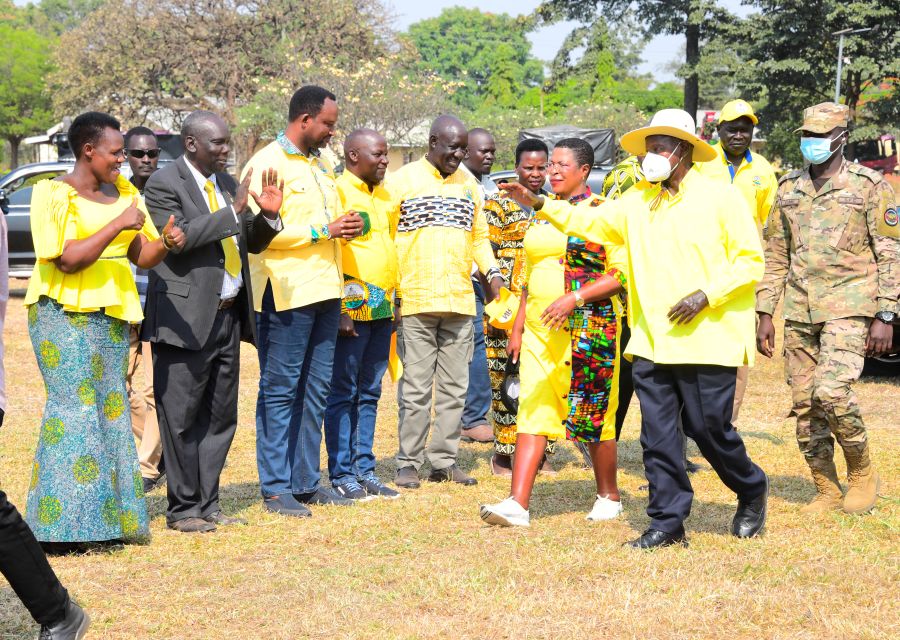
President Yoweri Kaguta Museveni has met local leaders from Acholi and Adjumani at Awich PTC in Laroo Pece Division, Gulu City, where he equipped them with clear messages of the National Resistance Movement (NRM) to relay to the communities they lead.
The engagement focused on the NRM’s seven key contributions to Uganda over the past 40 years and was aimed at empowering grassroots leaders to confidently address public concerns about poverty eradication, job creation, and national development.
“I am equipping you with what to tell the people you lead because they have questions in their minds. How do we get out of poverty? Where do jobs come from?” President Museveni said.
He explained that the meeting was a continuation of the parish conferences and noted that he had authored a booklet detailing the seven contributions the NRM has made to the country over the last four decades.
President Museveni outlined the contributions as peace, development, wealth creation, job creation, market integration, and regional integration, among others.
He emphasized that peace is the NRM’s first and most fundamental contribution, noting that Uganda’s past instability was caused by bad politics rooted in sectarianism, tribalism, and religious divisions—what he described as “fake politics” that failed to address the real needs of the people.
“Because we rejected sectarian politics and embraced patriotism and Pan-Africanism, we were able to build a national party and strong national institutions such as the army and police. These stable institutions made unity and development possible,” he said.
The President added that peace has enabled Uganda to achieve surplus production in several sectors through market integration, unlike in the 1960s when the country was fragmented by narrow political interests.
On development, President Museveni cited visible infrastructure improvements, including tarmac roads connecting Adjumani, Gulu, and other parts of the country, expanded electricity access, railways, and other critical infrastructure.
Regarding wealth creation, the President reiterated the NRM’s four-acre model as a practical solution for families with small landholdings. Under the model, farmers are encouraged to grow coffee on the first acre, fruits on the second, pasture for dairy cattle on the third, and food crops for the household on the fourth acre. He also encouraged poultry, piggery for non-Muslims, and fish farming for communities near wetlands.
“If you do these activities with calculation—ekibaaro or cuura—you cannot go wrong,” he said, adding that government plans are underway to promote valley fish ponds, citing a successful pilot project in Limoto.
President Museveni stressed that the NRM is a party of enlightenment that tells people the truth, particularly on the importance of irrigation in agricultural modernization. He cited government plantations in Bushenyi where irrigation and fertilizer use have resulted in banana yields of up to 53 tonnes, far higher than surrounding farms.
Addressing livestock restocking, the President acknowledged that war and cattle rustling devastated animal populations in Acholi, Lango, and Teso. He explained that after extensive consultations, affected communities opted for monetary compensation instead of livestock, and arrangements are underway to support restocking efforts.
On job creation, President Museveni said employment is mainly generated through key sectors such as commercial agriculture and industrialization through factories, urging leaders to clearly explain this reality to the public.
He also highlighted regional integration as a major NRM contribution, cautioning against leaders who overlook Africa’s market potential.
“If you don’t talk about Africa and its market, what is the future of our grandchildren?” he asked.
The President urged NRM leaders to lead by example, warning against remaining in chan chan (poverty) and encouraging them to build lonyo (wealth) within their families.
“It is not good for leaders to be poor. Every NRM leader must work hard to be prosperous and show the people the way,” he said.
To support grassroots mobilisation, President Museveni pledged to provide new bicycles to LC I leaders to ease their movement, while LC III leaders will receive motorcycles.
The Speaker of Parliament, Anita Among, thanked the President for empowering grassroots leaders, noting that it was the first time he had directly engaged Local Council leaders and enabled them to freely mobilize within their communities.
She said local leaders were ready to mobilize votes for President Museveni in their respective areas.
Meanwhile, the NRM Vice Chairperson for Northern Uganda, Hamson Obua, assured the President of an overwhelming victory, saying the campaign strategy had shifted to grassroots mobilisation.
He explained that Northern Uganda would adopt a “factor tree” approach, where leaders mobilize voters collectively rather than individually, ensuring broad-based support for President Museveni and the NRM.