
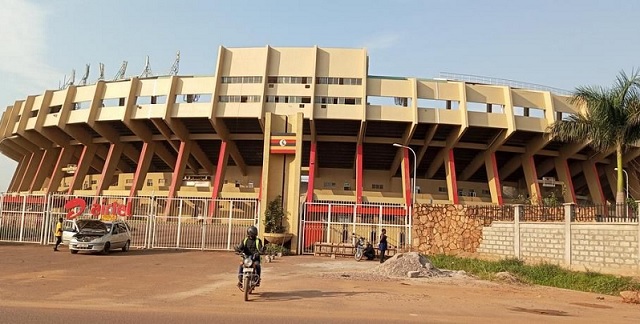
Mandela National Stadium, Namboole, is a bold, concrete-heavy national stadium built in the 1990s with a functional, enduring design that has hosted Uganda’s biggest sporting and national moments. It has been the pride of the nation for three dacades.
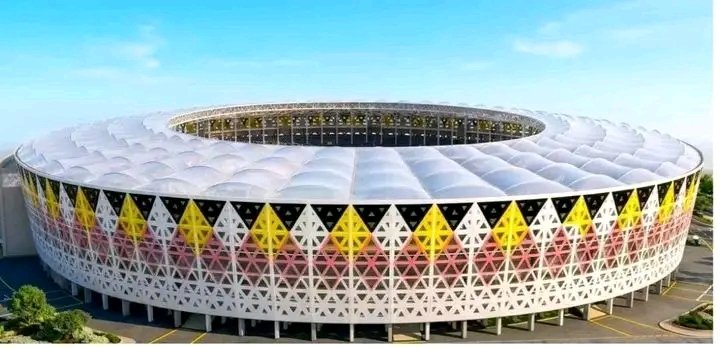
But now there is a sleek, modern redesign wrapped in national flag colours, complete with a futuristic façade, a continuous roof canopy, and a continental tournament-ready aesthetic. Supposedly, that is the plan for revelopment of Namboole.
But should Uganda modernise Namboole, or remake it entirely at the cost of its identity?
There is no doubt that Uganda’s sporting infrastructure has suffered years of neglect. The decision by government to launch a $60 million second phase upgrade of Namboole and assign the UPDF Engineering Brigade to modernise it is both necessary and timely. Uganda is preparing to co-host the 2027 Africa Cup of Nations, and compliance with CAF and FIFA standards is not optional. Improvements in turf, seating, lighting, media facilities, and roofing are urgently needed.
Alongside Namboole, the construction of Hoima City Stadium and Akii Bua Stadium signals a welcome shift in state investment into sports infrastructure. For years, Uganda has lagged behind regional peers in providing modern, safe, and competitive sporting venues. That gap is finally being addressed.
But the danger lies not in upgrading infrastructure — it lies in overhauling identity.
Mandela National Stadium is not just a sports facility. It is a national landmark embedded in Uganda’s collective memory. Since its inauguration in 1997, Namboole has hosted presidential celebrations, CHAN qualifiers, Cranes matches, concerts, national prayer gatherings, and moments that define Uganda’s modern cultural history.
Even Straka took her mega paid-per-view wedding there!
By all acocunts, Namboole is one of the few spaces where politics, sport, and national identity converge visibly.
To redesign it beyond recognition is to risk erasing that memory.
The proposed redesign, with its modern circular shell and decorative national motifs, may be visually impressive and Caf-compliant, but it raises an uncomfortable question: at what point does renovation become replacement? When a stadium loses its original architectural identity, does it remain the same national symbol, or does it become something entirely new?
Uganda has been here before. The demolition of Nakivubo War Memorial Stadium remains a painful reference point. Once a historic sporting and political landmark in Kampala’s civic memory, it was effectively erased and replaced by a commercial structure. Whatever arguments exist for development, the loss of Nakivubo left a gap that cannot be replaced by concrete or art turf.
The same concern applies, more seriously, to Namboole. Unlike Akii Bua Stadium, which never got up from the relic-like 'hut' it was, Namboole carries decades of national symbolism. It is part of Uganda’s post-independence architectural identity — a structure that tells a story of ambition in the 1990s, when Uganda sought to build modern national institutions of scale and permanence.
Globally, nations treat such structures differently. In Rome, Athens, and other historic cities, old stadiums and arenas are preserved, restored, and integrated into modern use. Their value is not measured only in compliance with sporting regulations but in cultural continuity and tourism appeal. Heritage, in these contexts, is not a burden — it is an asset.
Uganda, by contrast, often treats old infrastructure as disposable once it no longer meets modern standards - whoever makes such a judgement! Yet development does not require destruction of identity. It requires intelligent adaptation.
There is a strong case for upgrading Namboole to meet Caf and Fifa standards. But that can be achieved without stripping it of its original architectural character. The focus should be on functional improvement — better turf, improved drainage, upgraded seating, modern lighting systems, digital scoreboards, safety compliance, and roofing enhancements. These changes can transform the stadium’s usability without reinventing its external identity.
Public investment must also be prioritised wisely. With commitments still outstanding for regional stadiums such as Bugembe in Jinja City, or Mbale Stadium and others, it is legitimate to ask whether a full architectural redesign of Namboole is the best use of limited resources.
Ultimately, the issue is not whether Uganda should build modern stadiums. It already is. The issue is whether modernisation must always come at the cost of memory.
Namboole does not need to be reborn as something new. It needs to be renewed as itself — stronger, compliant, and future-ready, but still recognisably the stadium that Uganda has known for nearly three decades.
A country that erases its landmarks in the name of progress risks discovering, too late, that it has also erased parts of its story.
