
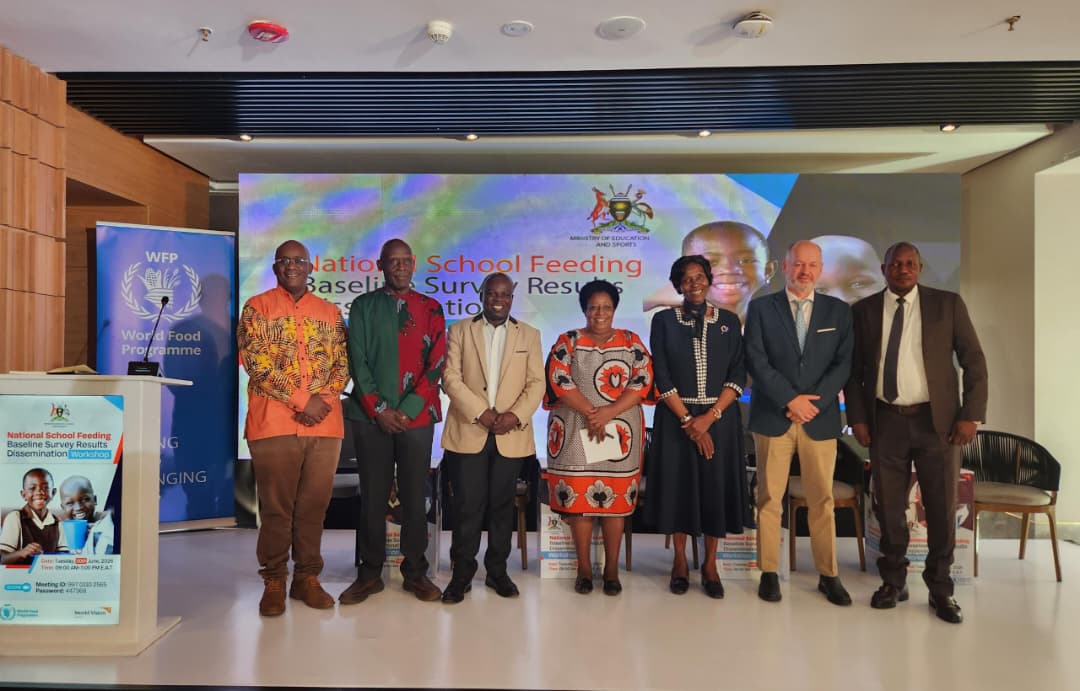
A new national survey has revealed that three in every ten primary school children in Uganda spend an entire school day without eating, raising concerns over the impact of hunger on learning, nutrition and education outcomes.
The findings are contained in the National School Feeding Baseline Survey conducted by the Ministry of Education and Sports and launched on Tuesday in Kampala with support from the World Food Programme (WFP) and World Vision Uganda.
The survey found that 46% of primary school learners receive meals prepared at school, while 14% bring packed food from home, 7% return home for lunch, and 3% buy snacks from school canteens. However, 30% of learners reported that they do not eat anything while at school.
Presenting the findings, Saul Onyango said the situation is more severe in government schools, particularly those under the Universal Primary Education (UPE) programme.
“When we specifically considered UPE schools, the proportion was much higher. Sixty percent of children did not actually eat while at school,” Onyango said.
The survey also revealed major regional disparities in access to school meals.
Karamoja recorded the highest school feeding coverage, with 98% of learners receiving meals at school, followed by Kampala at 92% and Buganda North at 86%.
However, access remained low in several regions, including West Nile (17%), Ankole (18%), Tooro (20%), Acholi (21%), and Lango (22%).
The regions with the highest proportion of children spending the entire school day without food were Ankole (77%), Elgon (76%), Lango (64%), and West Nile (61%).
Meanwhile, Karamoja (2%), Kampala (4%), Kigezi (5%), and Buganda South (8%) recorded the lowest levels of school-day hunger.
The survey further highlighted challenges in the nutritional quality of meals provided in schools. About 85% of schools serve maize porridge or posho with beans, while only 7% include vegetables, 1% serve rice, and very few provide animal-source foods.
Only 28% of schools provide meals containing at least five food groups, indicating that many learners are not receiving sufficiently diverse and balanced diets.
The report found that parents remain the biggest financiers of school feeding programmes, with 96% of schools relying on parental contributions.
In Karamoja, however, 89% of schools receive support from development partners and non-governmental organisations.
The survey also established that 86% of schools purchase food from private businesses, while only 20% source food from smallholder farmers, highlighting an opportunity to strengthen links between school feeding and local agricultural production.
Speaking at the launch, Frances Atima, Head of the Directorate of Education Standards at the Ministry of Education and Sports, said the findings provide government with evidence needed to improve school feeding programmes.
“This gives us a bearing on what is on the ground, what we need to do, and what we need to do better,” Atima said.
She noted that although the Education Act places responsibility for feeding children on parents and guardians, the conversation has shifted toward establishing a sustainable national system.
“The agenda has moved from the responsibility of households to a national discussion on systems, financing and local food economies,” she said.
Atima said government is finalising the National School Feeding Policy, which will focus on governance, financing, implementation and accountability while leveraging initiatives such as the Parish Development Model (PDM) to strengthen partnerships between schools and local farmers.
The Acting Country Director of WFP Uganda, Marcus Prior, described the survey as a major milestone in addressing the long-standing information gap on school feeding.
“Good policy begins with good evidence, and good investment decisions require reliable data,” Prior said.
He said the findings show both progress and significant inequalities in access to school meals.
“Three in every ten students still spend the whole day at school without having anything to eat. Access to school meals is not uniform across the country, and a national school feeding policy presents an opportunity to promote equitable access to meals for all,” he said.
Prior added that school feeding should be considered an investment that improves education outcomes while supporting local economies.
“Every school meal has the potential to improve attendance, concentration and learning, enhance child nutrition, while creating predictable markets for farmers and stimulating rural economies,” he said.
World Vision Uganda Programmes Director Edward Khaukha said the findings underline the urgency of completing and implementing the National School Feeding Policy.
“When only 46% of our children are able to have a meal at school, it is a big challenge for our country,” Khaukha said.
He said the organisation hopes the policy will ensure that every learner has access to a hot meal at school.
“We are looking at how to ensure that at least 90% to 100% of children have a hot meal at school, which is the Ministry of Education standard,” he said.
Khaukha warned that hunger is affecting school attendance, academic performance and learning outcomes.
“Thirty percent of children completely do not have access to a meal at school. That means their enrolment, performance and learning outcomes are affected, and that is a concern for everyone,” he said.
The survey recommends increased investment in school feeding, improved dietary diversity through the inclusion of vegetables, fruits and animal-source foods, expanded procurement from local farmers, stronger financing mechanisms, establishment of a National School Feeding Coordination Unit, and integration of school feeding indicators into Uganda’s education monitoring systems.
The recommendations come as Uganda moves toward implementing a comprehensive National School Feeding Policy aimed at ensuring more learners have access to nutritious meals while at school.
