
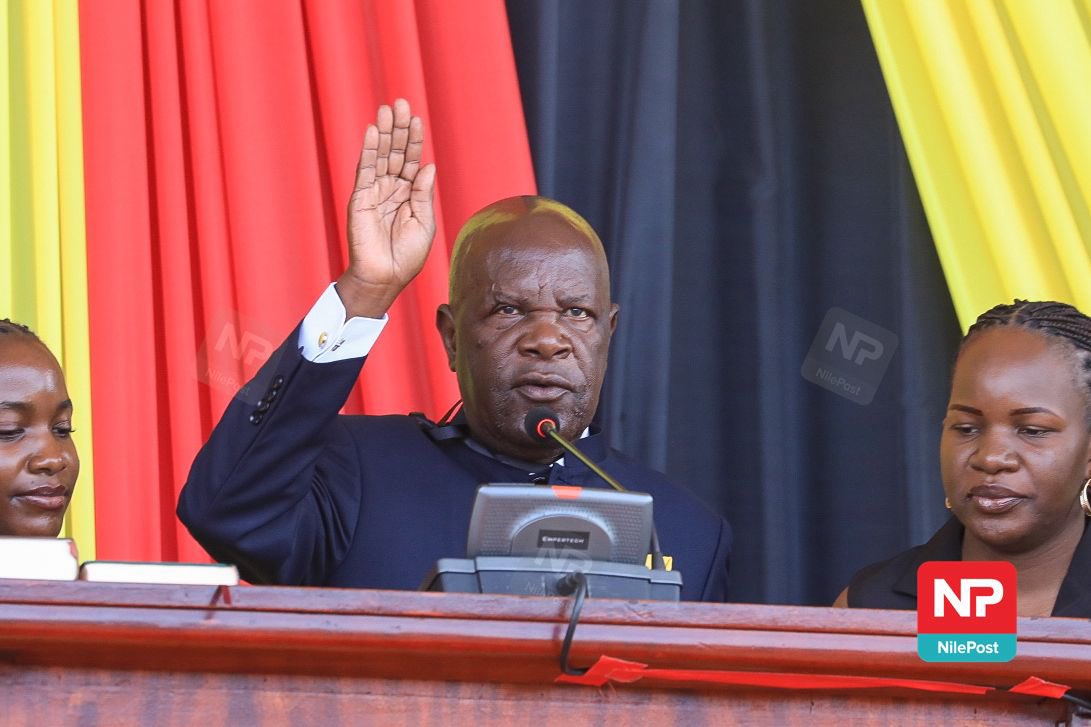
As Uganda completed the swearing-in of Members of Parliament for the 12th Parliament, some lawmakers drew public attention for taking their oath without holding a Bible, Quran, or any other holy book.
Among them was Ofwono Opondo, the representative for Older Persons in the Eastern Region, whose decision sparked debate online and in political circles about whether such an oath is legally recognised in Uganda.
Under Ugandan law, the answer is straightforward: MPs are fully allowed to take a secular affirmation instead of a religious oath.
The legal basis comes from the Fourth Schedule of the 1995 Constitution and the Oaths Act, both of which provide two lawful ways for public officials to assume office.
One is the traditional religious oath, where a person swears “in the name of the Almighty God” and often ends with the phrase “So help me God.” The other is a secular affirmation, where the individual simply “solemnly affirms” their commitment to faithfully perform their duties.
That second option does not require any mention of God or the use of a holy book.
In practice, MPs who choose the religious oath usually hold a Bible or a Quran while reciting the prescribed words. Those who opt for affirmation normally raise their right hand or stand and read the affirmation without any religious text.
Legally, both carry the same weight.
An MP who affirms rather than swears is still bound by the Constitution and remains subject to the same legal consequences for violating the oath of office. The law does not distinguish between a religious oath and a secular affirmation when it comes to accountability, legitimacy, or enforceability.
The principle is rooted in constitutional protections around freedom of conscience and belief. Uganda is a religious society, and public ceremonies are overwhelmingly conducted with Christian or Islamic symbolism. However, the law also recognises citizens who may not subscribe to a religion, may object to religious wording, or may prefer a secular pledge.
This is not unique to Parliament. Ugandan courts follow a similar principle. Before giving testimony, witnesses may either swear using a holy book or choose to affirm if they have religious objections or no religious belief. Once made, the affirmation is treated exactly like an oath under the law.
For many Ugandans, taking office has traditionally been closely associated with religious ritual. As a result, a public official declining to use a Bible or Quran can appear unusual or controversial even when it is entirely lawful.
The debate is therefore less about legality and more about social perception in a country where religion remains deeply influential in public life.
What the Constitution ultimately establishes is that loyalty to public office in Uganda is measured by the binding legal commitment a leader makes, not by whether that commitment is expressed through a religious oath or a secular affirmation.
