
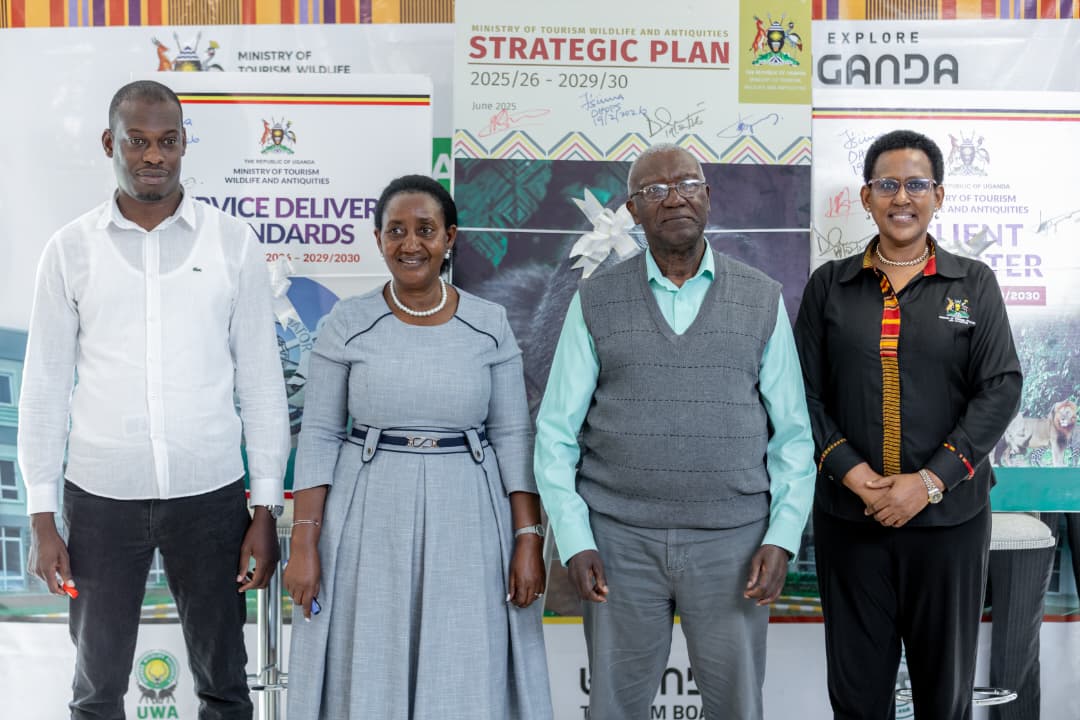
Government has unveiled an ambitious five-year blueprint aimed at positioning Uganda as a leading global tourism destination, with a strong focus on systems reform, product diversification, digital transformation, and improved service delivery.
Speaking at the launch of the Ministry’s new strategic instruments, State Minister for Tourism Martin Mugarra said Uganda’s tourism sector has emerged as a key pillar of economic transformation, registering a strong recovery from the shocks of the COVID-19 pandemic.
“Uganda's tourism industry is the key pillar of Uganda's economic transformation, not only as a source of revenue but also geared to showcase Uganda's culture and natural roles to the world,” he said.
The Minister noted that the sector recorded remarkable growth between 2023 and 2025. By December 2025, tourist arrivals had risen to approximately 1.65 million, while tourism revenues increased significantly from Shs3.9 trillion in 2023 to about Shs6.1 trillion in 2025.
“I think the sector has recovered from the economic shocks of 2020, including COVID-19. The sector is on track to achieve even greater success in the years to come with the ongoing initiatives and reforms,” he added.
Mugarra highlighted key infrastructure developments, including the completion of the Crested Crane Training Application Hotel at the Uganda Hotel and Tourism Training College and the new campus of the Uganda Wildlife Research and Training Institute in Kasese.
He said the facilities are expected to produce highly skilled professionals capable of meeting international standards.
The newly launched Strategic Plan is aligned with the National Development Plan and Uganda Vision 2040, both of which identify tourism as a priority investment area to drive double-digit economic growth and support the country’s long-term ten-fold growth strategy.
According to the Minister, the plan builds on lessons learned during the COVID-19 disruption and provides clear direction for the next five years. It is complemented by Service Delivery Standards and a Client Charter, which together establish performance benchmarks and define the responsibilities of both the Ministry and its stakeholders.
“The strategic plan, the service delivery standards, and the client charter provide clarity of mandate, clarity of processes, and clarity of expected returns,” Mugarra said. “They move us from broad intentions to measurable commitments, and strong systems enhance consistency, reduce inefficiencies, and strengthen accountability.”
He emphasized that the real test would lie in implementation. “The true measure of success will not be the launch of these documents but the tangible outcomes that they will produce,” he said, calling for strong leadership, inter-agency coordination, and active private sector and community engagement.
The Minister outlined several priority areas, including building domestic demand for travel, diversifying Uganda’s tourism portfolio beyond wildlife, fast-tracking the full implementation of the national tourism marketing strategy, and investing in critical infrastructure such as roads, stopover points, and ICT solutions.
He also stressed the importance of digital transformation in the sector. “We need to leverage data to track visa trends and embrace emerging technologies, including artificial intelligence, to enhance the tourism experience, wildlife protection, and conservation,” he said.
Product diversification will include expanding into cultural tourism and Meetings, Incentives, Conferences and Exhibitions (MICE), as part of efforts to reduce overreliance on traditional wildlife offerings.
Tourism, Mugarra said, remains one of Uganda’s key growth sectors with strong potential to generate foreign exchange, create employment, stimulate investment, and promote inclusive regional development.
“The Ministry of Tourism, Wildlife and Antiquities carries a uniquely strategic mandate. It is the custodian of our biodiversity, our natural beauty, and our cultural heritage—assets that define our national identity and position Uganda competitively on the global stage,” he said.
He reaffirmed government's commitment to ensuring that conservation, heritage preservation, and economic growth reinforce one another.
“When tourism thrives, the nation benefits. And that is the value we must deliberately create and sustain,” Mugarra said.
