

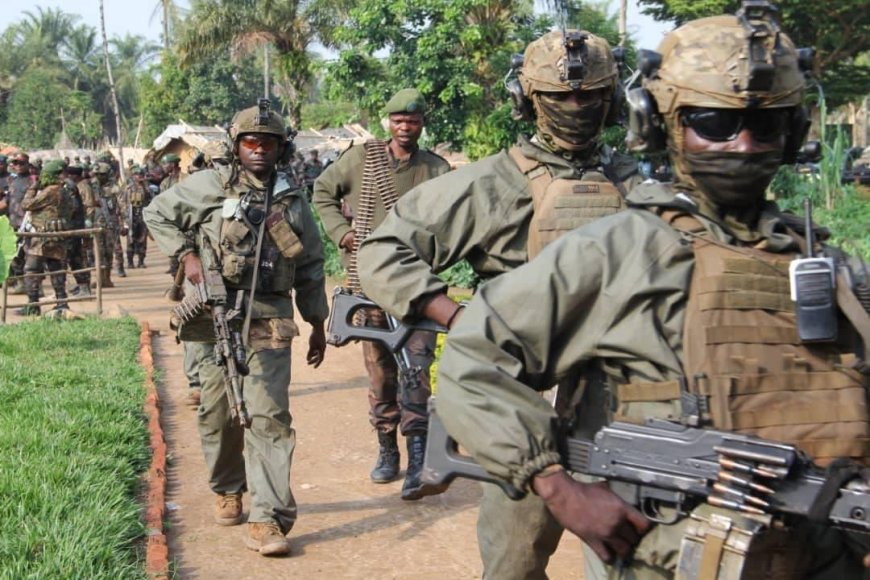
Violent clashes erupted on Tuesday, December 2, 2025, in South Kivu’s Walungu and Uvira territories as elements of the AFC/M23 confronted the Congolese army (FARDC) and allied Wazalendo forces.
According to multiple sources, hostilities began early in the morning, escalating along several key front lines.
The AFC/M23 coordinator Corneille Nangaa the Kinshasa regime—associated with the Burundian army, the FDLR, the Imbonerakures, the Wazalendo, and mercenaries—have "since this morning launched deadly attacks on Katogota–Luvungi, Kaziba–Hauts Plateaux, Kasika–Mwenga, and Tchivanga–Bunyakiri in South Kivu".
"In the face of this violation of the ceasefire within the framework of the Doha peace process, no choice is left to the ARC (AFC/M23) but that of defending itself and protecting the civilian populations," he said.
M23 spokesperson Lawrence Kanyuka, on his X account, accused “Burundian forces and mercenaries” of targeting civilians with bombs.
“The bombs dropped this Tuesday by the coalition forces of the Kinshasa regime struck the densely populated area of Kamanyola. Provisional toll: 3 civilians killed and 5 injured, including 1 man, 1 woman, and 3 children,” he wrote.
The AFC/M23 also warned that the intensity of the attacks was concentrated along several axes, including Katogota–Luvungi, Kaziba–Haut Plateau, Tchivanga–Hombo, and Kasika–Mwenga, describing the situation as “catastrophic and deteriorating minute by minute.”
However, FARDC spokesperson Major-General Silvain Ekenge Bomusa Ekomi blamed the rebels for the attacks, saying instead it was the government forces on the receiving end of Rwanda and rebel artilery.
"Indeed, since the morning of Tuesday, December 2, 2025, the Rwandan army and its AFC/M23 auxiliaries have carried out a series of attacks against FARDC positions in Kaziba, Katogota, and Lubarika in South Kivu," Gen Ekenge said in a statement on Tuesday.
"These attacks clearly demonstrate the determination of this coalition and its manifest intent to sabotage the peace agreements of Washington and Doha, deliberately undermining ongoing efforts to restore peace in eastern Democratic Republic of the Congo."
Local civil society actors report widespread disruption of daily life. “All school, social, and economic activities have been disrupted in Kamanyola, Katogota, Nyangezi, and Kaziba. Heavy and light weapons fire has been heard since 5:30 am. Some houses have been burned in Butuzi, Ngando, Mwera, and Muhumba, and there are injuries in Karhembo,” one source said.
The clashes follow a reinforcement of AFC/M23 fighters along front lines since Sunday. Residents report that hostilities began early in Katogota, with heavy gunfire allegedly initiated by M23–AFC rebels, reportedly supported by Rwanda.
Farmers and villagers were forced to abandon their fields as the fighting intensified.
“The inhabitants of Lubarika and Luvungi, who had gone to their fields early in the morning, were forced to turn back due to the intensity of the fighting. Several families are beginning to hastily leave their villages for fear of an advance of hostilities,” a local civil society actor said.
In Kamanyola, witnesses described large-scale military movements.
“Hundreds of soldiers crossed all night with tanks and heavy weaponry. They have set up positions above the parish near the drinking water facilities, in Karhimbirwa near the Luzinzi river in the direction of Kamonyi–Lubarika, and others are heading towards the Kalunga mountains to reach Ngali and Munanira,” said a resident.
The governments of Burundi and DR Congo have not spoken out on the allegations of bombardment.
The renewed violence comes just two days before the expected ratification of a peace agreement between the Democratic Republic of Congo and Rwanda in Washington, scheduled for December 4.
The visit coincides with escalating clashes in eastern DRC, where FARDC continues to confront M23 rebels accused of receiving Rwandan support—allegations consistently denied by Kigali.
Despite a previous agreement in June 2025, which included commitments to withdraw Rwandan forces and neutralize FDLR positions, the eastern DR Congo remains unstable.
The M23 continues to pressure strategic areas around Goma and other key localities, fueling civilian displacement and raising concerns over a broader humanitarian crisis.