

Economic and foreign policy analysts are urging Uganda to maintain a neutral stance on anti-Russia protests, arguing that taking sides would jeopardise the diplomatic and economic gains the country has accumulated from its ties with Moscow especially after joining the BRICS partnership.
Uganda became a BRICS Partner State on January 1, 2025, a move the Ministry of Foreign Affairs describes as a step toward engaging a “Global South-led architecture of cooperation.”
The BRICS framework emphasises non-interference, sovereign equality and development-focused diplomacy a model experts say aligns with Uganda’s geopolitical ambitions.
Economist and research analyst Nabil Ssegawa said supporting anti-Russia protests would undermine Uganda’s national interests and weaken its leverage within the bloc.
“Uganda has nothing to gain by taking a hostile position against Russia,” Ssegawa told this publication. “Our foreign policy should be anchored on strategic partnerships, not ideological confrontations. Russia offers Uganda market access, defence cooperation and technology transfer these are not benefits we should casually risk.”
Uganda’s engagements with Russia span multiple sectors. According to the Ministry of Foreign Affairs, the two countries signed agreements to deepen collaboration in medical science, including mobile laboratories and regenerative medicine.
The Third Session of the Uganda–Russia Intergovernmental Commission also listed health as a priority area for continued cooperation.
Trade relations have expanded as well. Uganda imports cereals, industrial supplies, transport equipment and paper from Russia, while exporting agricultural and value-added products to Moscow.
Government documents show plans for joint ventures in energy, mining, agriculture, education and medicine.
Educational ties are also strengthening. Makerere University recently signed an MoU with Russia’s National Research University Higher School of Economics, aimed at boosting research and institutional capacity.
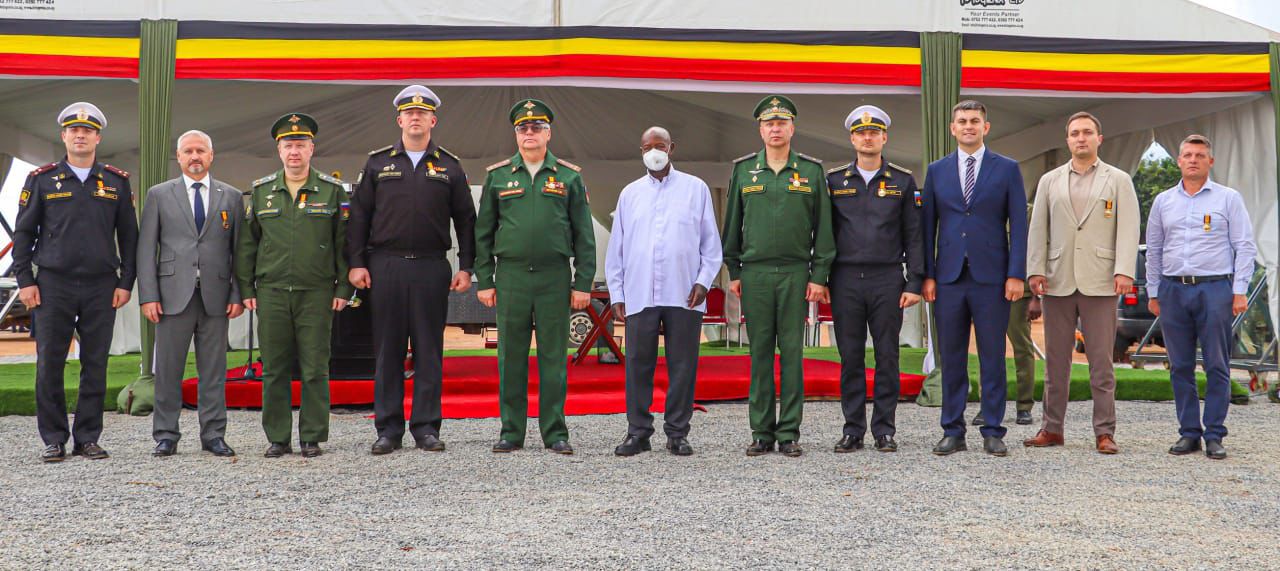
Russia remains one of Uganda’s long-standing defence partners. President Yoweri Museveni has publicly expressed satisfaction with the collaboration, while Defence Minister Oleru has praised Moscow’s role in regional stability.
The Uganda People’s Defence Forces (UPDF) continue to source training, equipment and technology from Russia.
These links, analysts note, reinforce Uganda’s strategic position in a volatile East African neighbourhood.
Risks of taking sides
Uganda’s growing ties with Russia are a key reason experts caution against backing anti-Russia protest movements. They argue that such a stance would compromise Uganda’s bargaining space in a shifting global order.
Ssegawa said aligning with Western pressure would weaken Uganda’s diplomatic flexibility.
“When you enter the BRICS orbit, you’re not just chasing investment you’re signalling that you are willing to diversify your development partners. Joining anti-Russia protests would send the opposite message and could close doors we are only beginning to open,” he said.
He added that neutrality protects Uganda from economic retaliation and safeguards its access to emerging markets and technology partnerships.
“Uganda’s path to industrialization and upper-middle-income status requires every partnership it can secure. Russia is one of those partnerships. We should not allow external conflicts to derail our priorities,” Ssegawa noted.
Analysts say neutrality also reflects Uganda’s broader diplomatic philosophy prioritizing sovereignty and non-interference. For a country balancing relations with China, the EU, Russia and the United States, taking sides could create long-term diplomatic complications.
Ssegawa argues that Uganda’s biggest foreign policy advantage is maintaining multiplicity.
“A small or mid-sized economy survives by balancing relationships. Once you become an instrument in someone else’s geopolitical game, you stop negotiating from a position of interest and start negotiating from fear,” he said.
With the BRICS partnership placing Uganda at the intersection of a global power reconfiguration, experts insist Kampala should leverage its position, not compromise it.
As Moscow continues to boost trade, defence and scientific cooperation with Kampala, the message from analysts is clear: Uganda must guard its strategic corridors of cooperation and avoid being drawn into foreign conflicts that promise no tangible benefit.