
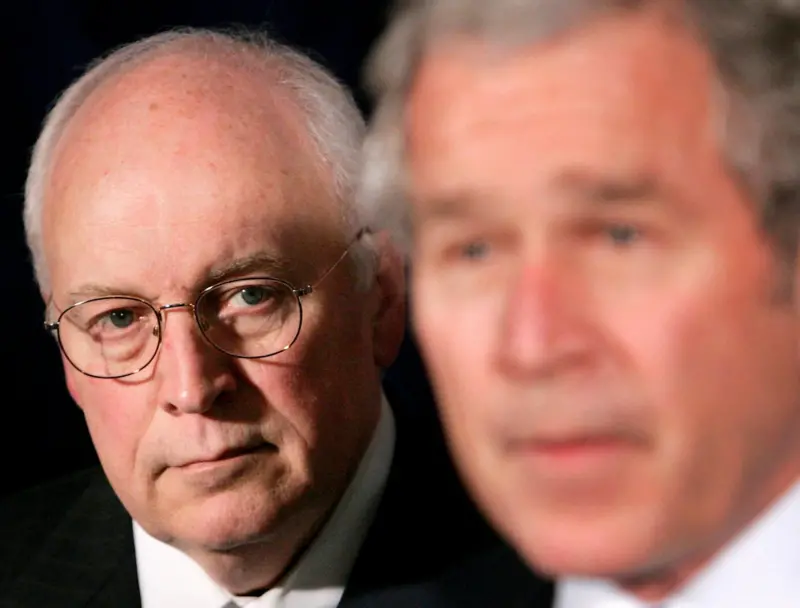
Dick Cheney, who served as Vice President under President George W. Bush from 2001 to 2009 and was one of the most influential figures in modern American politics, has died at the age of 84.
His family said he passed away on Monday night, November 3, 2025, from complications of pneumonia and cardiac and vascular disease.
A statement from his family described Cheney as “a great and good man who taught his children and grandchildren to love our country, and to live lives of courage, honour, love, kindness, and fly fishing.”
It added that his wife of 61 years, Lynne, and daughters Liz and Mary were by his side when he died.
Born in Lincoln, Nebraska, in 1941, Richard Bruce Cheney rose through the ranks of American government over five decades, holding some of Washington’s most powerful positions.
He served as White House Chief of Staff under President Gerald Ford in the 1970s, spent ten years representing Wyoming in the House of Representatives, and later served as Secretary of Defense under President George H.W. Bush from 1989 to 1993.
As Vice President under George W. Bush, Cheney became a defining voice in the administration’s response to the September 11, 2001, terrorist attacks.
He was widely regarded as the chief architect of the “war on terror,” including the invasions of Afghanistan and Iraq.
Cheney argued that Saddam Hussein’s regime in Iraq possessed weapons of mass destruction and had links to al-Qaeda — claims that were later discredited but shaped US foreign policy for years.
“The fact is we know that Saddam Hussein and Iraq were heavily involved with terror,” Cheney said in 2006, defending the administration’s decisions.
He maintained that the US faced a generational struggle against extremism, warning in 2005 of “decades of patient effort” to secure the world from terror threats.
Before re-entering government in 2000, Cheney was chairman and CEO of Halliburton, a multinational energy services corporation.
His time there drew scrutiny due to the company’s later involvement in US defense contracts during the Iraq War.
In his personal life, Cheney was known as an avid outdoorsman, though he made headlines in 2006 after accidentally shooting a friend while quail hunting in Texas.
In later years, Cheney broke with much of his Republican base, becoming a sharp critic of former President Donald Trump. In the 2024 US election, he made waves by endorsing Democratic candidate Kamala Harris, calling her “a defender of the Constitution.”
Cheney’s influence on US foreign policy — particularly in the aftermath of 9/11 — remains one of the most consequential and controversial legacies in modern American history.
Supporters credit him with steering the United States through an era of global insecurity; critics accuse him of expanding executive power and authorizing policies that fueled years of costly wars.
