
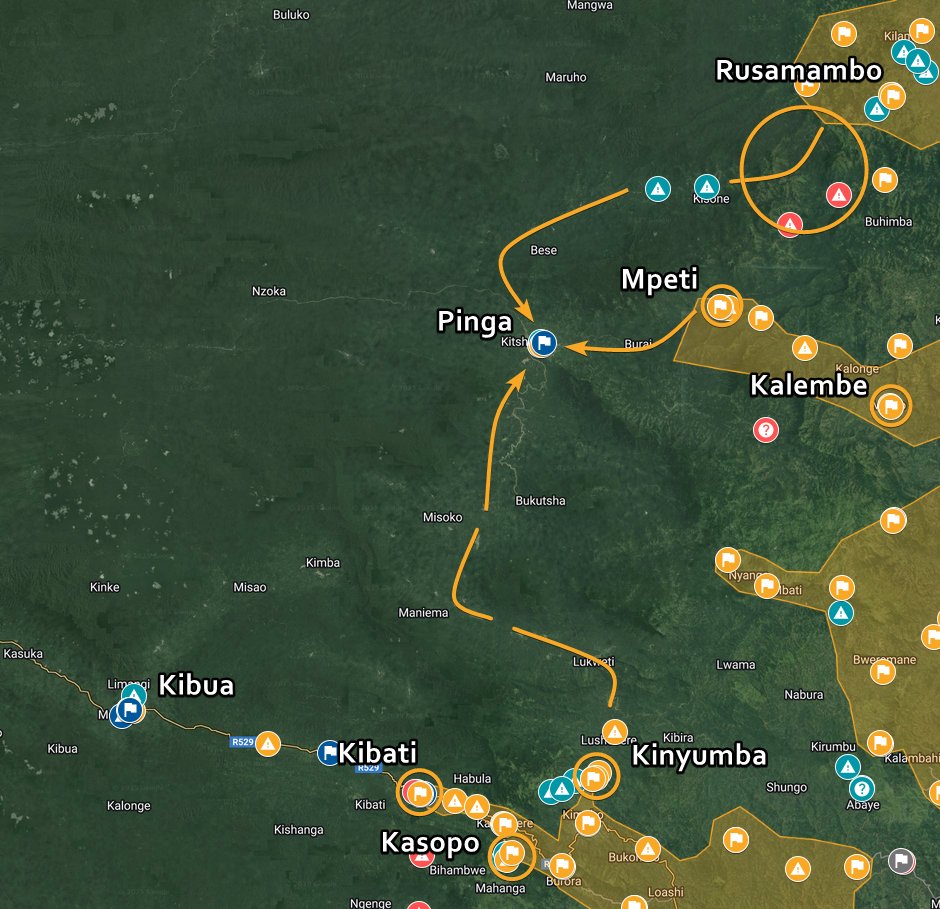
The M23 rebellion has announced plans to capture the town of Pinga in Walikale territory, North Kivu, raising fears of renewed heavy fighting in eastern DR Congo despite a fragile ceasefire backed by international mediators.
“We will soon take Pinga; we have realised that Félix Tshisekedi has no intention of respecting the ceasefire,” a member of the movement declared during a public meeting in Kalembe on Monday, June 2.
The declaration, delivered openly to a crowd of civilians, signals a possible shift back to offensive operations across key transport and trade routes once temporarily abandoned by the group.
It follows a steady build-up of troops and military hardware across multiple axes in Masisi and Walikale territories.
According to North Kivu media, vehicle convoys transporting men and equipment have been moving since Friday, May 30, along routes including Masisi–Nyabiondo–Kasopo and Nyabiondo–Kinyumba.
At least seven Kamaz trucks reportedly arrived in Nyabiondo on Friday evening, with four more arriving on Saturday.
Other convoys and deployments have been confirmed in Kinyumba (on the Nyabiondo–Mutongo axis), Kasopo (on the Kaandja–Buhimba axis), Kashebere, and Kibati—locations with strategic significance for rebel logistics and supply corridors.
In Walikale territory, heavy equipment has been moved toward Mpety in anticipation of the advance on Pinga.
Sources in Kalembe, including traditional leaders and local administrators, say the rebels held a mobilisation rally over the weekend in which they reiterated their intent to launch an assault on Pinga.
The presence of heavy weapons, reportedly moved under the cover of darkness, has intensified local fears of renewed clashes.
The rebel movements mark a new phase in the ongoing conflict after months of relative calm under a Qatar-brokered ceasefire that had initially pushed M23 forces to make a tactical retreat from Walikale town.
At the time, M23 sources claimed the withdrawal was a gesture of goodwill to allow talks to progress.
However, independent observers said the group had been forced to abandon the area after its retreat paths were cut off by Congolese troops and allied militia groups.
Walikale, a mineral-rich crossroads linking the rebel-held areas of Masisi, Rutshuru, and parts of Maniema province, has long been a strategic target.
Its road networks, particularly the RP529 which runs toward Walikale centre, are crucial for controlling trade flows and mineral smuggling routes that have helped sustain various armed factions for decades.
M23’s resurgence has not only been military.
The group is reportedly running a parallel administration in parts of Rutshuru and Masisi, complete with taxation, local courts, and security patrols—undermining the authority of the central government.
Their long-term goal, analysts suggest, is to carve out a semi-autonomous region under rebel control, drawing support from historical grievances over marginalisation and failed disarmament deals.
In a dramatic twist, the rebellion has recently been joined by former Congolese president Joseph Kabila, whose loyalist fighters are said to have reinforced M23 columns operating around Nyabiondo and Mutongo.
While Kabila has not publicly confirmed his alliance, security sources and defectors suggest his involvement has brought both resources and political weight to the rebel movement.
Similarly, former presidential candidate Rex Kazadi is reported to have aligned with the rebels in a move seen by Kinshasa as a further blow to efforts to maintain political stability and territorial integrity in the east.
Kazadi’s motivations remain unclear, but his defection has been interpreted as part of a broader rebellion against President Tshisekedi’s leadership, especially in light of alleged electoral fraud and constitutional manipulation.
The growing coalition of armed actors under the M23 banner, combined with their public defiance of the ceasefire, has heightened fears of a prolonged war in eastern DR Congo.
Local populations along the Kalembe–Kalonge–Pinga axis have pleaded with national defence forces and MONUSCO peacekeepers for increased vigilance and protection as the rebels edge closer to towns not yet under their control.
Meanwhile, the government in Kinshasa has remained tight-lipped about the rebel build-up.
A source within the army's North Kivu command local media they are “monitoring the situation closely” but would not comment on operational plans.
Civil society organisations, however, say the time for observation has passed.
“The ceasefire is being abused as a smokescreen for expansion,” said one activist in Goma.
“If the international community waits until Pinga falls, the cost will be unbearable—for civilians and for the future of this country.”
