
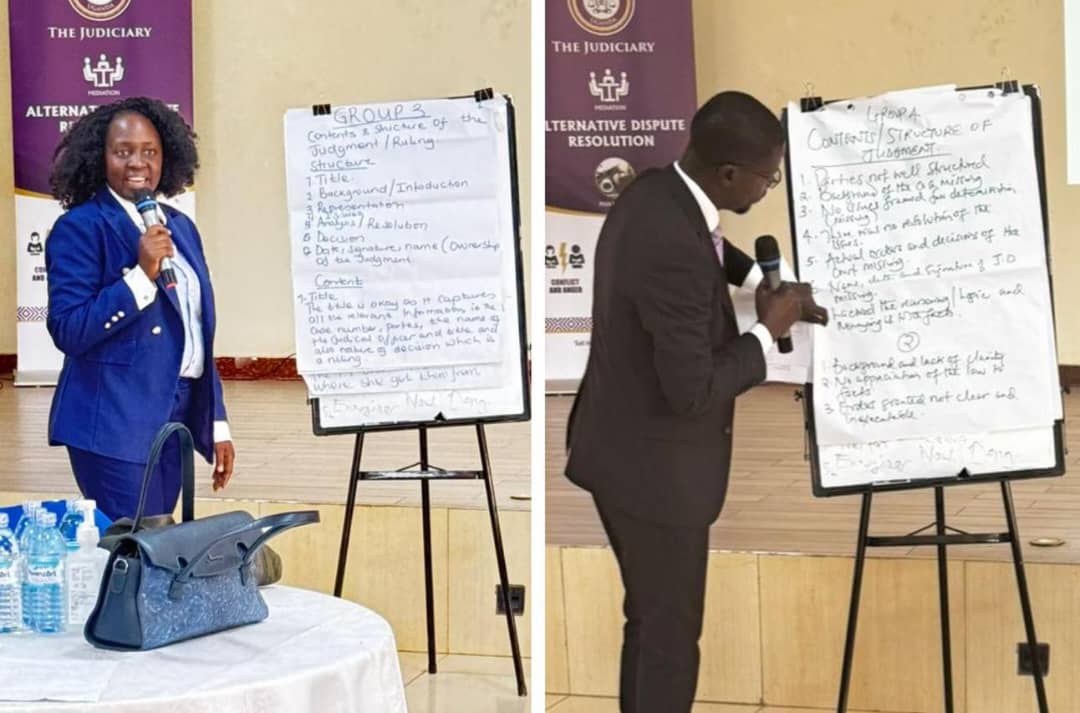
A week-long judicial training programme aimed at enhancing case management and judgment writing among judicial officers from Northern Uganda commenced on Monday in Gulu.
Organised by the Judicial Training Institute (JTI) in partnership with the Alternative Dispute Resolution (ADR) Registry, the training is being held under the theme “Judicial Effectiveness through Improved Case Management.”
The initiative brings together Judges, Deputy Registrars, Chief Magistrates, and Magistrates Grade One from the High Court circuits of Arua, Kitgum, Patongo, Gulu, and Lira.
The programme is designed to equip participants with practical skills in pre-trial and trial case management, judgment writing, and the integration of ADR mechanisms in judicial proceedings.
In his welcoming remarks, Justice Philip Odoki, Resident Judge and Head of the Gulu High Court Circuit, expressed pride in hosting the training in Gulu.
He urged participants to fully engage with the programme and take advantage of the opportunity to enhance their judicial practice while experiencing the region’s cultural richness.
The first day featured key presentations from two renowned facilitators, Principal Judge Emeritus Justice Yorokamu Bamwine and retired High Court Judge Justice David K. Wangutusi.
Justice Bamwine addressed the longstanding issue of delays in delivering judgments, particularly in land and commercial cases.
He emphasised that the structure and clarity of a judgment are equally as important as the ruling itself. “Well-articulated decisions build public trust in the Judiciary,” he said, urging judicial officers to maintain professionalism and consistency in their writing.
Justice Wangutusi echoed these sentiments, describing judgment writing as a critical skill for any judicial officer. He warned that inefficiencies in this area could exacerbate case backlogs and harm investor confidence in Uganda’s legal system.
Drawing from legal scholar Gerald Lebovits, he referred to judgment writing as “one of the most demanding legal skills, a blend of science and art.” Wangutusi took participants through practical techniques in fact analysis, legal reasoning, and structured decision writing.
Day One also featured interactive breakaway sessions where participants engaged in hands-on judgment writing simulations. Guided by Judicial Officers attached to the JTI, the exercises provided opportunities for peer review and collaborative learning.
The training is facilitated by a distinguished panel of senior judicial figures and legal experts, including Deputy Chief Justice Emeritus Richard Buteera, Supreme Court Justice Mike Chibita (Chairperson, JTI Governing Council), JTI Executive Director Justice Prof.
