

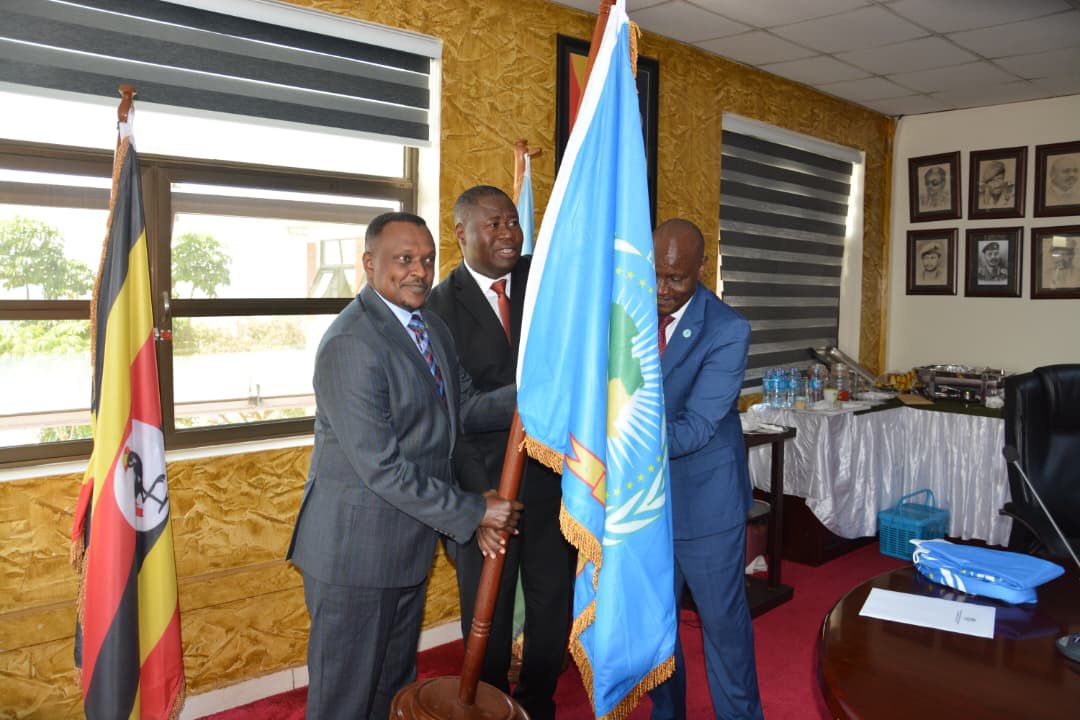
The Minister of Defence and Veteran Affairs and Chairperson of the Council of Ministers of the Eastern Africa Standby Force (EASF), Jacob Marksons Oboth-Oboth, has called for stronger self-reliance, improved visibility, and greater regional cooperation as the EASF officially transitioned leadership from Brigadier General (Rtd) Paul Kahuria Njema to Brigadier General Ronald Rwivanga of Rwanda.
The handover and takeover ceremony was held today at the Ministry of Defence and Veteran Affairs Headquarters in Mbuya, Kampala, marking the end of Brig Gen Njema’s three-year tenure and the official assumption of office by Brig Gen Rwivanga.
Presiding over the ceremony, Minister Oboth-Oboth commended Brig Gen Njema for his leadership during his tenure, saying he had strengthened the institution through improved operational readiness, enhanced governance structures, and prudent financial management.
“Your service has been clearly demonstrated through commitment to the very foundation of EASF’s work, the four pillars of our strategic plan. You ensured these pillars were not only understood, but consistently upheld in day-to-day planning and execution,” he said.
Minister Oboth-Oboth welcomed Brig Gen Ronald Rwivanga as the incoming Director and challenged him to build on the achievements already made by the organisation.
“You are stepping into big shoes. You inherit not only the achievements of the past, but also high expectations and a community committed to working with you in unity, professionalism, and purpose,” he said.
Minister Oboth-Oboth further urged Brig Gen Rwivanga to leverage Rwanda’s experience in innovation, discipline, and institutional rebuilding to strengthen EASF operations.
Addressing the withdrawal of some external partners, including the African Peace and Security Architecture Support Programme and other international stakeholders, Minister Oboth-Oboth said the development called for stronger internal resource mobilisation and greater self-reliance among member states.
“Your personality and institutional provision will be required to mobilise for resources, especially from the member states in view of the current situation in the world, which calls for nations and organisations to be self-reliant,” he said.
Minister Oboth-Oboth also called on the incoming director to improve the organisation’s visibility and credibility.
“Many people are asking, is the Eastern African Standby Force a force or something else? Are they really standing by or are they something else? So we expect you to counter this. Together, we will continue to strengthen the force’s ability to serve Eastern Africa with credibility and results,” he said.
In his farewell remarks, Brig Gen (Rtd) Njema described his tenure as a period marked by collective resilience and regional cooperation aimed at advancing peace and security in Eastern Africa.
“Today marks not only the end of my tenure as Director of the Eastern Africa Stand-by Force, but also a moment of reflection on a remarkable journey of collective resilience, cooperation, and service to peace and security within our region,” he said.
Brig Gen Njema noted that during his leadership, EASF enhanced institutional capacity and operational readiness through improved planning, training, exercises, and coordination among member states.
He also cited improved cooperation with strategic partners, strengthened policy frameworks, enhanced accountability, and increased financial stability among the key milestones achieved during his tenure.
Brig Gen Njema urged member states to increase their financial contributions to ensure the sustainability and operational effectiveness of the regional standby mechanism.
“There is an urgent need for us to adopt more inward-looking and sustainable approaches. We must go back to the founding principles of African solutions to African problems,” he said.
Meanwhile, incoming Director Brig Gen Ronald Rwivanga pledged to serve the organisation with transparency, professionalism, and accountability, describing his appointment as both an honour and a solemn duty to serve the region in advancing collective peace and security.
He said the contemporary security environment in Africa continues to evolve rapidly, with emerging threats such as terrorism, violent extremism, cybercrime, unconstitutional changes of government, climate-induced disasters, and humanitarian crises.
Brig Gen Rwivanga appealed to member states to provide sustained political, operational, and financial support to the organisation, stressing that predictable funding was critical to strengthening EASF’s readiness and effectiveness.
He also emphasised the growing importance of humanitarian assistance and disaster response operations, saying the organisation must remain relevant to the people of the region beyond conventional peace support missions.
“We have committed ourselves as EASF that whenever there is a humanitarian issue or disaster, whether floods, droughts, earthquakes, diseases like Ebola, or displaced people, the force stands ready to support member states whenever such disasters strike,” he said.
Brig Gen Rwivanga added that strengthening humanitarian and disaster response capabilities would improve public confidence in regional cooperation and reinforce EASF’s image as a people-centred institution committed to human security.
The Eastern Africa Standby Force is one of the African Union’s regional standby mechanisms established to support peacekeeping operations, conflict prevention, humanitarian assistance, and regional security interventions across Eastern Africa.
The ceremony was attended by the Deputy Chief of Defence Forces (UPDF) and Chairperson of the Chief of Defence Forces of EASF, Lt Gen Sam Okiding; Chief of Joint Staff Lt Gen Jack Bakasumba; UnderSecretary – Air Force Mr James Mutabazi; Chief of Staff – Uganda Rapid Deployment Capability Brig Gen Flavia Byekwaso; EASF Chief of Staff Brig Gen Stephen Kashure; senior officers; and members of the EASF Secretariat.
