

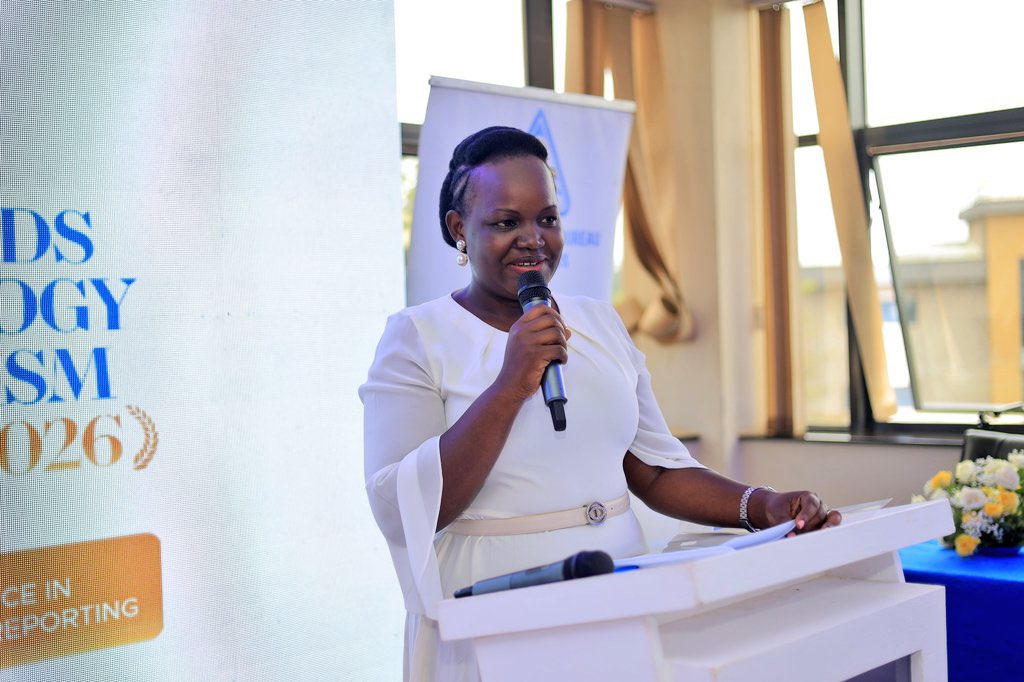
Uganda National Bureau of Standards (UNBS) has called on media houses to transform how they report on standards and quality assurance, urging a shift from enforcement-driven narratives to more constructive storytelling that highlights standards as drivers of trade, industrialisation, and economic growth.
Speaking at the Standards and Metrology Journalism Awards 2026, UNBS Principal Public Relations Officer and Spokesperson Sylvia Kirabo said traditional reporting has often framed standards within a narrow enforcement lens.
“For a long time, reporting on standards has largely been enforcement-focused and driven by a ‘police-versus-thief’ narrative,” Kirabo said. “This often portrays standards as barriers to business, rather than enablers of growth.”
Kirabo noted that such narratives have limited public understanding of the broader role standards play in ensuring safe trade, protecting consumers, and promoting fair competition. She said UNBS is actively working to shift this perception through sustained engagement with the media.
As part of this effort, the bureau has rolled out a targeted media capacity-building programme aimed at equipping journalists with the skills to report more accurately and effectively on standards, metrology, and certification processes.
“We are empowering journalists with the skills and knowledge they need to simplify complex concepts such as weights, measurements, and calibration,” Kirabo said. “This enables the public to better understand how standards protect consumers in their everyday lives.”
The initiative has included regional training sessions across the country, offering journalists hands-on experience in interpreting technical information and translating it into accessible content for wider audiences.
UNBS has also introduced media practitioners to digital verification tools, including its mobile application and e-portal, to strengthen fact-checking and improve transparency in reporting on certified products.
“These digital tools are critical in strengthening transparency and accountability,” Kirabo said. “They allow journalists and consumers alike to verify certified products, which is essential in combating substandard goods.”
The programme further promotes inclusive trade by encouraging coverage that highlights opportunities for micro, small and medium enterprises, as well as women and youth.
“Standards should not be seen as obstacles but as pathways to market access and competitiveness,” she added. “By reporting on how businesses can meet these standards, the media plays a vital role in driving inclusive economic growth.”
To support deeper and more impactful reporting, the initiative incorporates technical mentorship and competitive story grants, enabling journalists to produce in-depth and investigative content on standards and quality assurance.
Kirabo said the impact is already visible, noting that several finalists in the 2026 awards were beneficiaries of the training and grants.
“The results speak for themselves,” she said. “We have seen a clear improvement in the quality of reporting, which demonstrates that when journalists are well-equipped, they can significantly influence public understanding.”
She added that strengthening media capacity has wider implications for Uganda’s economy, including boosting consumer confidence, promoting fair competition, and supporting industrial development.
“By reshaping how standards are communicated, we are not only informing the public but also contributing to Uganda’s industrial growth and trade development,” Kirabo concluded.
The initiative reflects a broader strategy by UNBS to align media reporting with national development priorities, positioning standards as a key pillar in Uganda’s drive toward economic transformation and global competitiveness.
