

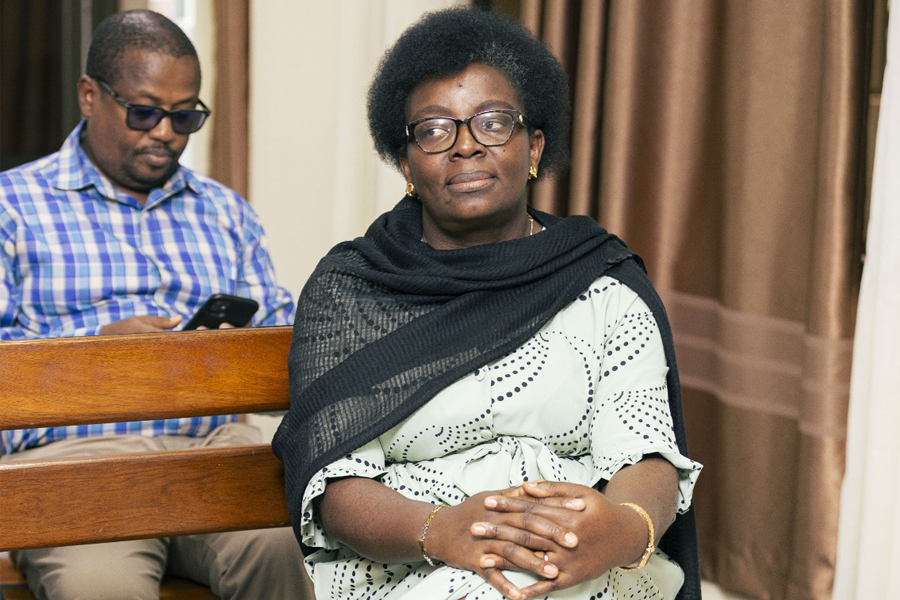
Victoire Ingabire, an opposition politician in Rwanda, has told court that although she knows many of the people accused of plotting to overthrow the government without using armed force, neither she nor her political party ever organised training for the alleged mission.
On Tuesday, the High Court ordered Ingabire to appear and answer questions in the case of nine people, including journalist Théoneste Nsengimana and Sylvain Sibomana, who claim she was their leader.
They have been detained since 2021.
In its case against the accused, the prosecution repeatedly referenced Ingabire, alleging that she played a major role in organising the training in question—hence the reason for summoning her to court.
Before she spoke, the judge, in a noticeably conciliatory tone, told Ingabire to regard herself simply as “someone providing information requested by the court,” not as a suspect or defendant making a defence.
Ingabire, who appeared with her lawyer Gatera Gashabana, confirmed that she knew many of the accused but denied any involvement in planning training sessions and said she had no knowledge of such activities.
She stated that her party, DALFA-Umurinzi, had no connection to the alleged training, as it is not a legally registered political party. She added: “The party could not have done anything since it does not legally exist.”
Her lawyer, Gashabana, said Ingabire had faced numerous obstacles and challenges in trying to register the party, which to this day remains unrecognised.
Ingabire told the court that, upon realising how difficult it had become to get the party registered, she instructed the interim committee she had established to halt all activities aimed at recruiting supporters.
In building its case, the prosecution had linked the alleged training to “Ingabire Day,” an annual event marked by some Rwandans in the diaspora who support the politician.
In court on Tuesday, Ingabire said there was no connection between the alleged training and Ingabire Day, explaining that the event is organised by Rwandans abroad and that her only involvement is to occasionally deliver a message when requested.
After hearing her testimony, the judges said they would deliberate in private to determine whether the information and explanations she provided were sufficient.
The court’s decision on the matter will be communicated later.
This article was directly translated from BBC Gahuza
