

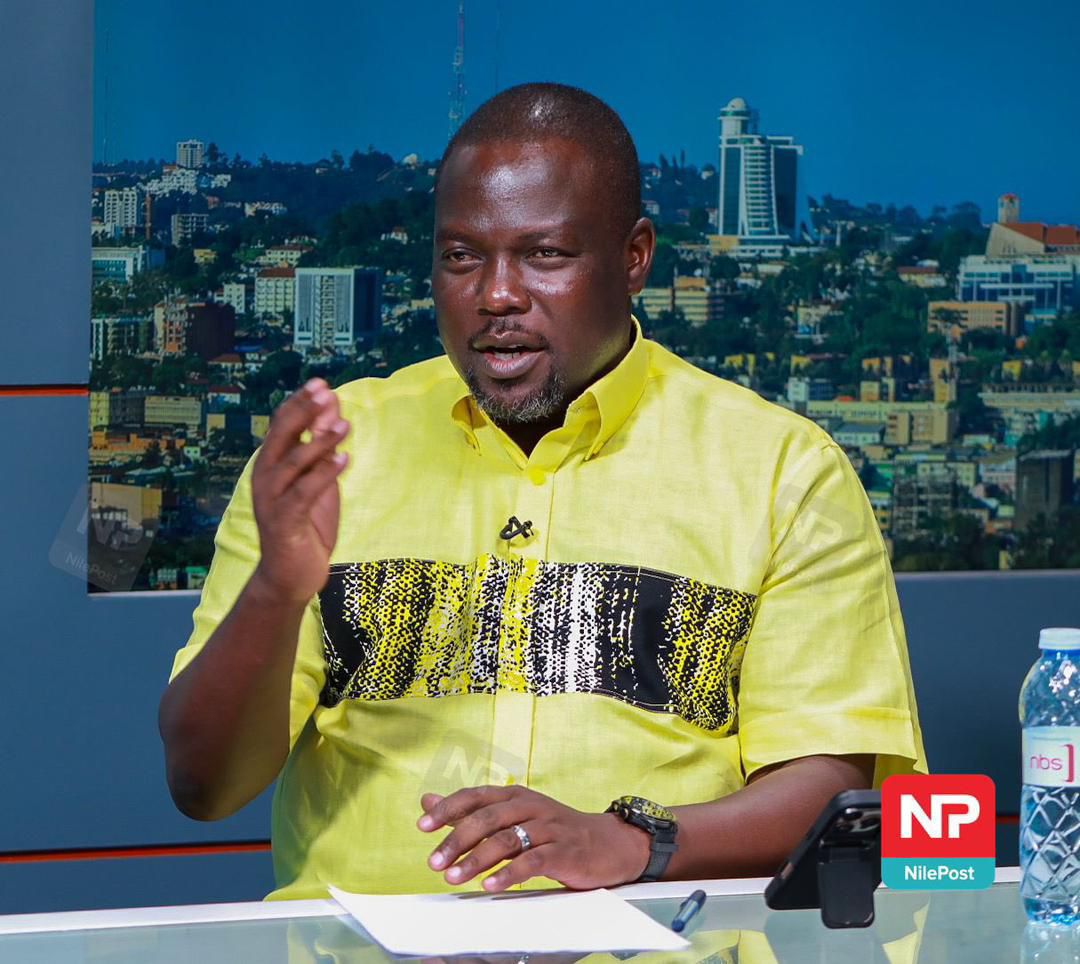
The Secretary General of the National Resistance Movement (NRM), Richard Todwong, has defended the ruling party’s conduct and organization during the recently concluded general presidential and parliamentary elections held nationwide on January 15, 2026, emphasising that early preparation and strong internal structures played a key role in the party’s electoral performance.
Speaking to Dalton Kaweesa during NBS Face Off on Sunday, Todwong said the NRM adopted a different strategy in the 2026 elections compared to previous electoral cycles.
“Every election has its own unique challenges, and every election has its own targets that are set. The previous election was handled using different approaches,” he said.
Todwong noted that the party began preparations much earlier this time, including updating and digitizing its membership register to better understand its voter base.
“For this election, we started our preparations much earlier. The preparation involved updating our party membership register after digitizing it, and this was meant to help us understand how many of our members are registered voters with the Electoral Commission,” he said.
With the NRM boasting of 18.5 million registered voters as of 6th May, 2025, Todwong underscored the size and reach of the NRM, arguing that it remains the largest organisation in the country.
“There is no organization in Uganda bigger than the NRM, not even the Government of Uganda,” he said.
In the presidential elections, NRM National Chairman, President Museveni, won the race with 7,946,772 votes, representing 71.65 percent of the total valid votes cast.
This victory secured him a seventh term in office and marked the first time in almost three decades that he exceeded the 70 percent mark, a milestone he last achieved in 1996 when he won with 74.3 percent.
His closest challenger, Robert Kyagulanyi Ssentamu—popularly known as Bobi Wine—of the National Unity Platform (NUP), received 2,741,238 votes, accounting for 24.72 percent of the total vote.
Todwong further emphasised that membership in a political party should be based on personal conviction rather than financial incentives.
“A political party is joined out of conviction; it is like a religion. It is a process of evangelization. You don’t join because you expect to be given money. Nobody gives you money to become a member of a party,” he said.
According to Todwong, the NRM does not distribute money to individuals to join the party. Instead, available resources during the campaign period were directed toward operational activities.
“As NRM, we don’t give money to anybody. Joining the party is voluntary,” he said, explaining that funds were used to support the party’s campaign logistics, including assisting flag bearers and district leaders, facilitating national rallies, hiring public address systems, and covering allowances for journalists and musicians who accompanied campaign activities.
Todwong also cited Mbarara as an example where the business community reportedly contributed resources toward campaign activities.
“What happened in Mbarara is that the business community contributed resources and told the party not to spend there. They said they would ensure that the flag bearers and the President’s rally were facilitated, and they also presented gifts to the President,” he said.
Addressing the presence of many independent MPs ahead of the 12th Parliament, Todwong argued that many of them are still affiliated with the ruling party despite contesting outside the NRM ticket.
“Despite the number of independents, which is slightly more than the number of any opposition political party in Parliament, you will realize that most of these independent Members of Parliament are NRM members,” he said.
The incoming Parliament is set to feature 370 legislators from the NRM, 60 independents, 49 from the National Unity Platform (NUP), 12 from the Uganda People’s Congress (UPC), 10 from the Forum for Democratic Change (FDC), six from the Democratic Party (DP), two from the People’s Front for Freedom (PFF), and one from the Alliance for National Transformation (ANT).
Todwong explained that disagreements arising from the party primaries held on July 17, 2025—following what was described by many as a fiercely contested process that eventually resulted in at least 380 petitions from dissatisfied aspirants—led some candidates to run as independents.
“Yes, the independents could have disagreed with our flag bearers during the primaries, which is possible because in an organization of about 20 million members, you cannot expect that there will be no internal contradictions,” he said.
Todwong added that Uganda’s transition into a multiparty political system still carries characteristics of the earlier movement system, which sometimes causes confusion about party discipline.
“We moved into the multiparty political dispensation with movement characteristics. Many people still do not understand how a plural political system should work. If I belong to Party A, I need to follow the codes and rules of that party. If there is a winner, I should concede and support the flag bearer, not compete against them,” he said.
Todwong also addressed scrutiny against NRM Electoral Commission Chairperson Tanga Odoi.
One of the politicians who has publicly challenged Odoi’s political influence is Tororo District Woman Member of Parliament Sarah Achieng Opendi who alleged that Odoi interfered with the electoral process in polling stations close to his home, supposedly in support of her opponent, Akoth Angella, who eventually defeated her by a narrow margin of 35 votes.
Beyond Opendi’s case, former West Budama North Member of Parliament Othieno Okoth has also, over the years, accused Odoi of wielding excessive influence over political leadership in his home constituency.
In the most recent elections, Okoth—who claims Odoi campaigned heavily against him—lost his parliamentary seat by just four votes. Maximus Ochai won the race with 12,259 votes, narrowly edging Okoth who secured 12,255 votes.
Todwong, however, dismissed these and other accusations, insisting there was no evidence to support the claims.
“I am not part of the CEC. The accusations against Dr. Tanga Odoi were brought before the CEC, but they were not substantiated. There was no evidence supporting the accusations against him,” he said.
