

On Christmas day 1498, 90 years into Europe’s period of Renaissance, Vasco da Gama rounded Africa’s southernmost tip landing at Natalis (Natal).
Southern Africa then, like most of Africa was a region of various kingdoms and chiefdoms sometimes leaving in harmony and at other times constant war.
In what is now Uganda, the Bachwezi dynasty had been replaced by the “Empire of Light” – Empire of Kitara – Bunyoro Kitara.
The rulership of Bunyoro Kitara stretched throughout the Nile valley specifically between the Eastern shores of Lake Mwitanzige and what is now central Uganda.
This mighty empire of Kitara also included Northern Tanzania, Eastern Congo (DRC), Rwanda, Burundi, Zambia and Malawi.
Busongora Kingdom located between Bunyoro and Rwanda remained independent, probably on account of having maintained alliance with Bunyoro after its founding, and also because the Banyoro felt that the Busongora, also known as Bachwezi, were sacred and not subject to attack.
In 1884, in a contest for natural resources to feed her burgeoning industry now under pressure from the Ottomans, Europe’s major powers of Germany, Portugal, Spain, United Kingdom, Belgium and the Netherlands congregated in Berlin and partitioned Africa amongst themselves.
By 1914 when World War 1 broke out in Europe, all of Africa except Abyssinia (Ethiopia), the Dervish state (portion of today’s Somalia) and Liberia was under colonial rule.
With German faced with imminent invasion from the allies, an armistice to end this hitherto unknown carnage was signed at Versailles.
As part of the terms of this armistice, the Germans and their allies gave up their colonies in Africa to the British and French.
With their ego wounded and pride dented, democratic order gave way to cynicism and radicalism in Germany.
This culminated in the rise of Adolf Hitler and his abhorrently populist National Workers Socialist Party of Germany (NAZI). Europe was again thrown into the theatre of war from 1939 – 1945.
African Nationalists sensing a weakening of their colonial masters begun agitating for political independence.
Men like Kwame Nkrumah of Gold Coast (Ghana) spearheaded this sometimes peaceful but often very violent struggle for Africa’s Independence.
In this, they echoed some of Africa’s premier resistance heroes like Bunyoro’s Omukama Chwa II Kabalega.
Uganda, with Dr. Milton Obote as Prime Minister, was East Africa’s second Independent nation - 1962 following in Mwalimu Nyerere’s Tanganyika- 1961. Both, like many before them, attained Independence from Britain.
Unlike the British, the French and the Portuguese were not so forthcoming in granting Independence to their colonies. Inspired and supported by Mwalimu, Egypt’s Abdel Nasser and others a new breed of militant philosopher upped the ante for Independence.
Men like, Frente de Libertação de Moçambique (FRELIMO) founding president Eduardo Chivambo Mondlane, Samora Machel, Frantz Fanon and the pragmatic Guyanese scholar Walter Rodney were at the frontline of the struggle against colonialism.
Into this politically healthy and ideologically correct environment, a young Yoweri Museveni together with some of his Front National Salvation (FRONASA) colleagues like the now Rtd. Gen. Caleb Akandwanaho best known by his moniker Salim Saleh and Gen. Ivan Koreta abandoned their paillasse and visited FRELIMO’s training bases in Mozambique.
Buoyed by an enthusiasm to liberate Uganda and Africa from the pangs of colonialists and their agents like Mobutu Sseko, Idi Amin and others, they set on a path of Uganda and African political and economic liberation.
On 6th February 1981, together with his colleagues in Uganda Patriotic Movement (UPM), Yoweri Museveni launched a Protracted People’s War, his Popular Resistance Army (PRA) chose the thickets and bushes of Luweero as a base.
42 men with 27 guns and including a 14-year-old store away – Andrew Kangaho dared to dream and believe.
Their cogitations caused them to name units in NRA after Kabalega, Mondlane, Nkrumah, Nasser and Luttamaguzi.
By December 1984, 100 years after the powers in Europe carved up Africa among themselves, this band of 42 men had grown to nearly 70,000 and controlled vast swaths of Uganda.
In decisive battles fought at Bireembo in Bunyoro and along the Rwenzori axis as well as in Mbarara, 1985 started on a sad note for Obote’s rapacious and insanely brutal regime.
A coup by the Okellos’ followed by “Peace jokes” hosted in Nairobi by Mzee Moi did not slow the now renamed National Resistance Army (NRA)’s match on Kampala.
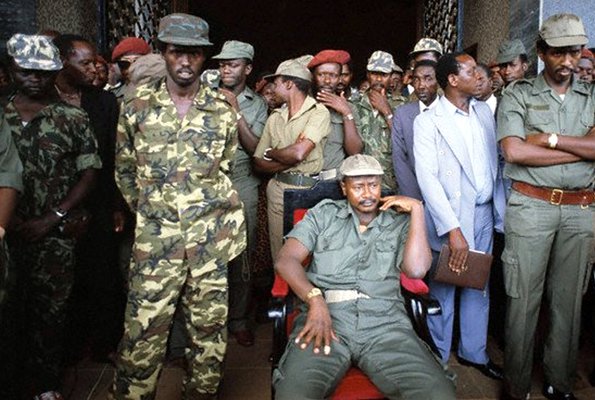
Kampala fell to the NRA on 26th January 1986. Uganda was now on an ascendency.
Museveni was and is the champion of Africa emerging from the pits of brutal colonial and post-independence ideological idiosyncrasy.
34 years after this great Peoples’ victory, Ugandans are called to remember the 26th of January. Ugandans are called upon to reject neo colonialists masquerading through political pretenders such as the “People Power”.
We are called to reject the cynicism of many in Forum for Democratic Change (FDC) and Democratic Party (DP) and others.
With a changing global political and economic terrain, young and old must remember the ideals for which Kabalega fought, for which Mondlane was assassinated, for which our liberation heroes in the NRA gave their lives.
Nyerere said it best: “African nationalism is meaningless, dangerous, and anachronistic, if it is not, at the same time, Pan-Africanism.”
The Writer is a Communication Assistant at Government Citizen Interaction Centre (GCIC), Ministry of ICT and National Guidance.
