

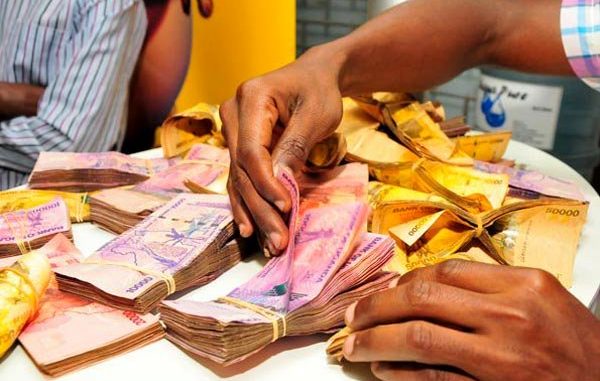
Despite Uganda’s debt burden being at shs42.7 trillion as of 31st December 2018, the finance ministry insists that government shall continue borrowing although this time contracting debt shall be on concessional terms, while restricting non concessional debt to only those projects that yield high returns.
Maris Wanyera, acting director debt and cash management at the finance ministry, explains that Uganda’s debt is still sustainable and most of it is long term with clear plans to keep on reducing the amount over time.
In the coming finance year of 2020/2021, shs9.5 trillion shall be subjected to debt payment and this has been the norm with debt payment figures resurfacing in every budget as government continues to struggle to reduce the debt burden.
Figures from the ministry of finance indicate that stock of disbursed and outstanding external debt as at 31st December, 2018 was UGX 28.59 Trillion
Wanyera says that, "Out of this, external debt disbursed and outstanding accounted for 66.5% (USD 7.7 billion, UGX 28,426.78) while domestic debt contributed 33.5% to total financing (USD 3.9 billion, 14,332.69)."
Maris Wanyera explains that bulk of these loans are dominated by multilateral creditors with 65%, commercial banks with 1% while bilateral creditors hold 34% of the stock.
"Most multilateral credit is from the World Bank, ADF and IFAD while bilateral credit share is taken up by China Exim Bank and Japan. Commercial banks share is dominated by AKA & Standard Chartered Bank," Wanyera breaks it down.
However, Julius Mukunda, the executive director of CSBAG, highlights reasons as to why government needs to check its appetite for borrowing before the government hits the maximum.
Mukunda says, "It’s not about sustainability, but what are we borrowing for, which projects qualify to borrow for now like the cctv camera loan was it necessary?"
Imelda Namagga, the programs officer at Uganda Debt Network, notes that the recurring public debt in the national budget is greatly stressing and having a negative impact on development with some sector allocated less.
Namagga argues, "Imagine having a budget of 40trillions with a public debt of 42 trillion. It means 1% of revenue collected goes on interest payment."
The total stock outstanding of government domestic debt as of December 2018 stood at UGX 14,332.7 Bn with T-Bills amounting to UGX 3,590.7 Bn and T-Bonds amounting to UGX 10,742.0 Bn.
Commercial banks, Pension, Provident Funds and Insurance Companies continue to be the biggest investors in Government Securities. As at end December 2018, Commercial banks were holding 79.9% while Pension and Provident Funds held 5.5% of the T-bills.
On other hand Pension and Provident Funds remained the biggest investor in treasury bonds accounting for 54.5% followed by Commercial banks (27.1%) while other financial institutions were at 6.9%.
