

Uganda has unveiled an ambitious pitch to regional and global investors, positioning its inaugural sovereign Sukuk issuance as both a strategic financing tool and a gateway into one of East Africa’s fastest-growing economies.
Addressing potential investors during the Inaugural Sovereign Sukuk Investor Roadshow at the Dar es Salaam Stock Exchange, the Permanent Secretary and Secretary to the Treasury described the planned EUR 405 million Sukuk as a “significant milestone” in Uganda’s evolving financing framework and a bold step toward diversifying the country’s funding sources.
“This issuance is a centerpiece of our Public Investment Financing Strategy,” the Treasury chief said, adding that Uganda was seeking to attract “values-aligned, long-term investors into our capital markets.”
The proposed 10-year Sukuk, structured under a Hybrid Ijarah/Istisna model, is expected to finance part of Uganda’s transformative Standard Gauge Railway (SGR) project — a cornerstone infrastructure investment linked directly to the country’s Vision 2040 development blueprint.
In a strong message aimed at reassuring investors, Uganda highlighted its macroeconomic resilience despite ongoing global economic uncertainties.
Treasury officials projected Uganda’s real GDP growth at 6.5% for the 2026/27 financial year while outlining a long-term ambition of transforming the country into a $500 billion economy by 2040.
Officials pointed to inflation averaging 3.6% in 2025, foreign direct investment inflows estimated at $3.5 billion, and international reserves worth nearly $6 billion — equivalent to 4.2 months of import cover — as indicators of economic stability.
Uganda also emphasized continued growth in coffee and gold exports alongside strong remittance inflows that continue supporting the country’s external balances.
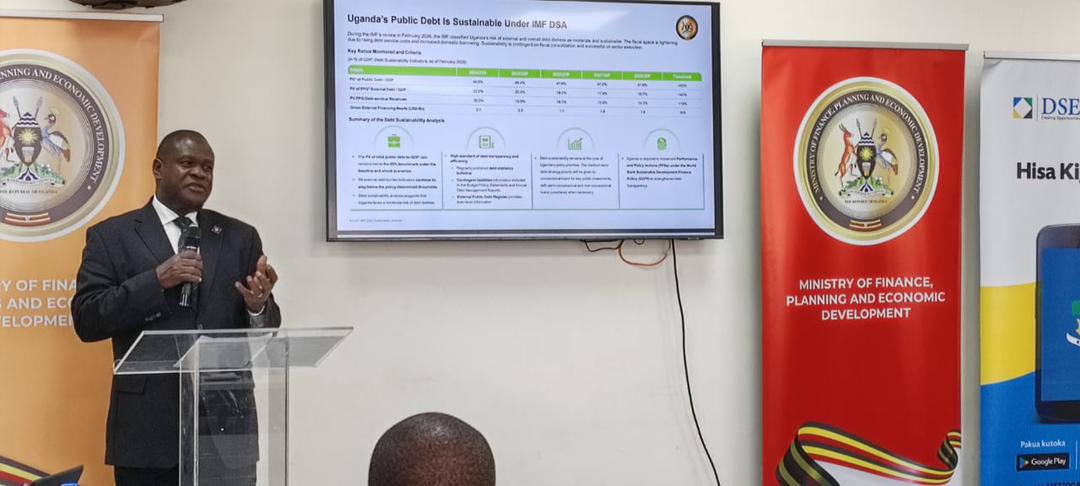
The government used the Dar es Salaam engagement to stress its commitment to fiscal discipline and debt sustainability, citing a February 2026 assessment by the International Monetary Fund that classified Uganda’s debt outlook as sustainable with a moderate risk of distress.
According to the Treasury, all major debt indicators remain within policy thresholds, while more than half of Uganda’s external debt portfolio remains concessional.
Officials further argued that the anticipated commencement of oil production in the 2025/26 financial year would strengthen fiscal buffers and gradually reduce debt-to-GDP levels.
“We are aggressively implementing a Domestic Revenue Mobilization strategy to broaden our tax base and structurally reduce reliance on external financing,” the PSST told investors.
At the center of the Sukuk pitch was the Standard Gauge Railway project, which government officials framed not merely as a transport investment, but as the future backbone of national productivity and regional trade integration.
The EUR 2.7 billion railway project is expected to create a high-capacity transport corridor linking Uganda to Indian Ocean trade routes while improving connectivity to industrial parks and agro-processing hubs across the region.
Government officials argued that the railway would catalyze industrialization, reduce logistics costs, and strengthen Uganda’s competitiveness within the East African market.
The financing model was presented as carefully structured, with 60% expected from Export Credit Agencies, 25% from Development Finance Institutions, and 15% from domestic instruments including the sovereign Sukuk.
Uganda also used the investor roadshow to signal political and institutional stability, pointing to what officials described as a peaceful electoral cycle and a predictable investment environment.
By choosing a Sukuk structure, Uganda aims to tap into a growing pool of Shariah-compliant capital while broadening participation in East Africa’s infrastructure financing landscape.
The Treasury concluded its presentation by inviting investors to participate in what it described as a generational infrastructure opportunity capable of reshaping Uganda’s economic trajectory for decades.
“This is more than a financing transaction,” the PSST said. “It is an opportunity to partner in Uganda’s long-term transformation.”
