

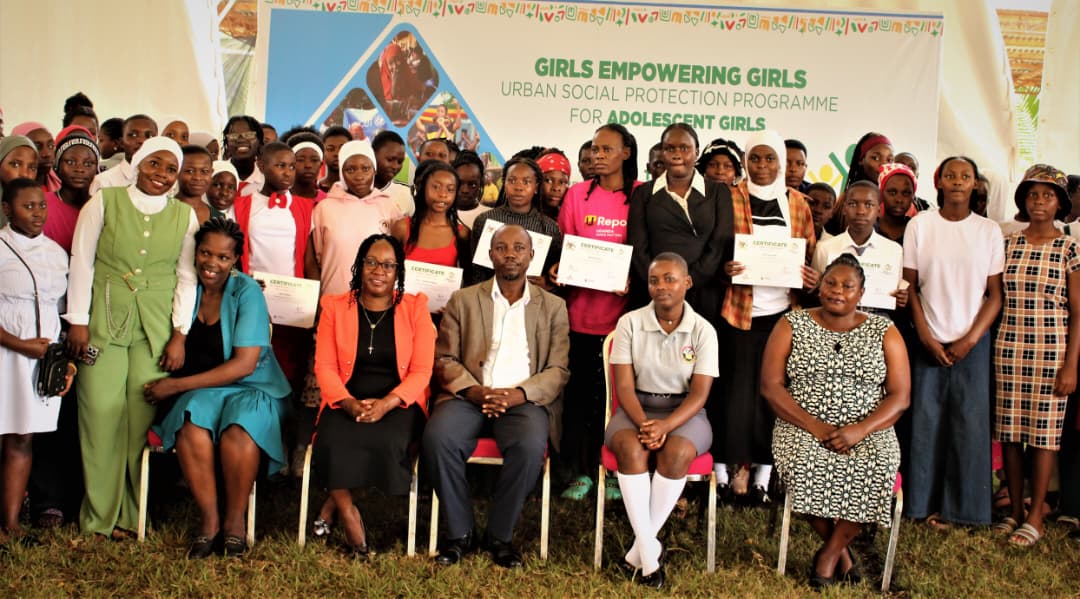
A seven-year partnership between the Kampala Capital City Authority and UNICEF has reached more than 4,000 girls through a social protection model combining cash transfers and mentorship, officials announced during a close-out ceremony at City Hall.
The Girls Empowering Girls initiative, launched in 2019 with support from the government of Belgium, was designed to address high dropout rates and social risks facing adolescent girls in urban settings.
The program delivered shs2.6 billion in financial support to vulnerable households, a move KCCA Executive Director Sharifah Buzeki said was essential to stabilizing families.
The program has restored dignity, Buzeki said.
"We have learned that empowering girls requires a multidimensional approach where education, social protection and economic empowerment work together," she said.
Buzeki described the initiative as one of the authority’s most transformative social interventions, noting that its success should be measured in both statistics and improved life outcomes.
She pledged to integrate these lessons into ongoing city strategies to ensure young women remain central to Kampala’s development agenda.
The project, implemented by Trailblazers Mentoring Foundation (TMF Uganda) and Uganda Youth Development Link (UYDEL), focused on the city’s most vulnerable, including teenage mothers, girls with disabilities and refugees.
According to KCCA data, the initiative successfully re-enrolled more than 800 girls into formal education, while 211 completed vocational training and 35 started their own small businesses.
Parents across Kampala divisions said the program’s mentorship component, which utilized mentors as guides for younger girls, was as vital as the financial aid.
Before this program, our children feared opening up, but now they freely share their challenges with us, said Jamada Sserunjogi of Namungoona. This has helped us guide them better and keep them in school.
Another parent, Prossy Nassali, noted that her daughter gained the confidence to avoid bad influences, while Aisha Mutesi said the program strengthened family bonds by helping parents understand the specific challenges their children face.
Asha Naigaga, a resident of Kibuli Market B Zone in Makindye Division and a mother of two beneficiaries, said the program eased the financial burden that once threatened her children’s education.
"I have gained from it because my children were suffering, and I was struggling with school fees. By the time the program was introduced, my first child was in Primary Six and is now in Senior Three. The second joined Senior One after completing Primary Seven. They are studying very well in a government school in Kansanga, she said.
As part of the program, parents and caregivers received financial literacy training alongside a monthly stipend to support basic household needs. Naigaga credited the initiative for improving her livelihood through small business opportunities.
"I was able to save the small money they were giving me. I started by making ice cream for children and later expanded into selling clothes. I even travel to Busia to buy stock," she explained.
Despite the gains, she expressed concern about the program’s future, praying it would continue to support children through Senior Four.
According to Diana Kamwada, a peer mentor, the initiative played a critical role in supporting the transition from primary to secondary education.
The research we conducted shows that children at this stage are vulnerable and can easily be influenced, Kamwada said. During mentorship sessions, we create safe spaces where girls can open up about issues affecting them.
She noted that the provision of stipends helps girls meet essential needs, such as sanitary products, which are often a barrier to consistent school attendance.
"These girls are now empowered to take charge of their lives. They can report cases of abuse, including defilement and domestic violence, and speak up when something is wrong in their communities," she said.
UNICEF Country Director Robin Nandi reported that 95 percent of girls who completed their primary education under the program transitioned to secondary school.
Despite these gains, Nandi noted that multidimensional child poverty remains high at 44 percent in Uganda, prompting an expansion of the GEG model to 11 additional districts, including West Nile and Acholi. This expansion aims to reach 15,000 more girls with funding from the European Union, Iceland and the Netherlands.
Belgian Ambassador Hugues Chantry described the initiative as a landmark for gender equality. However, the program's closure in Kampala has raised concerns among local mentors. Lydia Kamyuka noted that many girls still lack basic materials, while Chrisbianel Bukirwa urged parents to continue the mentorship role themselves.
Rubaga Division Mayor Zachy Mawula Mberaze and KCCA’s Sylvia Tibakirawo encouraged the community to sustain the progress made.
"The end of the program should not stop the progress achieved," Tibakirawo said. Let us use the knowledge gained to continue empowering our girls.
Daniel Kaseregenyi, deputy director for gender, welfare and community services at KCCA, said the initiative targets girls in upper primary to ensure a smooth transition to secondary school.
He explained that GEG supports both in-school and out-of-school girls.
"Those who had dropped out are traced and supported to return to school where possible. For those we cannot return, we empower them economically by supporting them to start small businesses."
He added that involving parents and caregivers has been key to the program’s success.
"We do not work with children alone. We engage parents and caregivers to ensure the support system at home is strong," he explained.
According to KCCA, participating schools have reported a noticeable decline in dropout rates.
"What we have learned is that school dropout is sometimes caused by very small issues. When parents listen and respond early, it makes a big difference," Kaseregenyi said.
As the program phases out, beneficiaries and officials are calling for its continuation, citing its role in strengthening education outcomes and household resilience.
Sheila Birungi Gandi, the program coordinator, said the initiative leaves behind a strong, evidence-based foundation for future urban social protection efforts in Uganda.
