

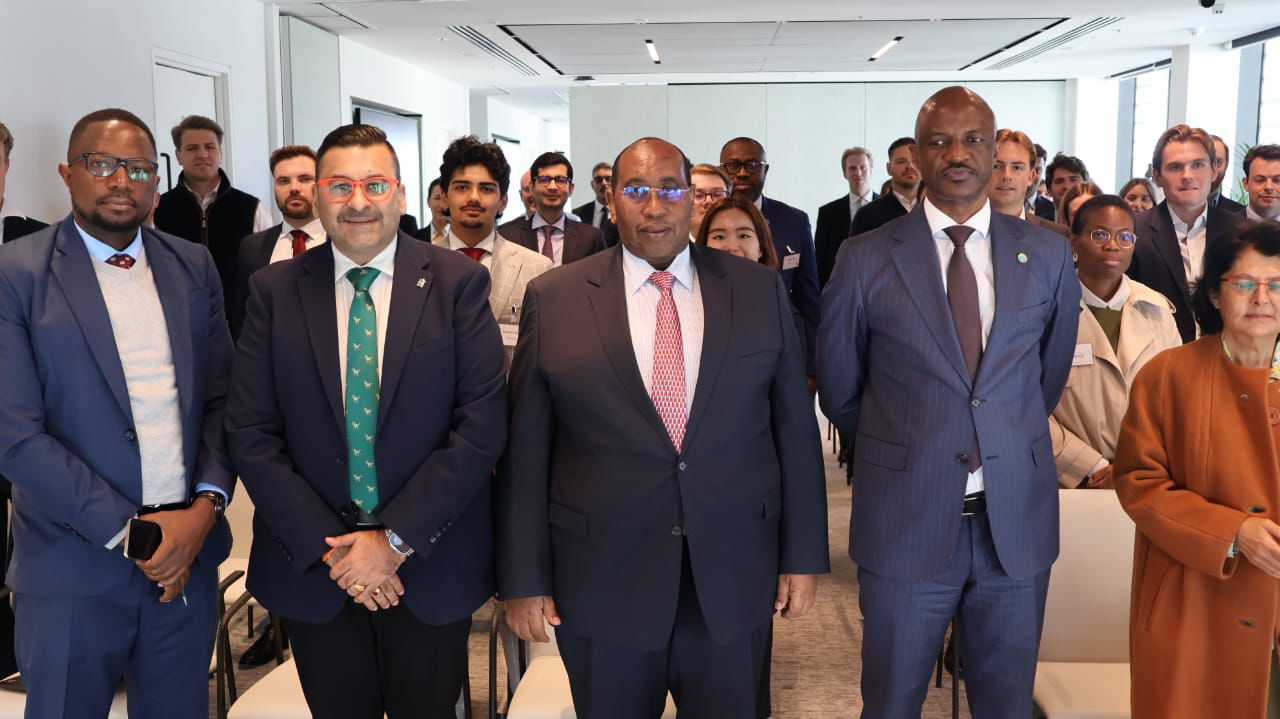
The Permanent Secretary and Secretary to the Treasury (PSST), Dr. Ramathan Ggoobi, has assured prospective development partners in the United Kingdom that Uganda maintains a stable and well-managed macroeconomic environment with strong long-term growth potential.
Ggoobi made the remarks during an engagement with insurers, banks, and investors at Standard Chartered Bank headquarters in London, where he presented Uganda’s economic outlook and strategic priorities aimed at building a $500 billion economy by 2040.
He attributed Uganda’s macroeconomic stability to prudent monetary policy, noting that robust foreign exchange reserves continue to provide a buffer against external shocks.
“Favourable terms of trade, alongside strong portfolio flows and foreign direct investment, have helped boost Uganda’s foreign exchange reserves to an all-time high,” Ggoobi said.
He added that Uganda’s real GDP growth is projected to rise above 7% in 2026, driven largely by developments in the oil sector. Oil production is expected to commence in the fourth quarter of 2026 and peak at approximately 230,000 barrels per day by 2028, potentially lifting economic growth to around 9%.
Ggoobi, who was accompanied by Director of Economic Affairs Moses Kaggwa, Director of Debt and Cash Policy Maris Wanyera, and Bank of Uganda Executive Director Dr. Adam Mugume, outlined key investment opportunities across sectors.
He highlighted Uganda’s mineral potential, noting that the country has confirmed commercially viable deposits of more than 30 minerals. He also pointed to major infrastructure projects, including the East African Crude Oil Pipeline, the Malaba–Kampala Standard Gauge Railway, the Hoima Oil Refinery, and the development of industrial parks.
On public debt, Ggoobi said Uganda’s debt stood at USD 32.2 billion as of June 2025 but emphasized that it remains sustainable under a prudent medium-term debt management strategy.
He explained that government is implementing measures such as domestic revenue mobilization and leveraging concessional financing to manage debt and reduce the burden of interest payments on the national budget.
Standard Chartered Bank Uganda Chief Executive Officer Sanjay Rughani described the engagement as an opportunity to strengthen dialogue between Uganda and UK investors, reaffirming the bank’s commitment to supporting the country’s long-term growth agenda.
The Ugandan delegation also held discussions with the bank’s Chief Economist for Africa and the Middle East, Razia Khan, focusing on the implications of the ongoing Middle East crisis and Uganda’s preparedness to withstand external economic shocks.
Ggoobi noted that Uganda’s response strategy prioritizes investment in growth and resilience rather than short-term measures such as tax cuts or subsidies.
“This crisis presents an opportunity for Uganda to position itself strategically in areas such as renewable energy, food production, and the broader decarbonisation agenda,” he said.
He added that shifting global investment patterns, particularly in oil and gas, could create new opportunities for African economies, including Uganda.
The engagement also featured technical discussions on export credit agency financing, private credit opportunities, and investment prospects in Uganda’s mining and metals sectors.
