

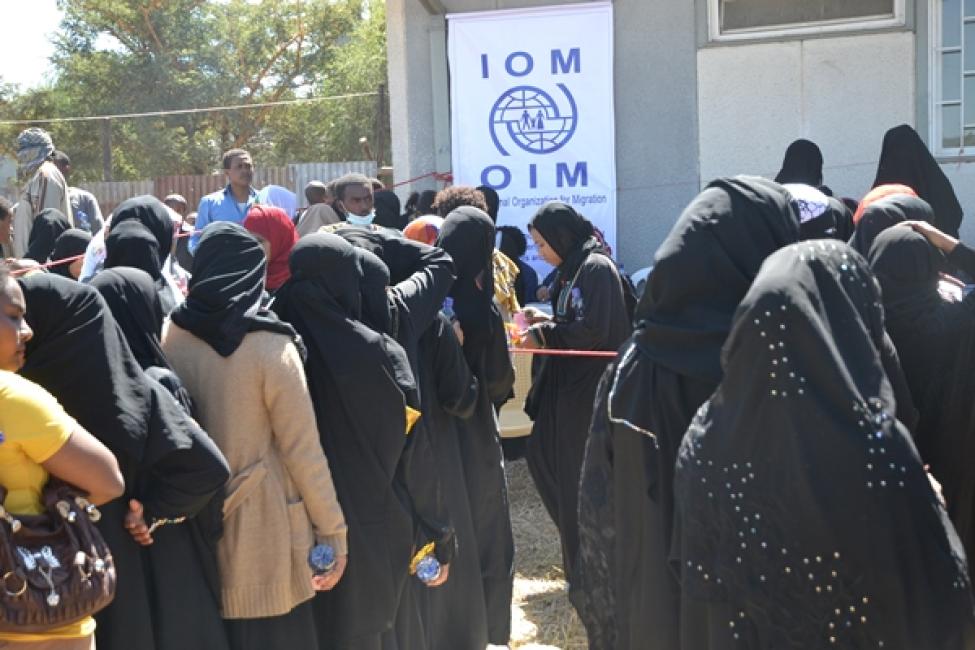
The Global Crisis Response Platform of the International Organization for Migration has provided a close-up view of African migration from the eastern regions of the continent along the eastern and southern routes, in an effort to protect unaccompanied children, survivors of gender-based violence, and victims of human trafficking.
According to the platform’s 2026 plan report, “Ethiopia remains the primary country of origin for migration along the eastern and southern routes.
In 2025, the International Organization for Migration recorded 224,400 departures, a figure close to that of 2024 (234,000 migrants), with Ethiopians accounting for 79% of flows recorded along the eastern route, while Saudi Arabia remained the main destination.”
The report adds that “although young people continue to constitute the majority of migrants, there has been a notable increase in the proportion of women and children, with migrant women now accounting for 26% and children 6% of total departures from Ethiopia.”
Intersecting Risks
Beyond the conditions that drive them to leave their homeland in search of employment opportunities, the Global Crisis Response Platform notes that “since 2017, more than 750,000 Ethiopians have been forcibly returned, most of them from Saudi Arabia.
In 2025 alone, 95,100 returnees were documented, many of whom arrived with limited resources and suffered from significant physical or psychological trauma.”
It also warns of the “overlapping risks migrants face, including violence, lack of food and shelter, and serious protection violations during their journey, while women, girls, and unaccompanied minors face heightened risks of gender-based violence and human trafficking.”
In a report published last May by The New Humanitarian, information reveals that “hundreds of thousands of Ethiopian migrants in recent years have undertaken a perilous journey across the Red Sea in hopes of a better life in Saudi Arabia.”
It notes that “a large portion of these migrants travel along what is known as the eastern migration route, crossing the Red Sea and the Gulf of Aden into Yemen, and then onward to Saudi Arabia, where they hope to find work and send money back to their families.”
“But most find only further suffering,” the report states, adding: “The journey draws them into a shadowy transnational economy built on the exploitation of human misery. Along the way, human smugglers and violent militias exploit their desperation for profit. Many die along the route. Even those who reach Saudi Arabia face other dangers, including the horrors of the prison system.”
Yassin’s Story
Within the same report, Ethiopian youth Yassin Omar recounts his painful story, beginning with a harsh journey to reach Saudi Arabia, though its most painful chapter unfolded inside the Kingdom itself. He says: “When I arrived in Saudi Arabia, I worked as a shepherd, but my employer reported me instead of paying my wages.”
The young Ethiopian continues: “Prison was terrifying.
They put 300 people in a small cell without sufficient food… we fought over food, and then the guards beat us,” also referring to “harsh methods of torture, including forcing prisoners to perform exercises on floors covered with nails.” He remained in prison for nine months before being deported to Ethiopia.
The New Humanitarian report notes that “in 2024, Saudi Arabia arrested around one million people on charges of illegal entry and deported more than 576,000, while thousands remain in prisons,” adding: “As a result, the Kingdom has faced criticism from human rights organizations over its treatment of migrants, including forced labor and abuse.”
Moreover, “a 2023 report by Human Rights Watch documented mass killings of Ethiopian migrants at the border.”
Commenting on his ordeal, Yassin says: “Smugglers only tell you the good things about Saudi Arabia—they didn’t tell us about the journey or what we would face. Even when we arrived, things were nothing like they said.”
The same report indicated that the total number of Ethiopians who left their country via the eastern route in 2024 reached 234,000 migrants 69% men, 26% women, 3% boys, and 2% girls with Saudi Arabia serving as the primary destination for 94% of them.
Meanwhile, a report by the International Organization for Migration published last March points to “a 14% increase in the number of children forcibly returned from Saudi Arabia (amounting to 4,700 children),” noting in particular that many returning Ethiopian women had given birth in the Kingdom.
This arbitrary approach was also documented in a 2022 report by Amnesty International, which confirmed the “forced return of hundreds of thousands of Ethiopian migrants by Saudi authorities after subjecting them to arbitrary detention for indefinite periods in inhumane and harsh conditions,” calling on “the Kingdom to investigate cases of torture, as well as at least ten deaths in detention between 2021 and 2022.”
Under the title “As If We Were Not Human,” the report described “forced returns and horrific detention conditions for Ethiopian migrants in Saudi Arabia,” documenting the conditions of Ethiopian men, women, and children arbitrarily detained in the overcrowded Al-Kharj and Al-Shumaisifacilities, where they endured dire conditions and grave abuses before being forcibly returned to Ethiopia between June 2021 and May 2022.
