

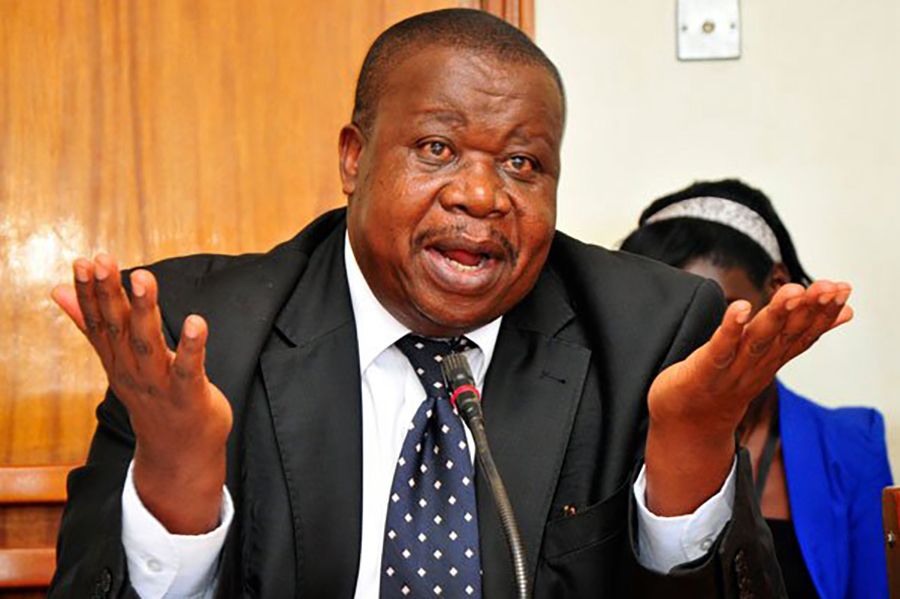
The Minister of Internal Affairs, Rtd Major General Kahinda Otafiire, has called for urgent and decisive government intervention to tackle the escalating crisis of congestion in Uganda’s prisons, emphasizing the need for expanded infrastructure and increased judicial capacity.
Speaking during proceedings before Parliament’s Defence and Internal Affairs Committee, Otafiire underscored that while reforms such as parole may contribute to easing pressure on correctional facilities, they cannot serve as a standalone solution.
He instead advocated for the construction of more prisons and the recruitment of additional judicial officers to expedite case handling.
“We have individuals who should serve six-month sentences but remain incarcerated for up to three years due to delays in the justice system. This is not just a congestion issue—it is a systemic challenge that requires investment in both infrastructure and Human Resources,” he said.
His remarks were echoed by the, Minister of State for Internal Affairs, David Muhoozi, who emphasized that no single intervention would resolve the crisis.
“A comprehensive approach is necessary. We must address remand delays, expand prison infrastructure, and implement parole strategically. Each of these measures plays a role in creating sustainable change,” he said, adding that the the significant proportion of inmates on remand, many of whom spend extended periods in custody before trial, further exacerbates congestion.
The remarks come amid alarming revelations by the Uganda Prisons Service regarding severe overcrowding across the country’s correctional facilities.
Appearing before the same committee, Undersecretary Samuel Emigu disclosed that Uganda’s prisons are currently holding approximately 79,269 inmates against an official capacity of just 23,184—an excess of over 56,000 prisoners. He warned that, if left unaddressed, the prison population is projected to rise to 111,822 by 2030.
“This means we are operating at levels up to seven times beyond approved capacity in some facilities. The situation calls for urgent planning and intervention to manage congestion effectively,” he said.
To mitigate the crisis, the Prisons Service is seeking an additional Shs 75.099 billion to facilitate the construction of 50 new prison wards, three local security prisons, and several regional minimax facilities.
Further insight was provided by Deputy Commissioner General Samuel Akena, who reported that as of March 30, 2026, Uganda’s prisons held 80,110 inmates. Of these, 42,340 are convicted prisoners, while 37,074 remain on remand.
“The occupancy rate stands at 345%. In practical terms, this means a space designed for one prisoner is now occupied by four. This level of congestion is our biggest operational challenge and a major driver of costs,” he said.
Akena also revealed that the long-awaited parole system is expected to be rolled out in the 2026/2027 financial year, pending finalization of regulatory frameworks. He expressed optimism that parole could help reduce congestion, particularly among convicted inmates eligible for early supervised release.
However, Otafiire cautioned that implementing parole effectively requires substantial financial investment in supervision systems, which are currently underfunded.
According to Otafiire, infrastructure limitations compound the challenge. Many of Uganda’s prison facilities are over 104 years and were constructed as early as 1922 during the colonial era, with only limited expansion in the 1960s. Despite a tripling of the national population since then, prison capacity has remained largely unchanged.
“The population has grown, but prison space has not kept pace. While parole is an option, we must prioritize constructing new facilities to match current realities,” he said.
