

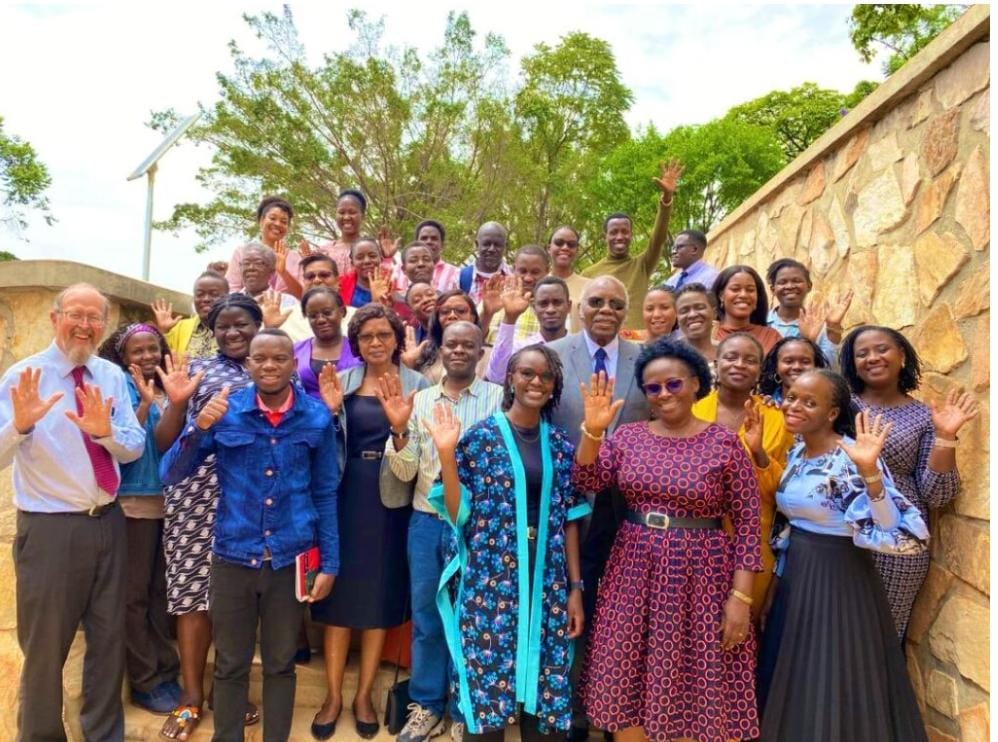
A section of civil society actors, development practitioners, faith leaders, and community representatives gathered in Kampala for a national dialogue aimed at redefining the meaning of justice and its role in building a gender-equal society.
The roundtable, held at the Bahá’í Information Center auditorium, was organized by the Bahá’í Office of External Affairs (Uganda), an agency of the National Spiritual Assembly of the Bahá’ís of Uganda.
The meeting sought to deepen understanding of justice beyond legal systems and explore how it can be practiced more meaningfully in everyday life.
The discussion was guided by the statement Reconceptualising Justice: Laying Foundations for a Gender-Equal World, which was presented by the Bahá’í International Community to the 70th Session of the United Nations Commission on the Status of Women (CSW70).
The document calls for improved access to justice for women and girls and encourages societies to view justice not only as a legal matter, but also as a social and moral principle that shapes equality.
Participants noted that justice is often narrowly associated with courts, laws, and formal institutions. However, the dialogue emphasized the need for a broader perspective that reflects people’s daily experiences.
Discussions explored how justice is influenced by cultural practices, family dynamics, social relationships, and community norms that shape opportunities and treatment for women and men.
At the center of the conversation was concern over the unequal access to justice faced by many citizens. Several participants pointed to barriers such as cost, limited information, and lack of transparency within the legal system.
“The justice system is not transparent or accountable, and it does not reach the ordinary person. If you have no money, you cannot access justice,” one participant observed, highlighting the gap between legal structures and the realities faced by vulnerable groups..
Speakers also stressed the need for stronger community involvement in justice processes. Limited public awareness and weak information-sharing were identified as key obstacles to meaningful participation.
“We still lack a community-led approach in our deliberations because dissemination of information is insufficient, and this has limited participation,” another contributor noted, calling for more inclusive and locally grounded engagement.
Gender equality emerged as a central theme throughout the dialogue. Participants reflected on how discrimination against women and girls continues to manifest through harmful cultural practices, limited economic opportunities, underrepresentation in leadership, and persistent gender-based violence.
Many agreed that these challenges not only affect women but also undermine social and economic development.
One participant emphasized the importance of early intervention through education.
“Issues of gender equality are introduced too late. These conversations should begin at the family level and in early schooling,” the participant said.
The discussions pointed to the need for deeper cultural transformation alongside legal reforms. Participants agreed that laws alone cannot eliminate inequality if societal attitudes and behaviors remain unchanged.
True justice, they noted, must be reflected in homes, schools, workplaces, faith communities, and public institutions.
The roundtable further explored how legal frameworks and moral values can reinforce each other. While strong laws are essential for protecting rights, they are most effective when supported by a culture that promotes fairness, consultation, accountability, and inclusion.
Participants called for collaborative action involving policymakers, grassroots organizations, development partners, and community leaders to create systems where justice is not only enforced through legal mechanisms but also embraced as a shared social responsibility.
