

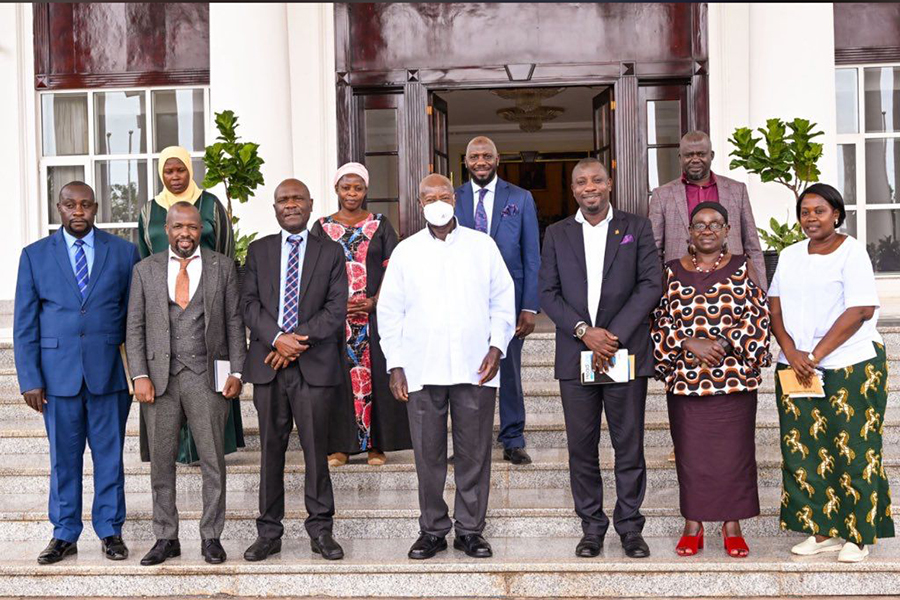
Political analysts and political actors are divided over whether opposition politicians engaging President Yoweri Museveni strengthens national consensus or weakens the credibility and independence of opposition parties.
The debate has intensified in recent years following President Museveni’s public remarks describing opposition figures who refuse to engage with him as “bad opposition,” raising broader questions about what constitutes constructive political engagement within Uganda’s multiparty political system.
Since 2006, several opposition politicians have held meetings with the president, some publicly acknowledged and others reportedly conducted privately.
However, the outcomes of many of these engagements have remained undisclosed, fueling speculation, mistrust, and internal tensions within opposition ranks.
Political analyst Christopher Lubogo said engagement between opposing political actors should not automatically be viewed as betrayal.
“Dialogue between political actors is a cornerstone of democracy. It provides an opportunity to find common ground on national issues and does not necessarily mean betrayal,” Lubogo said.
However, such engagements have often carried significant political consequences. Some opposition leaders who met President Museveni later joined government or accepted political appointments.
Former Uganda Federal Alliance leader Betti Kamya, once a presidential challenger, later served as Minister for Kampala Capital City, Minister for Lands, and Inspector General of Government before leaving office last year.
Similarly, Democratic Party president Norbert Mao’s engagement with President Museveni preceded his appointment as Minister for Justice and Constitutional Affairs.
People’s Front for Freedom (PFF) National Chairman Wasswa Biriggwa cautioned that opposition engagement must be principled and issue-based.
“You can engage on principle. I appeal to the president to release youth prisoners, Dr. Kizza Besigye and Hajji Obed Lutale, who have spent more than a year in prison,” Biriggwa said.
Meanwhile, NRM Director of Mobilization Rosemary Sseninde defended the engagements, arguing that dialogue is essential for governance and national unity.
“Engagement is part of democratic maturity. Leaders must be willing to engage. If you don’t, how will you extend service to the people? You must appreciate working with government,” Sseninde said.
Some opposition figures who have met President Museveni have faced accusations of being “moles,” with critics arguing that such engagements weaken opposition resistance and bargaining power.
Those accused, however, maintain that their actions reflect a commitment to dialogue rather than defiance, underscoring the ongoing tension over the role, limits, and political cost of opposition engagement with the ruling establishment.
