

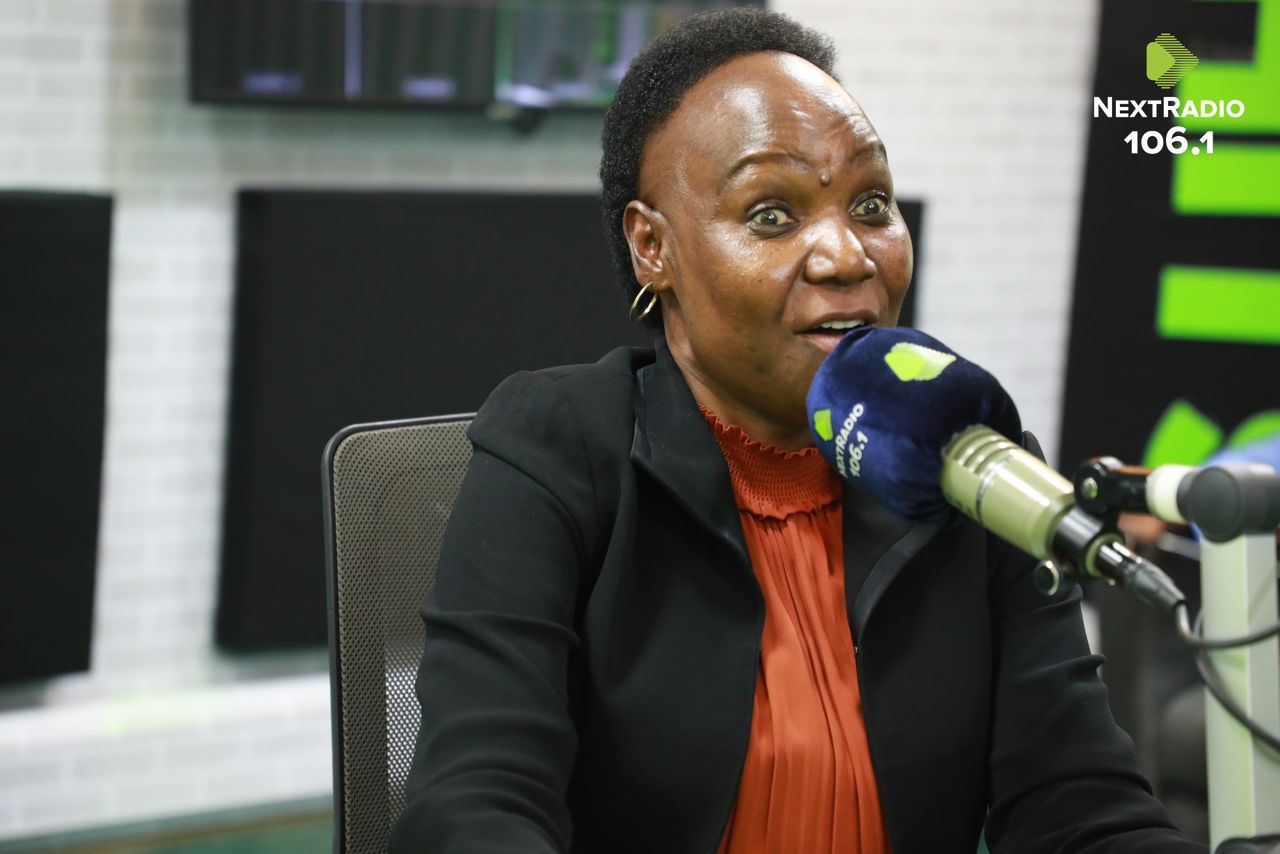
Uwezo Uganda educationist Margaret Nakabugo has raised concerns over delays in implementing key education policies, persistent gender disparities in learning outcomes, and inadequate funding in Uganda’s primary education system, despite modest gains recorded in the 2025 Primary Leaving Examinations (PLE).
Nakabugo was speaking to Canary Mugume during Next Big Talk, hosted by Next Radio on Wednesday under the theme, “Who’s really failing PLE? Implementation or the education system?”
She pointed to the delayed implementation of the Early Childhood Education policy as a major missed opportunity to strengthen learning foundations at the earliest stages.
“Last year around May, a policy of Early Childhood Education was passed committing government to allow for at least one year of pre-school. It is not yet implemented,” Nakabugo said.
She also highlighted continued gender disparities in academic performance, noting that while access to primary education for girls has improved significantly, boys still tend to perform better academically.
“There is still a worry that even as we celebrate the access of girls to primary education, the boys are still outperforming them,” she said.
Nakabugo urged stakeholders to strike a balance between celebrating progress and critically examining areas that need urgent attention within the education system.
“We need to celebrate the modest progress that has been made and examine how we can further improve the system, including recognising the number of children who complete the primary education cycle,” she said.
At the curriculum and instruction level, Nakabugo recommended a review of the primary school curriculum alongside targeted capacity building for teachers to effectively deliver the competence-based curriculum.
“For the primary education level, I would recommend that the primary school curriculum be reviewed and teachers also be trained for the new competence-based curriculum,” she said.
However, she cautioned that curriculum reforms alone would not translate into improved outcomes without adequate financing and staffing.
“A competence-based curriculum alone is not going to change the situation until it is funded. Schools are struggling with resources and recruiting teachers,” Nakabugo said.
Her remarks come as the Uganda National Examinations Board (Uneb) released the 2025 PLE results on Friday, January 30, 2026, showing a modest overall improvement compared to the previous year.
According to Uneb, 730,233 candidates passed the 2025 PLE. The largest proportion, 388,293 candidates, passed in Division Two, followed by 165,226 in Division Three, 91,990 in Division One, and 84,724 in Division Four.
Compared to 2024, 7,503 more candidates passed the examinations, while 7,689 additional learners attained Division One.
The results show that although more girls passed the examinations in absolute numbers, with 380,264 compared to 349,969 boys, boys performed better in the top divisions.
A total of 48,220 boys, representing 12.54 per cent, attained Division One, compared to 43,770 girls, or 10.35 per cent.
In Division Two, 48.54 per cent of boys passed compared to 47.69 per cent of girls.
Failure rates were higher among girls, with 42,580 female candidates, or 10.07 per cent, remaining ungraded, compared to 34,500 boys, representing 8.97 per cent.
Uneb reported that 817,883 candidates from 15,388 examination centres registered for the 2025 PLE, an increase from 797,444 candidates in 2024.
Of these, 522,036 candidates, or 63.8 per cent, were beneficiaries of Universal Primary Education (UPE), while 295,847 candidates, or 36.2 per cent, were non-UPE students.
