

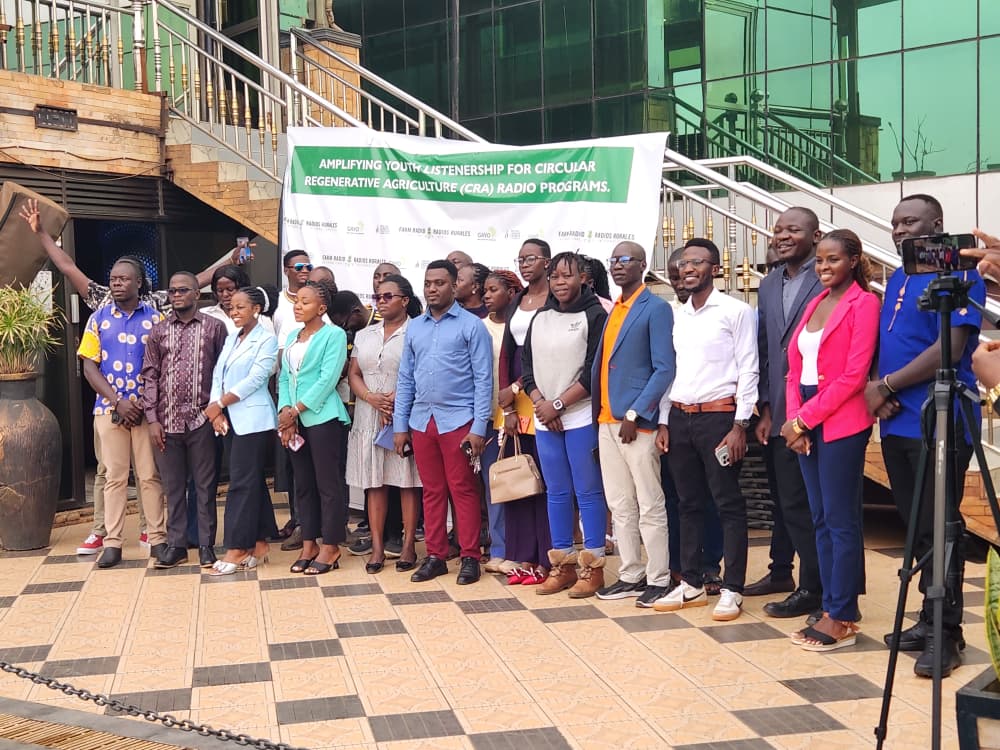
Stakeholders in the agriculture sector have called for a shift in how farming is presented to young people, arguing that poor packaging of agricultural content has driven youth away from a sector that remains the backbone of Uganda’s economy.
The call was made at the close of a training for radio broadcasters held at Hotel La Grande in Kampala. The training was organized by the Green Africa Youth Organization (GAYO) in partnership with Farm Radio International.
The program brought together 24 radio broadcasters from different regions of the country to equip them with skills to communicate circular regenerative agriculture in ways that resonate with young audiences.
Addressing participants, GAYO National Director Isaac Nyamuhaki said agriculture programs continue to attract low youth listenership largely because they are not youth-friendly.
“We understand there is a gap in that messages tailored to agriculture receive minimal listenership from young people. Some of these programs are not packaged well, they are not well elaborated, and they are not youth friendly. That is why most youth tune out,” Nyamuhaki said.
He explained that the training aimed to retool radio broadcasters and producers to craft effective messages on circular regenerative agriculture that can attract wider youth listenership across Uganda.
Nyamuhaki added that broadcasters are expected to return to their respective regions and apply the skills acquired, while urging radio station owners to allocate more airtime to agriculture-focused programming.
“We also call upon radio station operators to subsidise or increase airtime for young people on circular regenerative agricultural programs so that more youth are motivated to participate,” he said.
Farm Radio International, through its Greenleaf radio magazine programs, partnered with GAYO to amplify youth voices in agriculture. Pascal Mweruka, the Greenleaf senior team lead, said radio remains a powerful communication tool when combined with platforms already popular among young people.
“We noticed that not many youth tune in to radio stations, but we wanted to use radio alongside social media channels, which are widely used by the youth, to scale up circular regenerative agriculture practices,” Mweruka said.
He noted that many farmers already apply regenerative methods without recognizing them as such.
“Most people practice circular regenerative agriculture unknowingly. They do some of these practices but are not aware that what they are doing falls under regenerative agriculture,” he explained.
Mweruka emphasized that regenerative practices—such as mulching, use of animal residues, terracing in highland areas, organic fertilizers, and indigenous seeds—are essential for soil health, long-term productivity, and environmental sustainability.
He also stressed that youth participation in agriculture should extend beyond farming activities alone.
“Much as the youth constitute the largest population in Uganda, many of them do not own land. We want to show them that even if you cannot go to the garden, you can engage in aggregation, marketing, value addition, and transportation. All these are part of agriculture,” he said.
One enterprise benefiting from increased attention to regenerative agriculture is Simbla Ventures Ltd, a rural-based social enterprise in Kamwenge District. Its founder, Myers Ndyabawe, welcomed the renewed focus on agriculture in the media, saying limited coverage has weakened the sector.
“Radio stations giving more airtime to other programs than agriculture has negatively affected farming and the country as a whole,” Ndyabawe said.
He explained that Simbla Ventures promotes circular regenerative farming through coffee and mushroom production, using mulches and agricultural waste such as coffee husks, bean husks, and maize stalks.
“Uganda has the potential to become a food basket for East Africa and beyond, but when the media focuses mostly on politics, football, and less productive subjects, it weakens the agriculture industry,” he added.
Ndyabawe argued that limited media coverage has left young people uninformed about opportunities within the sector.
“If people know about a war in Ukraine but do not know the price of a tomato, it becomes hard for them to see agriculture as an alternative,” he said.
Organizers believe that reshaping agricultural storytelling through radio and digital platforms could inspire more young people to view agriculture as a viable, innovative, and profitable career path—while also easing pressure on government to create formal employment opportunities.
