

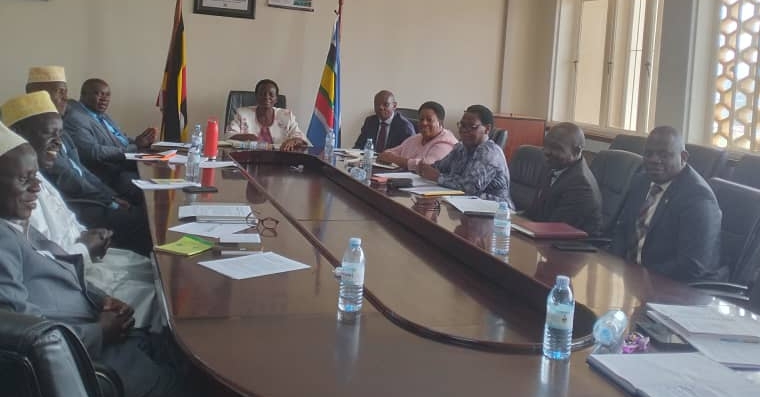
The Ministry of Education and Sports (MoES) and the Uganda Muslim Supreme Council (UMSC) have reaffirmed their commitment to strengthening collaboration aimed at improving the quality, management, and sustainability of Muslim education institutions across the country.
The commitment was made during a meeting held at the Ministry headquarters in Kampala, bringing together senior officials from both institutions to address long-standing policy and operational challenges affecting Muslim-founded and Muslim-managed schools.
The meeting was chaired by the Permanent Secretary of the Ministry of Education and Sports, Kedrace Rwankore Turyagyenda, and attended by key UMSC officials, including the Education Secretary, Sheikh Juma Bakhit Cucu, and the Chairperson of the National Education Committee, Hajji Muhmood Kateregga Namuguzi.
During the engagement, Sheikh Cucu presented a policy paper titled “Education Policy Issues Affecting the Smooth Running of Muslim Education in Uganda,” outlining critical concerns ranging from school financing and access to government grants to teacher recruitment, deployment, and transfers.
Other key issues raised included the recognition of Islamic theology education, school calendar arrangements, ownership and licensing of Muslim schools, protection of religious rights, observance of the Muslim dress code, and the formalisation of institutional Muslim chaplaincy (muallims).
“Our intention is to ensure that Muslim-founded institutions operate smoothly within the national education framework while preserving their religious identity,” Sheikh Cucu said.
The dialogue also focused on accelerating improvements in the sector, with emphasis on infrastructure development, upgrading teachers’ skills and qualifications, community mobilisation, and clearer definition of roles among education stakeholders.
“Quality education can only be achieved when government and faith-based institutions work together in a structured and transparent manner,” Turyagyenda noted.
Both institutions agreed on the need to strengthen monitoring and follow-up mechanisms, particularly for madrassa schools, to ensure consistent standards nationwide.
They also committed to sustaining regular consultations and cooperation to promote inclusive, high-quality education for future generations of Ugandans.
