

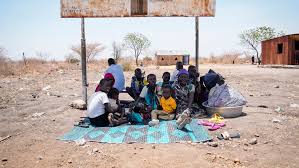
At present, Sudanese displaced people await nothing but a return to their old homes, where memories of days without war occasionally sweep through their imaginations in displacement camps and in neighboring countries.
War erupted in Sudan in mid-April 2023 between the army based in Port Sudan and the forces of the Sudan Founding Alliance (“Ta’sis”), resulting in the displacement of nearly 14 million people.
With shifts in the course of the crisis, the Port Sudan authorities announced in March that they had taken control of the capital, Khartoum, declaring that life had returned to normal as it was before the outbreak of war.
In the aftermath, initiatives were announced to facilitate the return of displaced people to their homes in Khartoum, from within and outside a country where more than 20 million Sudanese are currently suffering.
The displaced returned to their homes in succession, resolving to start anew in Khartoum. Among them arose images of the city’s once-vibrant streets, café debates, the clamor of theaters, and the daily congestion of markets.
However, the reality the city now endures has made displacement camps, according to testimonies, more conducive to settlement, as returnees failed to recognize the city that had never left their imagination before the war.
One resident recounted his experience to Alrakoba News after returning to his home in the eastern part of the capital in late August.
“The return was fraught with tragedies,” he said, noting that his younger brother lost his life after contracting dengue fever, while his family was subjected to a series of looting incidents that resulted in two of his children losing their mobile phones, and another sustaining a head injury while attempting to fend off the attackers.
He described the days preceding their second departure as the most difficult, amid electricity and water outages, the spread of disease, and the absence of security.
He noted that neighborhoods had become nearly deserted, adding that he “found only five neighbors to help bury his brother, reflecting the scale of social collapse in the city.”
In another account, a resident who returned to the capital and “remained there for three weeks before leaving again” expressed his shock at the extent of destruction he witnessed.
He said he faced “major difficulties moving around due to destroyed roads and checkpoints run by armed men who treated people harshly,” before reaching his home in the southern part of the city.
He added that the neighborhood, once “teeming with life, appeared as though it had been abandoned for a century,” and that one of the few remaining neighbors told him he had lost hope of staying but did not know where else he could go.
Returnees found no room for stability, as the Port Sudan authorities launched a wide-ranging campaign to remove unplanned housing—commonly referred to disparagingly as “informal”—in areas including Mandela, Al-Sareeha, Al-Feitap, Al-Ezba, Al-Khairat, and others, amid controversy between affected residents and local authorities.
One citizen told Jubaraka News that his “life was turned upside down on the morning of October 19, 2025,” the day his family lost their home in the Mandela neighborhood of the Mayo area, south of the Belt, where they had lived since 1997.
He explained that notices and warnings began with markings granting them only 72 hours to vacate a place that represented an entire life and memory.
Once the deadline expired, forces from the Joint Forces, security services, police, and the army arrived and turned the neighborhood, as he described, into a scene of anxiety and fear.
Homes were not only demolished, but residents were subjected to insults and painful accusations of supporting the Rapid Support Forces during their presence in Khartoum while fighting the army, despite the fact that most of them have been displaced for years from the regions of Darfur and the Nuba Mountains.
He affirmed that the demolition left behind a sense of helplessness, as they, like many others affected, were left without any shelter alternative.
Some families were split between relatives’ homes, others rented, while many were left with no option, sleeping in the open air amid a neighborhood transformed into an empty desert.
He added that the authorities “provided us with no support or housing alternative, and treated us as though they were taking revenge on those who have continued to suffer from wars to this day and must be disposed of.”
Among the reactions, the Sudanese Congress Party in Khartoum State condemned the forced demolition of citizens’ homes in the Mandela neighborhood, describing it as a crime against humanity.
It held local authorities and state police responsible, calling for an urgent investigation, compensation for those affected, and guarantees that such practices would not be repeated.
The party stressed that “solutions must be pursued through approaches that preserve human dignity and take economic and social conditions into account, not through forced removal policies that exacerbate the suffering of the poor.”
Meanwhile, Khartoum has recently witnessed a worrying spread of several epidemics amid the collapse of the healthcare system, placing citizens’ lives at real risk.
