

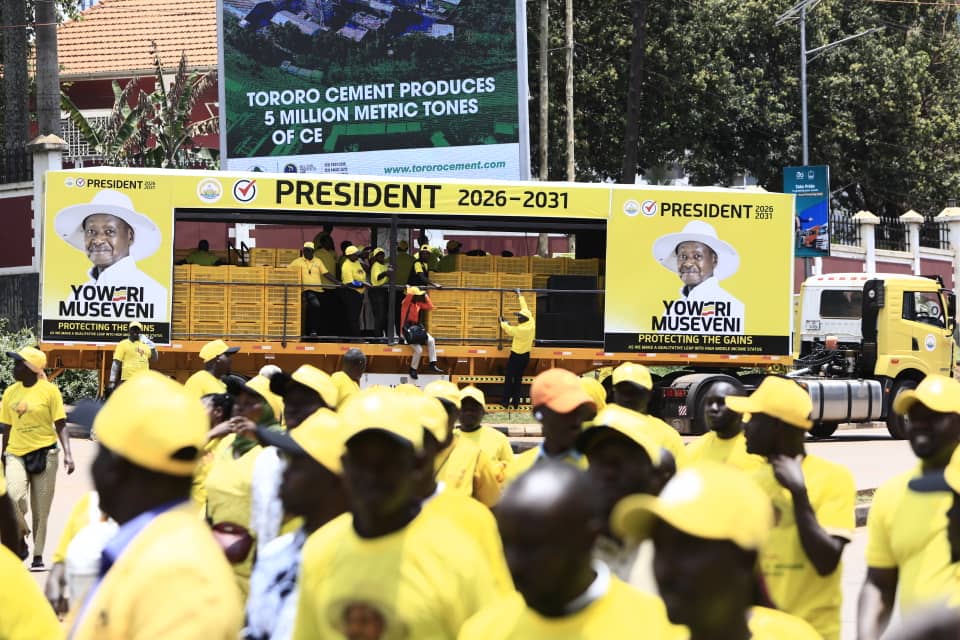
The ruling National Resistance Movement (NRM) has announced a significant shift in its campaign strategy ahead of the 2026 general elections, opting to rely heavily on its grassroots and district structures rather than the traditional national task force-led model.
NRM Secretary General Richard Todwong revealed the new approach during an exclusive interview with Nile Post, stating that the party seeks to maximize its organizational strength at the local level to deliver a decisive victory for President Yoweri Museveni, who is seeking a seventh elective term.
Under the new plan, each member of the NRM’s local structure—from village level upwards—will be tasked with securing at least four votes for President Museveni. The party is targeting 13 million votes in total, a figure it believes is sufficient for a resounding win in the 2026 polls.
“We need to keep them busy; we need each of them to look for not more than three to four votes. You don’t need to struggle much,” Todwong said.
He noted that the model had already been tested during the recent signature collection exercise for President Museveni’s nomination.
“We tested this when we were collecting signatures that we submitted to the Electoral Commission yesterday. We sent these forms to the villages and simply told the village leaders to get two additional persons in addition to themselves, and we got overwhelming results,” he added.
The revamped approach marks a departure from campaigns dominated by the central party secretariat, the presidential candidate, and national task force. Instead, elected leaders and local officials will act as “foot soldiers,” mobilizing support and spreading the party’s message at the community level.
Despite this decentralization, President Museveni is still expected to conduct a limited number of rallies and engagements across the country.
Opposition Skepticism
Opposition leaders have expressed doubts about the effectiveness of the new strategy.
Kira Municipality MP and People’s Front for Freedom (PFF) spokesperson, Ibrahim Ssemujju Nganda, questioned whether relying on party structures guarantees electoral support.
“In 2021, we had agents at some polling stations and [FDC presidential candidate] Amuriat scored zero votes, so it’s no guarantee that your people will support you,” Ssemujju said.
He cited the recently concluded Kawempe by-election, where the NRM candidate secured just 8,000 votes despite the party claiming over 20,000 registered members in the constituency.
“I have covered elections as a journalist, and NRM in some elections in the north was getting zero where they have 30 members in the structures,” he added.
Some political observers interpret the strategy shift as a pragmatic response to President Museveni’s advanced age and reduced capacity to personally traverse the country, placing greater reliance on local networks to drive voter mobilization.
The NRM is scheduled to hold its first public rally under the new campaign strategy on September 23, 2025, shortly after the nomination process.
