

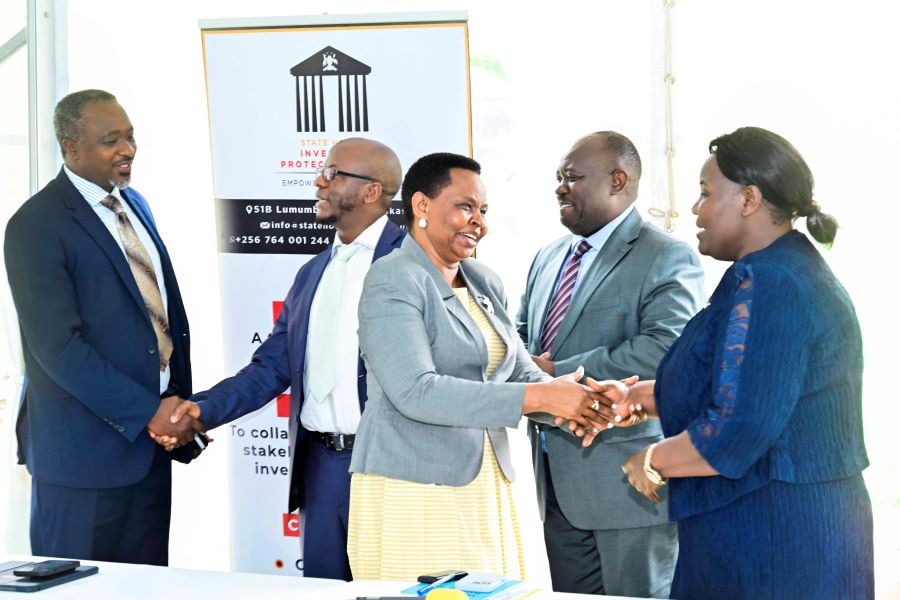
The Head of the State House Investors Protection Unit (SHIPU), Col. Edith Nakalema, has met and held discussions with leaders of government agencies, focusing on strategies to promote Uganda’s national development.
The meeting, held at SHIPU offices in Kampala, centered on aligning agency goals with Uganda’s growth aspirations as outlined in the forthcoming National Development Plan IV (NDPIV).
Col. Nakalema explained that NDPIV seeks to accelerate socio-economic transformation by achieving higher household incomes, full monetization of the economy, and sustainable employment.
“The goal of the plan is to achieve higher household incomes, full monetization of the economy, and employment for sustainable socio-economic transformation,” she said.
She reminded agency leaders that they hold positions of responsibility not just because of technical expertise but because of their duty to Uganda’s future.
“Even more important beyond technical capability, we are public servants because we care about the future of this country. Therefore, we cannot afford to miss the opportunity to make a contribution towards securing the future which our NDPIV has charted out,” Nakalema urged.
She stressed that what binds heads of agencies is not only working jointly but also leveraging goodwill to push Uganda forward.
“The clarion call to advance socio-economic transformation therefore enjoins us to simultaneously deliver tangible results on every front of national service.”
Col. Nakalema further noted the need to tackle development constraints that undermine quality of life.
“The season is now for us to move beyond being the ‘conveyor belt of service delivery’ and put up a united front as a joined-up government not to meet our performance targets but to drive national transformation,” she said.
She emphasized accountability and communication, urging leaders to show citizens their progress.
“As holders of public office, the onus to ponder on the dividends we can generate for citizens is impelling. What will count most upon our retirement from public service is the difference we will have made to the progress of natives.”
Agency heads speak out
Dr. Barirega Akankwasah, Executive Director of the National Environment Management Authority (NEMA) and chairperson of the heads of agencies, said the collective platform allows leaders to share ideas for sustaining peace and development.
“We should share views on how we can support stability during a period of transition from one government to another. Uganda has been stable and peaceful, and we should be appreciative by contributing to its continuity.”
Ms. Mercy Kainobwisho, Registrar General of the Uganda Registration Services Bureau (URSB), emphasized showcasing achievements.
“We should showcase what we have done in the last five years since we have been implementing through the manifesto. We need to come up with a clear strategy by providing accountability without involving politics in it.”
Ms. Juliana Kagwa, Chief Executive Officer of the Uganda Tourism Board (UTB), highlighted ineffective communication as a key challenge.
“We need a platform for inter-agency collaboration so that we are not operating in a parallel universe. We should be speaking the same language.”
She also advised involving youth to create content and publicize campaigns.
Dr. James Musinguzi, Executive Director of the Uganda Wildlife Authority (UWA), echoed this, stressing that much government work goes unnoticed.
“A lot is being done but not publicized. For example, UWA shares revenue with communities neighboring protected areas and compensates them, but this is not known by many.”
Mr. Don Wanyama, CEO of Vision Group, called for consolidating government achievements to secure continuity.
“Let’s create a task force to research what Uganda under the NRM has achieved in the last 40 years and popularise its vision for the next five years.”
Dr. Ezra Muhumuza, Executive Director of the Uganda Manufacturers Association (UMA), emphasized the Manifesto as a social contract that government agencies must implement. He urged strengthened collaboration among agencies.
Eng. Ziria Tibalwa Waako, CEO of the Electricity Regulatory Authority (ERA), called for mobilizing young people to join development campaigns.
“We possibly need age groups between 15 to 40 to support us. They are the majority and easy to convert. If you use the right language, they are easy to move. This cluster should become our ally.”
