

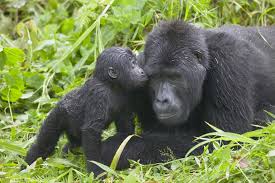
Ahead of this year’s World Gorilla Day tomorrow, conservationists have expressed happiness over the increase of gorillas in Uganda, Rwanda and Democratic Republic of Congo in the last three decades.
Addressing journalists on Monday at Skyz Hotel in Kampala, conservationists said since 1991, the International Gorilla Conservation Programme , a coalition of three leading nature conservation organizations Conservation International, Fauna & Flora and WWF has recorded remarkable successes and overcome seemingly insurmountable challenges along its journey.
They says these conservation efforts have contributed to an increase in the mountain gorilla population from about 600 individuals, less than three decades ago to 1,063 individuals globally according to the 2019 Bwindi – Sarambwe mountain gorilla census report.
“This remarkable bounce back has inspired renewed global conservation efforts to restore hope for the survival of these gentle giants of the mountains. Although mountain gorillas are the only great apes whose population size is increasing, they remain a conservation-dependent species. We have worked tirelessly for over three decades, innovating and adapting our approaches to support mountain gorilla conservation at the population and transboundary landscape levels, working to support and enhance the capacity of individuals and institutions across international borders,” said Mr. Wellard Makambo, IGCP Director.
“This collaboration, across the three countries that are home to the world’s wild mountain gorilla, has enhanced social and political support for conservation, boosted tourism revenue-sharing among park-adjacent communities, strengthened community livelihoods and access to resources, and improved how effectively mountain gorilla parks are managed.”
Over the last three decades, IGCP in collaboration with protected area authorities and other partners has championed mountain gorilla censuses and various ecological surveys right from planning, coordination and implementation, to the publication of results.
This investment has allowed conservationists to verify population trends of gorillas and understand their ecology, and the threats they face, thus enabling more effective and targeted conservation.
Conservationists say IGCP has created opportunities for communities to benefit directly from mountain gorilla conservation, established genuine partnerships with communities who are enabled to be stewards of mountain gorilla conservation, strengthened community livelihoods and access to key resources like fresh water, and supported communities to manage and reduce conflicts between people and wildlife.
“Mountain gorilla numbers have been rising steadily over the past two decades. Thanks to science-based conservation actions and innovative approaches, they now number over 1,000 from less than 600 three decades ago,” Makambo said.
He revealed that the threat status of gorillas has since been downgraded from ‘critically endangered’ to ‘endangered’ in the IUCN Red List of Threatened Species in 2018”.
Wendy Elliott, Biodiversity Practice Interim Leader, WWF said hailed the impact of the IGCP on the gorilla population.
“The fact that all other great apes - barring ourselves - are in steep decline, makes the recovery of the mountain gorilla remarkable. But more remarkable still is how this was achieved. IGCP, as a partner organization itself, focusses on deep partnerships with local communities, governments and many others, and this is where real success finds its roots. IGCP is living proof that conservation works, and that conservation done in partnership works best,” Wendy said.
Cath Lawson, Senior Programme Manager, Eastern Africa at Fauna & Flora said Mountain gorillas are a conservation success story because of IGCP, its effectiveness as a transboundary facilitator, its focus on people - centered approaches, and its ability to catalyze the global community to respond as one through the coalition.
