

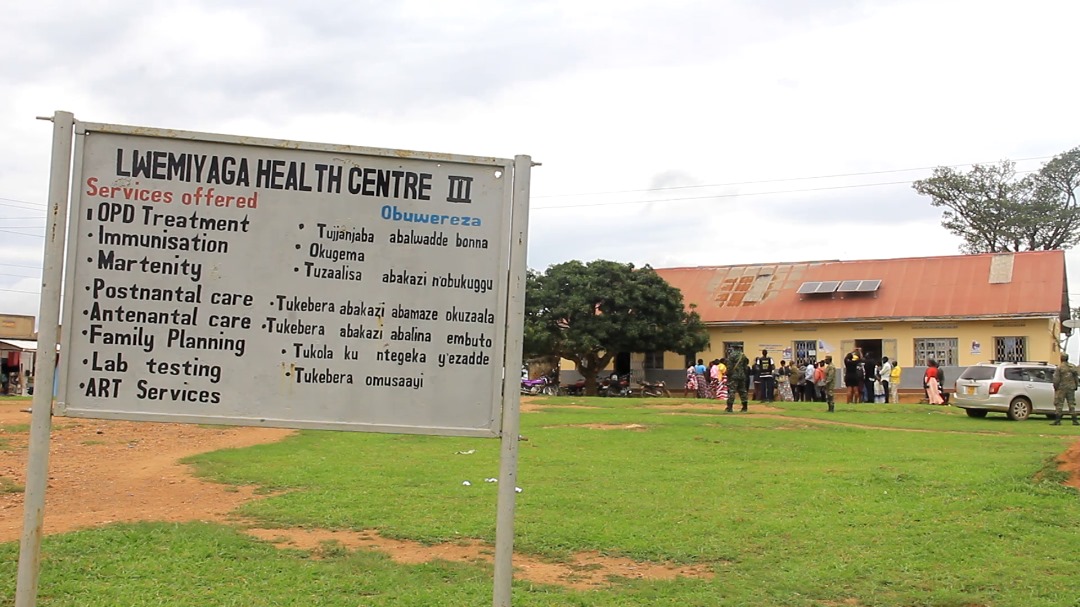
Health workers at Lwemiyaga Health Centre III in Sembabule District have raised alarm over the dire conditions under which they operate, warning that congestion, poor sanitation, and lack of basic facilities are endangering both patients and staff.
Established in 1987, the centre serves over 70,000 people from more than 20 surrounding villages, including some from neighboring Kazo District.
Despite the heavy workload, the facility is staffed by just 13 personnel, led by in-charge Ambience Nuwagaba.
On average, the health centre receives more than 100 new patients daily, about 30 of them expectant mothers.
Health workers say they are forced to operate in cramped, unhygienic spaces, with overflowing latrines and a filled placenta tank. The compound has reportedly become a dumping site for garbage.
Midwife Beatrice Nakayondo told The Nile Post that the facility has only one main building, partitioned into small rooms for maternity, testing, and records keeping.
Outside, a worn-out container serves as an examination room for expectant mothers, while a makeshift tent handles women battling cancer—both in poor condition.
Patients, regardless of age or illness, share a single ward, raising concerns about cross-infection.
“When a patient’s condition becomes critical, we refer them to Sembabule Health Centre IV or Masaka Hospital, but many die on the way due to the long distance and lack of transport,” Nakayondo said.
Local residents, led by Emmanuel Rwashande, have appealed to the government and well-wishers to renovate and expand the facility.
They also urged the Uganda People’s Defence Forces to support the construction of a better health centre in Lwemiyaga through their community outreach programs.
Attempts to reach Sembabule District Health Officer Charles Matovu for comment were unsuccessful.
The situation at Lwemiyaga highlights a broader challenge across Uganda’s rural health sector, where underfunding, decaying infrastructure, and neglect continue to limit access to quality healthcare.
