

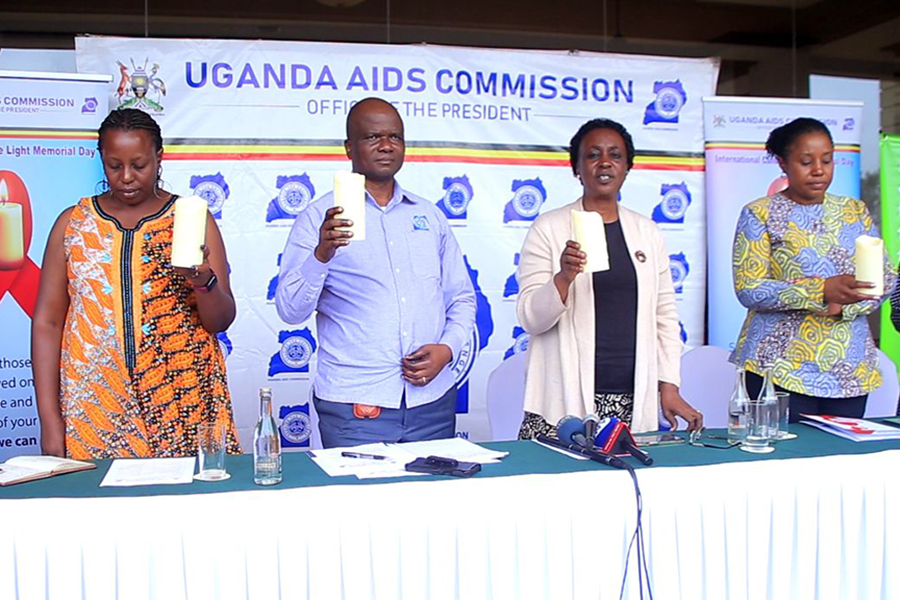
Women have been urged to take a leading role in Uganda’s fight against HIV/Aids as the country intensifies efforts to end the epidemic as a public health threat by 2030.
The call was made during the official launch of the 2026 Candlelight Memorial Day, scheduled for May 19 at Kitante Hill Secondary School in Kampala.
The annual commemoration honours lives lost to Aids-related illnesses while reinforcing global solidarity with people living with HIV.
Speaking at the launch, Uganda AIDS Commission Board Chairperson Canon Ruth Senyonyi said women remain disproportionately affected by HIV, with prevalence estimated at 6.4% compared to 3.4% among men.
She noted that persistent structural challenges—including gender inequality, income disparities, early marriages and harmful cultural practices—continue to expose women and girls to higher infection risks.
“Women are central to the success of the national HIV response. Empowering them with knowledge, resources, and leadership opportunities is critical if we are to end AIDS as a public health threat by 2030,” she said.
The 2026 commemoration will be held under the theme “Ending AIDS by 2030: Embracing the Role of Women,” with emphasis on prevention, awareness and community mobilisation.
Senyonyi also raised concern over mother-to-child transmission, noting that about 4,700 babies were born with HIV by the end of 2024. She urged expectant mothers to consistently attend antenatal care and undergo testing.
“With the available treatment and strong prevention strategies, no child should be born with HIV,” she said.
The Director General of the Uganda AIDS Commission, Nelson Musoba, said new HIV infections have declined by 69% since 2010, attributing the progress to improved interventions and awareness campaigns.
However, he warned that Uganda still records about 37,000 new infections annually, saying the country must intensify prevention efforts to close remaining gaps.
“These numbers show we are getting closer to ending HIV in Uganda, but this is not the time to relax,” Musoba said.
UNAIDS Country Director Jacqueline Makokha said Sub-Saharan Africa remains the global epicentre of the epidemic, with women and girls accounting for 63% of new infections in 2024.
She added that about 4,000 adolescent girls contract HIV every week, calling for urgent, targeted interventions.
She also urged stronger community-led efforts to reduce stigma and improve access to prevention and treatment services.
Meanwhile, HIV advocate Ruth Akulu, who has lived with HIV for over 29 years, called for greater protection and empowerment of women, stressing the need for continuous sensitisation to reduce stigma and promote responsible decision-making.
Stakeholders at the event also emphasised the importance of strengthening HIV testing, preventing gender-based violence, and expanding community support systems for women and young girls.
Uganda continues to align its national response with the global goal of ending AIDS as a public health threat by 2030, with experts stressing that sustained progress will depend heavily on empowering women and addressing underlying social inequalities.
