

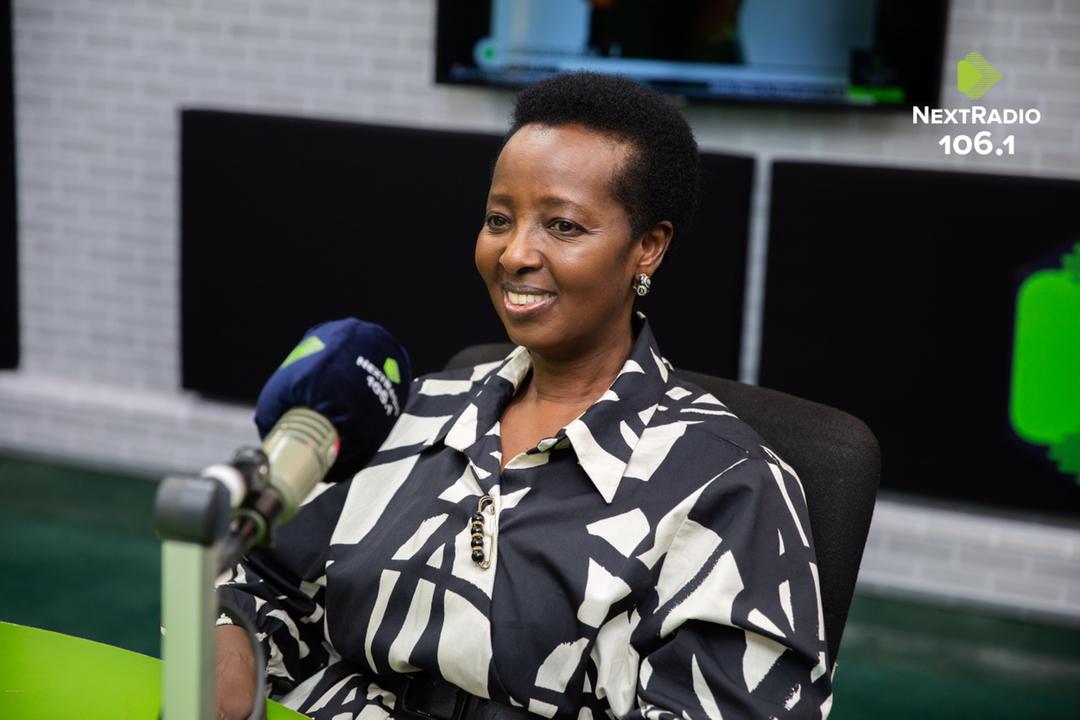
When Allen Kagina speaks about leadership, she strips away the mythology.
“I don’t think I was born a leader,” she said during an appearance on Next Radio’s Morning Switch. “I was born an ordinary young girl.”
Her journey began in Nyakatare in the hills of Kanungu, later moving through Fort Portal, Kasese and Jinja during her primary school years before attending Gayaza High School. Raised in a large, close-knit family, Kagina says there was little room for standing out — but the environment shaped her values.
Her father, a public administrator, introduced her to the power of service and structure, while her mother embodied quiet strength and discipline.
“My father taught me administration. My mother taught us dignity, discipline, and how to build a home,” she reflected.
Kagina believes opportunity often exists long before success does — but fear holds many people back.
“Opportunities come to us, but if you are not ready, someone else will slip into that gap,” she said.
After graduating in the mid-1980s during a period of instability, Kagina struggled to find work until Makerere University offered her a role as a teaching assistant. Trained in psychology, mathematics and biology, she gravitated toward psychology.
Her early teaching days were humbling. Walking into lecture rooms filled with peers her age, she had to establish authority from scratch.
“I knew I had to be in control, otherwise it would be hard for me,” she recalled.
Those early lessons in confidence and composure would later define her leadership style.
Kagina joined the President’s Office before rising to prominence at the Uganda Revenue Authority, where she navigated occasional gender bias but focused primarily on institutional performance and reform.
Her most defining chapter came at the Uganda National Roads Authority, where she became the first female Executive Director. She assumed office during a turbulent period marked by the Katosi road scandal.
“I didn’t know much about road construction when I went in,” she admitted. “But when I read the audit reports, I realized this was bigger than I thought.”
Her decision to push for a commission of inquiry exposed deep institutional flaws and led to restructuring, job losses and intense public scrutiny. She maintains that the risks were necessary to rebuild credibility.
“We had to take huge risks in a short time to rebuild the institution,” she said.
By the end of 2024, UNRA was mainstreamed into the Ministry of Works, closing a complex chapter defined by funding challenges, deteriorating infrastructure and mounting maintenance pressures.
Kagina argues that many of the sector’s difficulties stem from financial constraints rather than leadership transitions.
“The maintenance program has suffered more because of funding shortages, not necessarily leadership changes,” she explained.
After retiring, she was called back to serve as chairperson of the TVET Council, where she now champions technical and vocational education as a driver of national transformation.
“Skilling is where the growth of this nation will come from,” she said.
Despite employability rates of up to 82 percent among vocational graduates, she acknowledges that stigma continues to surround technical education. Her focus is on restoring dignity and structure to skills training, aligning programmes with industry demands and strengthening certification systems.
From construction technicians and tour guides to tailors and artisans, Kagina argues that Uganda’s economic engine lies in skills that are often overlooked or uncertified.
“These are the people who produce, yet many operate under the radar without recognition or proper pay,” she said.
Throughout her career, Kagina says she has drawn inspiration from personal mentors and global leaders she encountered through reading, while remaining grounded in humility.
“I looked up to many people who may never know they inspired me,” she said.
Beyond public service, she speaks candidly about family life. Married to her husband Paul for 33 years, she credits faith, mutual respect and shared values for the strength of their relationship.
“Love must be anchored in respect,” she said. “For us, marriage is a covenant for life.”
Today, Kagina’s story resonates not as one of sudden prominence, but of steady growth shaped by discipline and conviction. From lecture halls to tax reform, institutional restructuring to skills transformation, her journey underscores a consistent philosophy: leadership is less about titles and more about responsibility.
Her enduring message is simple — greatness is rarely born. It is built, one decision at a time.
