

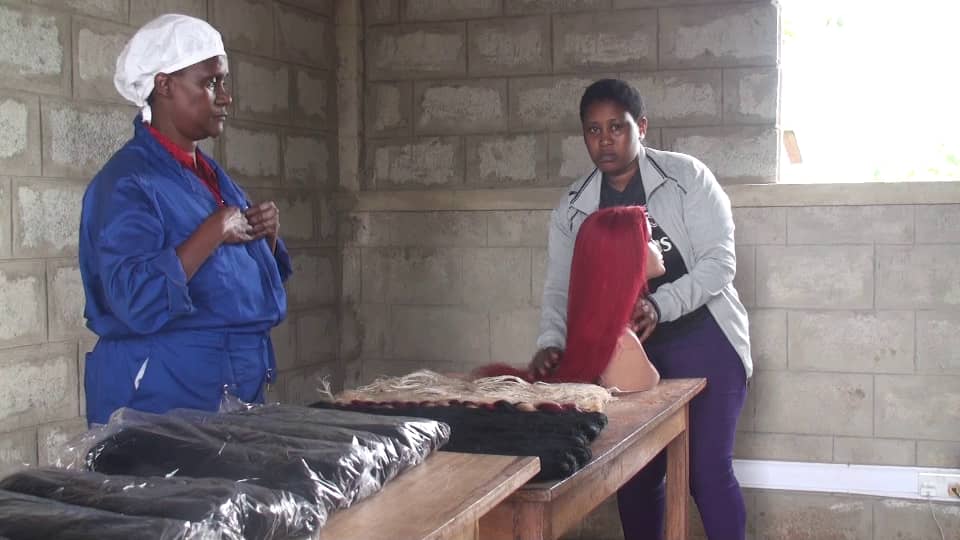
Uganda’s hair and beauty industry is undergoing an eco-friendly transformation as innovators pioneer the production of hair extensions made from banana stalks — an initiative now attracting the support of the Uganda National Bureau of Standards (UNBS).
UNBS has launched consultations with manufacturers of hair and beauty products as part of a drive to develop national standards for emerging eco-friendly innovations in the sector.
During a recent visit to TexFad, a factory based in Kasayi, Kyampisi Sub-county in Mukono District, UNBS held a stakeholder workshop to understand new natural alternatives to synthetic hair products and assess their safety and market readiness.
According to Levy Brian Kaneene from UNBS, the bureau began engaging with local manufacturers after they started producing extensions from natural materials such as banana stalk fibers.
“Manufacturers contacted us when they started making hair from natural fibers and wanted to ensure quality for their customers,” Kaneene said.
“The first step has been to consult with hairdressers, retailers, and consumers to assess whether these products are safe.”
He said the consultations aim to guarantee product safety and performance standards before the banana-fiber extensions enter the wider market.
TexFad Chief Executive Officer Kimari Muturi explained that Uganda, one of the world’s top banana producers, generates massive amounts of agricultural waste in the form of banana stalks, which are often discarded after harvest.
However, these stalks contain durable fibers suitable for sustainable manufacturing.
“We are turning agricultural waste into value,” Muturi said. “The banana stalks contain fiber strong enough to create natural hair extensions. We currently employ over 40 people and are attracting serious attention from international markets.”

Muturi added that the initiative has empowered banana farmers through training and the provision of equipment to process fibers before selling them to TexFad, creating a full value chain that supports rural livelihoods.
“Banana farmers have been trained and supported with machines to process the fibers, which we then buy from them. It’s a value chain that benefits communities and promotes sustainable agribusiness,” he explained.
Hairdresser Maria Maureen Nabulime, one of the early adopters of the new product, said the banana fiber extensions are durable, environmentally friendly, and safer than synthetic alternatives.
She raised concerns about health risks linked to artificial hair products, claiming many women suffer from illnesses associated with prolonged use of non-organic materials.
“These hairstyles last longer and are good for the environment,” Nabulime said.
“Many women are dying from cancer-related illnesses caused by synthetic hair products, but these natural fiber extensions are safer.”
Busitema University researcher and lecturer Edwin Kamara, who attended the workshop, praised the project for transforming agricultural waste into a high-value commodity.
He said such innovations could be integrated into academic training to build expertise in green manufacturing.
“This initiative shows how agricultural waste can be turned into valuable products,” Kamara said. “We plan to encourage more Ugandans to specialize in sustainable innovations through education and entrepreneurship.”
With UNBS now engaging stakeholders to develop standards, Uganda’s hair and beauty industry appears poised for a green revolution that merges environmental responsibility with local enterprise — proving that beauty and sustainability can grow from the same stalk.
