


Uganda Airlines is once again caught in turbulence, not only from the crosswinds of global aviation but also from the storm clouds of vested interests within.
The national carrier, barely six years into its rebirth, is now facing headwinds stirred by insiders more eager to flex personal ambition than to steady the airline’s flight path.
In March this year, a senior manager at the airline was sacked. The individual, by all accounts technically capable, had long drawn complaints from staff about their abrasive style.
Sources say the ultimatum was stark: his head on the chopping block or the loyalty of his team.
The board eventually made the call, but what should have been a managerial adjustment has since spiraled into manufactured turbulence shaking both the cockpit and boardroom of the national carrier.
From that decision sprouted an open season of leaks, blogs, and whisper campaigns. Every boardroom discussion, every State House meeting on the airline’s future, is now gleefully published online. The blogs carry a single through-line: Jennifer Bamuturaki, the chief executive officer, must be shown the emergency exit.
The cabal is out to get Jenny.
For Bamuturaki, the job was never going to be easy. Reviving an airline, especially one that had spent nearly two decades in the aviation graveyard, is no task for the faint-hearted.
Yet under her watch, the airline has pulled off milestones few would have predicted when its wings were clipped in 2001.
Finance Minister Matia Kasaija told Parliament in June that Uganda Airlines’ revenues had grown from Shs28 billion in FY2019/20 to Shs319 billion in FY2023/24.
More Ugandans are flying — to Nairobi, to Dubai, even to London — not only because Uganda Airlines connects them directly but because its presence has forced competitors to slash fares. A round trip to Nairobi that once cost $800 now hovers around $300.
From just 4% of Entebbe’s traffic in 2019, the airline today commands a quarter of the market, making it the dominant operator from Uganda’s only international hub. It now operates 17 direct routes, linking the Pearl of Africa to Africa, the Middle East, Asia, and Europe.
These are not small feats for a carrier that many predicted would crash on take-off.
Of course, Uganda Airlines is not yet profitable. In aviation, few start-ups are. The Auditor General’s 2024 report showed losses reduced from Shs324.9 billion in 2023 to Shs237.85 billion in 2024, a 26% improvement.
Bamuturaki explained the culprits to COSASE: fuel, depreciation, and crew allowances. These are the heavy baggage of any airline.
But instead of the narrative being one of narrowing losses, some legislators and critics spun it as evidence of deeper rot.
Remarks about the Canadair Regional Jets (CRJs) being temporarily grounded due to spares shortages were twisted to suggest the planes were “junk,” echoing the infamous 1990s helicopter scandal.
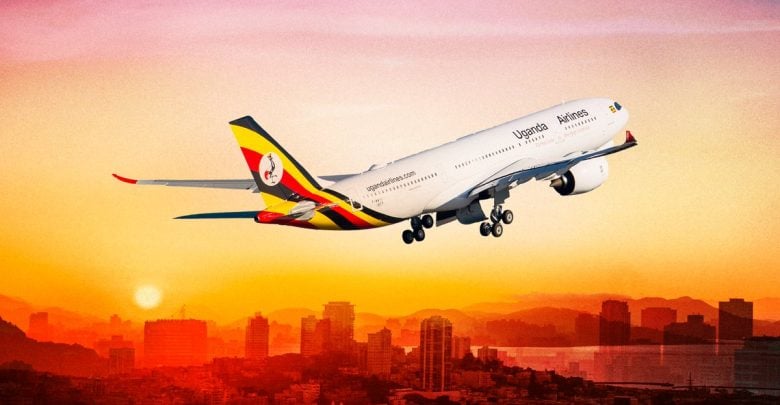
Uganda Airlines currently flies four Bombardier CRJ-900s for short-haul regional routes and two Airbus A330-800neos for long-haul operations.
It is not an unusual fleet for an airline of its size. What is unusual is the relentless effort to brand it as dysfunctional.
Still, the airline has not escaped genuine operational turbulence. This September, disruptions hit some of its most prestigious long-haul routes — London, Dubai, Mumbai, and Lagos–Abuja.
The A330-800neos, prized as Africa’s most modern long-haul aircraft, were grounded intermittently due to technical challenges. The disruptions, though resolved, fed the critics’ narrative of incompetence.
From the cockpit to the boardroom, pressure mounted. The chief commercial officer, Adedayo Olawuyi, and other executives aligned with Bamuturaki found themselves under siege.
The whispers are growing louder: Bamuturaki must go.
The latest point of turbulence is the fleet renewal plan. Reports indicate Bamuturaki favors Boeing jets over additional Airbus orders — specifically, a package involving four Boeing 787 Dreamliners, a 737 MAX, and a dedicated freighter.
That has raised alarms not only in aviation circles but also among those who see aircraft procurement as fertile ground for commissions and kickbacks.
In the aviation industry, the stakes are massive. Aircraft purchases attract commissions of 3.5–5% of contract value. For a Dreamliner worth over $200 million, that’s $7–10 million per unit.
It is no surprise then that boardrooms shake and blogs buzz when such deals are floated.
For instance, in 2018, a senior aircraft manufacturing official checked into a Kampala hotel, dangling $5 million in front of decision-makers if they would tip the scales for a contract that was already on the table.
No one should be surprised that similar winds are blowing now, as Boeing and Airbus compete for Uganda’s skies.
Sources have told the Nile Post that it is not Boeing 737-800 freighter that Uganda Airlines is eying but rather the a 777 freighter. The 737-800 was first produced as a passenger aircraft and later converted to carry cargo but the 777 has a dedicated freighter variant.
It is understood one of the highly collared officials in the country involved in coffee promotion and exports is determined to have a 777 freighter sprayed with the Black-Yellow-Red trident of the national colours and parked in the hangers at Entebbe.
But can Uganda Airlines afford the fuel burn and maintenance of such a behemoth? Or should it use its passenger fleet belly-hold capacity more efficiently before venturing into dedicated freighters?
These are genuine strategic questions. What is not genuine is the attempt to twist them into ammunition against the CEO.
At its core, this turbulence is not about Bamuturaki’s leadership. It is about vested interests jostling for contracts, influence, and the spoils of a young airline with billion-dollar horizons.
Uganda Airlines is too young, too fragile, to be turned into a tug-of-war between cabals. In aviation, stability is everything. Passengers trust you with their lives. Less visibly, creditors, lessors, suppliers, and global regulators watch every move. A perception of instability can ground an airline faster than any storm.
This is why President Museveni must resist the pressure. To yield to cabals now would be to throw Uganda Airlines into a nosedive from which it may not recover.
Bamuturaki’s job is thankless. She is not perfect, no airline CEO is. But she has weathered parliamentary inquisitions, labor unrest, operational hiccups, and media firestorms — all while reducing losses and expanding market share. That is not failure. That is flight through turbulence.
The airline needs stability, not another leadership decapitation. It needs the continuity to consolidate its gains, not another reset that would delay progress by years.
Uganda Airlines was reborn in 2019 with two CEOs in six years. If every whisper campaign can eject another captain from the cockpit, the airline will never climb to cruising altitude.
Uganda Airlines is not just another parastatal. It is a flag carrier, a symbol in the skies. Its trident tail painted in black, yellow, and red represents more than commercial ambition — it represents national pride, connectivity, and sovereignty.
Cabals see it as spoils to be carved up. Ugandans should see it as a shared project worth protecting.
The airline is still taxiing on the runway of profitability. To abort the takeoff now, for the sake of private ambitions, would be reckless.
The president must fasten Bamuturaki’s seatbelt, hand her the runway lights, and let her fly through the turbulence. Only then can Uganda Airlines truly soar.
