

Ugandans are increasingly taking up the majority of jobs on the East African Crude Oil Pipeline (EACOP) project as it moves closer to completion, the company has announced.
EACOP Deputy Managing Director, John Bosco Habumugisha, made the remarks while presenting project updates at the two-day 11th Oil and Gas Convention held at Munyonyo Commonwealth Resort. Habumugisha said that as the project nears completion, many roles previously handled by expatriates are being transitioned to Ugandans, particularly those who have undergone sector-specific training.
“We have a workforce count of over 4,000 people, spread between EACOP staff and its subcontractors. However, we are already scaling down on expatriates and ensuring that we transfer these jobs to nationals,” he said.
According to Uganda’s Petroleum Directorate, the project is expected to generate 14,000 direct jobs, 45,000 indirect jobs, and 105,000 induced employment opportunities.
Habumugisha noted that significant capacity building has been undertaken through trainings, internships, and international deployments in countries such as France, Malaysia, and Oman, all aimed at preparing Ugandans to take over technical roles.
He further reaffirmed the commitment to deliver the pipeline this year, with current progress at 84%. He said key components have already been completed, including the Tilenga feeder line, installation of marine loading arms for transferring crude oil into vessels, and insulation of crude oil tanks to maintain optimal temperatures. Work is currently focused on completing piping systems required to transport and process crude oil.
“We made a commitment to deliver the pipeline this year and we will not stop until it is done,” Habumugisha said.
Beyond the technical milestones, Habumugisha emphasized the project’s continuous community development initiatives along the pipeline corridor. These include reconstruction of schools, improvement of sanitation facilities, development of a sports complex in Masaka, clean water projects, and environmental awareness programmes such as the green schools initiative, which trains learners in tree planting, waste management, and school gardening.
“The project is not only about oil but also about leaving a positive legacy in host communities,” he said.
Habumugisha attributed the project’s progress to strengthened stakeholder relationships, including collaboration with the Catholic Church and the Bunyoro Kingdom, which has provided 500 acres of land for tree planting. This adds to more than 138,000 trees already planted in efforts to establish a “green petroleum hill.”
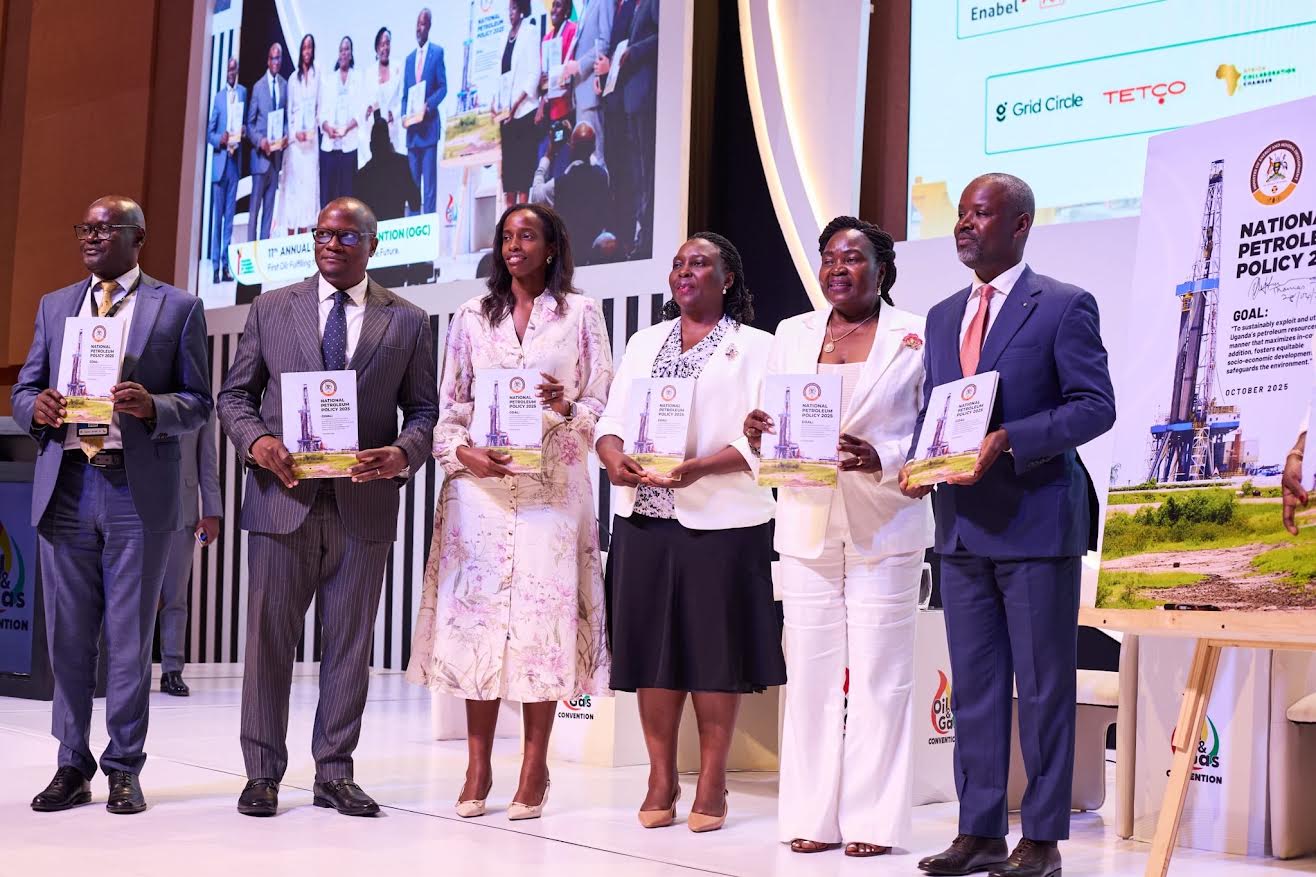
At the conference, the National Petroleum Policy 2025 was launched, purposely to guide the oil and gas sector as it transitions from infrastructure development to commercial production. It focuses on enhancing exploration, sustaining production, maximizing value addition, and ensuring environmental protection.
Uganda expects its first oil production in July, amid rising global oil price tensions, with production projected at over 60,000 barrels per day. The oil will be transported through the 1,443-kilometre pipeline from Kabale, Hoima in Uganda to Tanga, Tanzania.
