

Uganda’s industrialisation drive has received a major boost following a commitment by Chinese investors to develop a large-scale industrial park in Lusenke, Kayunga District—an initiative government says could generate more than 200,000 jobs and significantly accelerate the country’s economic transformation agenda.
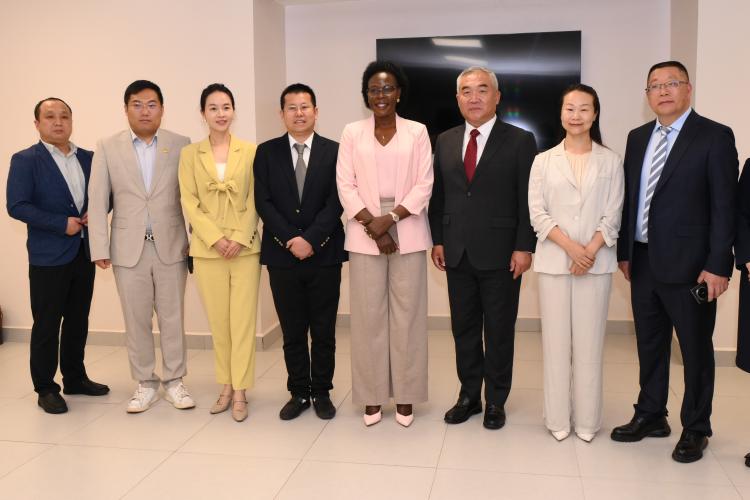
The development was confirmed over the weekend when State Minister for Privatization and Investment Evelyn Anite hosted a delegation of Chinese investors led by Paul Zhang, a prominent developer behind existing industrial hubs in Mbale and Mbalala.
The proposed project will sit on more than 1,200 acres of land in Lusenke, allocated by President Yoweri Kaguta Museveni in recognition of Zhang’s track record in mobilising foreign direct investment into Uganda. His developments have already attracted manufacturers producing goods ranging from mattresses and electronics to household products, contributing to job creation and export growth.
Addressing the delegation, Anite reaffirmed government’s commitment to turning its long-term economic ambitions into concrete investments.
“Our vision is not just to dream of a $500 billion economy, but to turn this dream into reality,” she said.
“We are focused on practical investments that transform livelihoods, expand industrial capacity, and create opportunities for Ugandans.”
The Lusenke industrial park is expected to become a cornerstone of Uganda’s industrial strategy, with projections indicating it could create over 200,000 direct and indirect jobs in the medium term. Officials say the project will particularly benefit young graduates, engineers, and technical professionals entering the labour market.
Beyond manufacturing, the planned industrial park will integrate supporting infrastructure aimed at sustaining industrial productivity. Its proximity to a hydroelectric power station is expected to guarantee reliable energy supply, while additional plans include solar power generation and a chemical manufacturing facility.
“We are not just building factories,” Anite noted. “We are building complete industrial communities—with schools, hospitals, and commercial centres—to support workers and their families and ensure sustainable development.”
The initiative aligns with Uganda’s broader economic priorities, including agro-industrialisation, tourism development, mineral-based industrialisation, and science and technology innovation, all seen as key drivers of value addition and export growth.
Chinese firms are already positioning themselves for participation. Lu Wei, representing Shenzhen Mingyang Technology Company, said the firm is exploring opportunities in Uganda, particularly in energy storage solutions for industrial use.
“Our interest is to support industrial growth with reliable and efficient energy systems,” he said. “We see Uganda as a strategic entry point for providing battery storage solutions that can stabilise power supply for factories and industrial parks.”
Anite also commended Paul Zhang’s role in attracting investors, noting his independent efforts in mobilising capital for Uganda’s industrial sector. “He has gone out of his way, without relying on government resources, to attract high-value investors into Uganda. These are significant capital commitments that are creating jobs and expanding our economy,” she said.
She added: “These investors are not only coming to grow their own businesses; they are contributing directly to Uganda’s development by creating employment and strengthening our industrial base.”
The minister called on Ugandans to support credible investors, emphasizing the national importance of such projects. “If we are to achieve a $500 billion economy and address unemployment, we must embrace and support credible investors who are committed to building our country,” she said.
Uganda currently aims to expand its economy from about $50 billion to $500 billion in the coming decades. Analysts say achieving this ambition will depend on sustained foreign investment, infrastructure development, and consistent policy implementation.
As planning advances, the Kayunga industrial park is being viewed as a key milestone in deepening Uganda-China economic cooperation and advancing the government’s industrialisation-led growth strategy.
