

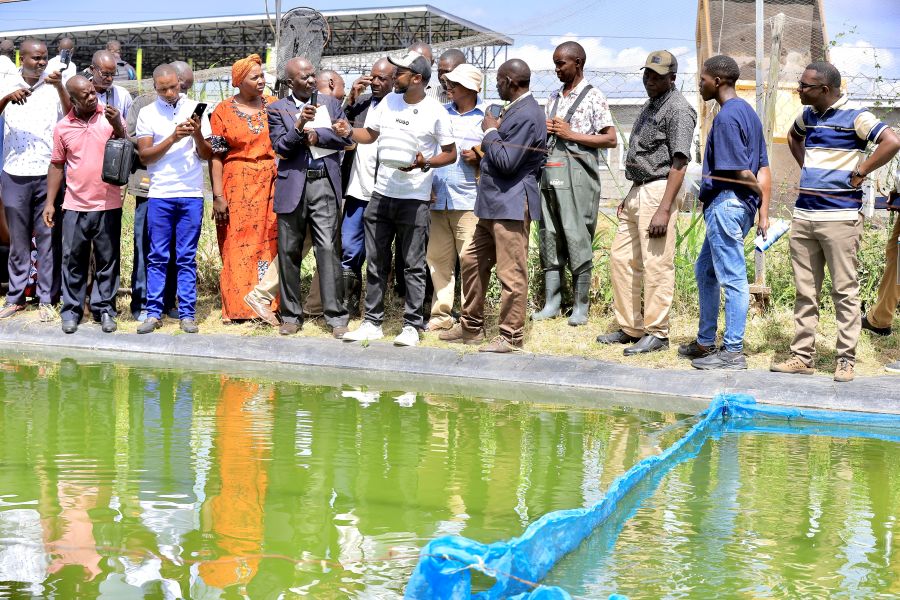
State House, through the Office of the Special Presidential Assistant on Press and Mobilization, on Saturday sent 60 model farmers from the Busoga sub-region to Kenya for a three-day benchmark study on modern fish and livestock farming practices.
The study visit was conducted at Fish Farm Paradise and Resort in Kamulu, Machakos County, a few kilometres from Nairobi City. The facility specializes in aquaculture and dairy farming.
The initiative forms part of President Yoweri Kaguta Museveni’s broader campaign to help households in Busoga diversify income sources beyond sugarcane growing. Other promoted enterprises include poultry farming, cocoa growing, dairy farming and aquaculture.
Leading the delegation, Florence Mutyabule commended State House for organizing the study tour, describing it as timely for a region seeking more sustainable and profitable economic activities.
She noted that President Museveni has consistently encouraged communities to utilize wetlands responsibly through fish farming along wetland peripheries as a way of generating wealth while conserving the environment.
“The strategy is working well. Fish farming will help Busoga fight poverty. Busoga is surrounded by water bodies such as Lake Victoria, which gives us natural potential for aquaculture,” she said.
Mutyabule also praised the proprietor of Fish Farm Paradise and Resort for effectively utilizing wetlands through the establishment of fish hatcheries, fish ponds and recreational facilities.
“He utilized the wetland very well by setting up hatcheries and ponds for catfish and tilapia alongside a recreation centre. Such investments can help Busoga create wealth,” she added.
She further emphasized the need for Busoga to establish fish holding centres to strengthen market access for farmers.
Mutyabule urged the participating model farmers to become change agents in their respective districts by implementing and sharing the knowledge acquired during the study visit.
“We are 60 model farmers here, and I believe we can transform Busoga through the knowledge we have gained,” she said.
Mr. Stanley Mworia, Chief Executive Officer of the Aquaculture Association of Kenya, welcomed the Ugandan delegation and briefed them on modern fish farming technologies aimed at improving productivity.
According to Mworia, the facility operates fish ponds and hatcheries using modern systems, with each pond accommodating up to 3,000 fish.
He also highlighted the use of integrated power systems, including electricity, generators and solar energy, to ensure proper aeration and stability in fish holding tanks.
“If fish are ready for sale but there is no market immediately available, we keep them in holding tanks until buyers are secured,” he explained.
Mworia revealed that the facility has the capacity to produce up to 500,000 fish per month.
On fish feeds, he urged East African governments to exempt taxes on raw materials used in feed production in order to reduce operational costs for farmers.
Mr. Jacob Kazindura, a model farmer from Jinja, expressed gratitude to the Office of the Special Presidential Assistant on Press and Mobilization for organizing the study tour.
“I have learned modern methods of fish and dairy farming, including water recycling systems that help maintain fish safety,” he said.
Kazindura added that the training had equipped farmers with knowledge on profitable fish varieties and cost-effective fish feed formulation.
Ms. Mary Immaculate Abwooli, a fish farmer from Namutumba, described the benchmark study as beneficial and encouraged Busoga farmers to form associations to strengthen product aggregation, bargaining power and market access.
She also emphasized the importance of technology in increasing fish productivity.
“This initiative by State House was timely and necessary for us as model farmers,” she said.
Meanwhile, Mr. Magala Samuel Ngobi, a model farmer from Luuka District, thanked Haji Faruk Kirunda for organizing the study trip.
He said that while communities in Luuka are capable of establishing modern fish ponds, financial support remains a major challenge.
“However, with the knowledge gained from this trip, we shall improve our agricultural enterprises,” he noted.
