

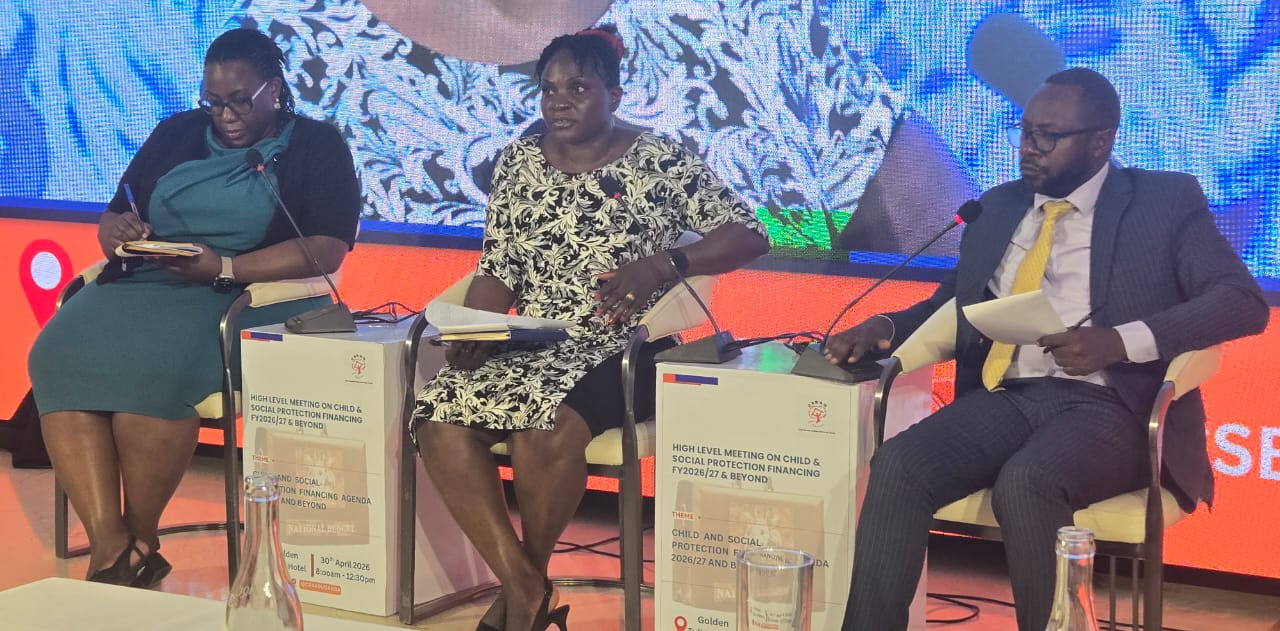
Ugandan leaders, policymakers, and civil society actors have called for a significant increase in financing for child welfare and social protection programmes, warning that current interventions are underfunded, inconsistently implemented, and leaving vulnerable populations behind.
The appeal was made during a high-level dialogue on the “Child and Social Protection Financing Agenda FY 2026/27 and beyond,” organised by the Civil Society Budget Advocacy Group (CSBAG) in Kampala.
The meeting brought together parliamentary champions, officials from the Ministry of Finance, Planning and Economic Development, the Ministry of Gender, Labour and Social Development, and civil society organisations including the Initiative for Social and Economic Rights (ISER).
CSBAG Executive Director Julius Mukunda said existing social protection allocations are inadequate and failing to meet growing needs, particularly among the elderly and children.
“25,000 shillings is now peanuts. It’s an insult,” Mukunda said, referring to monthly support under the Social Assistance Grants for Empowerment (SAGE) programme.
“We are paying 25,000 shillings per month, and after 10 years it remains unchanged. It is an insult to give a person who has built this country such an amount.”
He noted that although government policy targets citizens aged 65 and above, current implementation largely reaches those aged 80 and above, leaving a significant coverage gap.
Mukunda also welcomed a shs15 billion allocation for children with disabilities but said it remains far below what is needed.
“As we look at the future of this country, if we do not invest properly in our young people, then our future is at risk,” he said, warning of rising child vulnerability, including street children and youth gangs.
He further urged Parliament to prioritise funding over pledges, saying: “If you come with a big bag of money, we will appreciate it. But if you come with promises, we call that ‘byoya byanswa’.”
ISER Executive Director Angella Kasule Nabwobwe emphasized that underinvestment in children carries long-term economic consequences.
“If you don’t meet that cost now, it does not disappear. It accumulates and shows up in our economy for decades,” she said.
Citing global research, she noted that child benefits yield measurable returns. “For every 15 dollars transferred to a family, you get back 19 dollars. This is evidence-based research,” she said.
She illustrated the human cost of underinvestment through case studies of vulnerable children affected by poverty, school dropout, and child labour, including those in mining areas.
“We have seen children as young as eight working in gold mines,” she said. “Some were even paid with local alcohol residues as food.”
Nabwobwe argued that countries at similar income levels to Uganda are investing more in social protection. “It is not a question of resources. It is a question of prioritisation,” she said, citing countries such as Nepal, Ghana, and Zambia.
From government, Ministry of Finance senior economist Janet Nankya said Uganda operates under significant fiscal constraints despite large programme allocations.
“We are relatively operating a budget-constrained government,” she said, noting that funding requests often exceed available resources by up to shs30 trillion annually.
She warned that expanding SAGE eligibility to age 65 would significantly increase costs and strain administrative systems.
“We need strong data, social registries, and digitised payment systems to reduce inefficiencies and leakages,” she said.
Nankya also stressed the need for a stronger legal framework, saying government prioritises programmes backed by policy and legislation.
“We need a social protection policy and continued advancement of the social protection bill,” she added.
Rukiga District MP-elect Patrick Katabazi called for urgent legislative action, warning that the absence of a dedicated law weakens implementation.
“We don’t have a social protection law in place. If government delays, we shall bring a private member’s bill,” he said.
He urged coordinated advocacy, saying fragmented approaches weaken reform efforts. “We must design a unified social protection framework as a country,” he said.
Nebbi Municipality MP-elect Emmanuel Ongiertho warned that failure to invest in children today would lead to higher future costs.
“If you avoid investing in children today, be prepared to pay heavily in the future,” he said.
He called for sustained parliamentary engagement on social protection issues, even beyond political transitions.
“We must continue advocating so that social protection remains a national priority,” he said.
Stakeholders at the meeting agreed that Uganda must urgently strengthen financing, policy frameworks, and implementation systems if social protection programmes are to effectively support vulnerable groups and contribute to long-term national development.
