

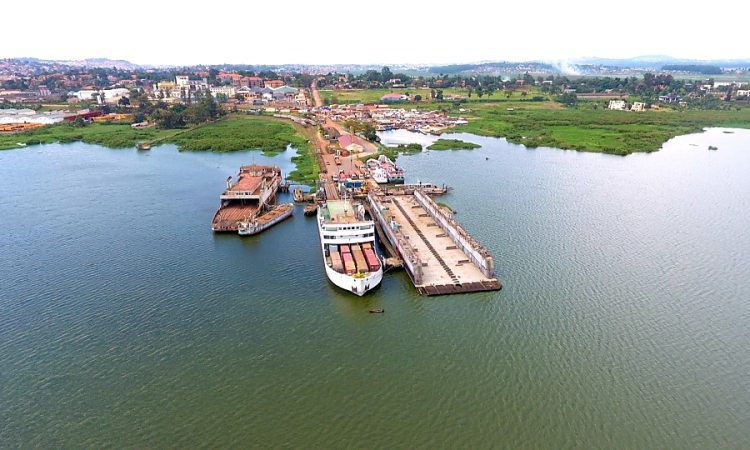
Uganda’s push to transform its transport and logistics sector has received a major boost after Indian firm Mohan Mutha Infrastructure signalled interest in investing at least $100 million (about shs 370 billion) in inland port development on Lake Victoria, as government intensifies efforts to shift cargo from roads to waterways.
The proposed investment, which targets port infrastructure and related transport systems, comes amid growing consensus among policymakers and private sector leaders that Uganda must urgently modernize its logistics network to remain competitive in the region.
Speaking during a multi-agency engagement, company director Praful Mutha said feasibility studies conducted across several African countries had identified Uganda as a strategic priority due to its favorable business environment and untapped potential in water transport.
“Our studies revealed major roadblocks, including poor access routes and underdeveloped port facilities, which limit the full potential of water transport,” Mutha said.
He noted that while countries such as Tanzania, Ghana and Ivory Coast have made progress in port infrastructure, Uganda’s key facilities—including Port Bell and Jinja Port—remain constrained by limited accessibility and logistical bottlenecks.
Mutha said investment in inland water transport could cut logistics costs by between 30 and 40 percent through reduced fuel consumption, while also unlocking opportunities for carbon financing through institutions such as the World Bank. He added that each port could require more than $100 million depending on land availability and feasibility outcomes, noting that the projects would be privately financed with returns expected from increased cargo efficiency and regional trade.
Government officials say the investment aligns with a broader policy direction aimed at reducing the high cost of road transport and easing pressure on public infrastructure.
Permanent Secretary in the Ministry of Works and Transport, Waiswa Bageya, said inland water transport presents a more sustainable alternative.
“Transporting cargo by water is the cheapest option and in some cases the shortest route. We must move cargo off the roads to waterways to reduce the burden on the Treasury,” he said.
Bageya warned that heavy cargo traffic continues to damage roads, draining government resources through constant repairs, while regional competitors invest heavily in more efficient logistics systems.
He pointed to developments in Kenya and Tanzania, which have expanded ports and standard gauge railway networks, cautioning that Uganda risks losing its position as a transit hub for Rwanda, South Sudan and the Democratic Republic of Congo if it delays infrastructure upgrades.
He said government is considering strategic interventions, including a bridge at Mpatta, while ongoing port upgrades at Port Bell and Jinja are progressing in phases. The first phase has covered master planning, geotechnical surveys and access roads, with the next stage focusing on dredging and full port construction.
Bageya added that authorities are also exploring expansion of water transport on Lake Albert to boost trade with eastern DRC, while calling for adoption of soil stabilization technologies to address rising road construction costs caused by dwindling murram resources.
At the State House level, the government says it is removing bureaucratic bottlenecks that have historically slowed down major investments.
Head of the State House Investors Protection Unit, Col. Edith Nakalema, said her office is coordinating ministries to ensure investors are supported efficiently.
“Our mandate is to bring together all relevant ministries, departments and agencies so that investors are served efficiently. Time is money, and investors should not be delayed,” she said.
Nakalema said officials from the Ministry of Finance, Planning and Economic Development and the Ministry of Lands, Housing and Urban Development have already committed to fast-track engagements with Mohan Mutha Infrastructure following a positive technical presentation.
“Inland water transport is cheaper and can ease the pressure on our roads, which are increasingly congested due to economic growth and rising vehicle numbers,” she added.
However, private sector leaders are urging government to broaden its approach beyond cargo transport and fully exploit the economic potential of Lake Victoria.
Executive Director of the Private Sector Foundation Uganda, Stephen Asiimwe, said planners must view the lake as a multi-sector economic hub rather than a single-purpose transport corridor.
“A port is not just about cargo; it is an entire ecosystem,” Asiimwe said.
He noted that the Lake Victoria Basin economy is valued at between $40 billion and $80 billion and supports nearly 100 million people, adding that improved water transport could cut travel time between Kampala, Jinja and Masaka from six hours by road to under one hour by boat.
Asiimwe also called for integration of tourism, fisheries, manufacturing and agriculture into infrastructure planning, highlighting Uganda’s advantage of hosting nearly 80 percent of the lake’s islands despite controlling about 30 percent of its waters.
He warned that inefficiencies in cargo movement such as transit delays of up to 11 days from seaports are costing Uganda between one and three percent of its GDP, urging adoption of phased development plans, multimodal transport systems and stronger regional linkages.
The convergence of investor interest, government policy and private sector advocacy now places Lake Victoria at the center of Uganda’s economic strategy, with stakeholders betting that revitalized inland ports could unlock faster trade, lower costs and long-term growth.
