

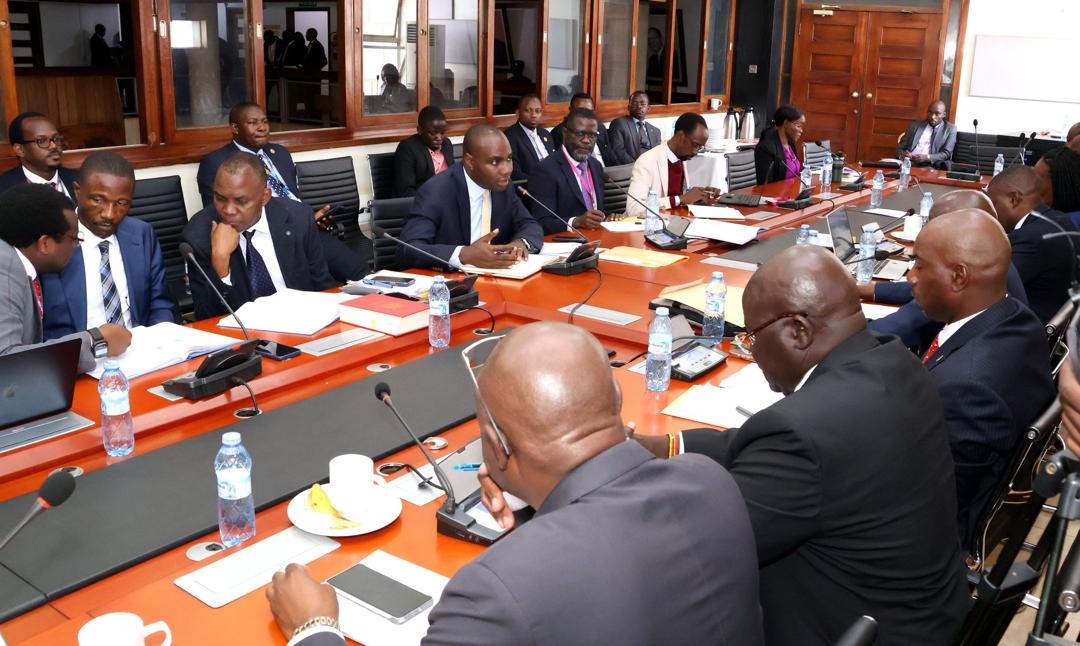
With eight new tax bills presented to Parliament’s Finance Committee on Thursday, Uganda is gearing up for significant changes in its fiscal landscape.
The measures are projected to generate Shs1,741 billion in the 2026/27 fiscal year, while an additional Shs3,164 billion is expected from improvements in tax administration by the Uganda Revenue Authority, contributing to a total projected revenue effort equivalent to 15.5% of GDP, up 0.6 percentage points from the previous fiscal year.
“The Bills are meant to raise revenue, foster compliance, and assist the Uganda Revenue Authority in its work,” the Minister of State for Finance, Planning and Economic Development, Henry Musasizi said, emphasising that effective revenue mobilisation is essential for financing government priorities, including socio-economic transformation and stabilising public service costs.
The proposals are complemented by compliance strategies designed to bring informal businesses into the formal economy, gradually expanding Uganda’s tax base.
The eight bills presented include the Income Tax (Amendment) Bill, Excise Duty (Amendment) Bill, Value Added Tax (Amendment) Bill, Tax Procedures Code (Amendment) Bill, Stamp Duty (Amendment) Bill, External Trade (Amendment) Bill, Lotteries and Gaming (Amendment) Bill, and Traffic and Road Safety (Amendment) Bill.
Under income tax, the proposals include allowing taxpayers to pay rental income tax monthly; introducing a 6% final withholding tax on public entertainers, a 10% withholding tax on commissions paid to data and voice bundle distribution agents, and a 0.5% alternative minimum tax for businesses carrying forward losses beyond seven consecutive years. Non-business assets will also attract a 6% final withholding tax.
VAT proposals include raising the threshold from Shs150 million to Shs250 million to support small businesses and providing clarification on the taxation of imported software.
Stamp duty changes would see land transfer duty rise from 1.5% to 3%, while motor vehicles and motorcycles would incur duties on first registration and transfers, with Shs100,000 for regular motor vehicles, Shs200,000 for commercial vehicles, and Shs50,000 for motorcycles.
Excise duty measures are extensive. Fuel levies will increase by Shs200 per litre for diesel and petrol. The excise duty on spirits below 80% alcohol will rise from Shs1,700 to Shs3,500 per litre, while the first registration excise on motorcycles jumps from Shs200,000 to Shs500,000.
Excise duties will now apply to all single-use plastics, increasing from 2.5% or USD 70 per tonnene (whichever is higher) to 25% or USD 1,500 per tonnene.
Cement duty rises from Shs500 to Shs1,000 per 50 kg, sugar from Shs100 to Shs300 per kg, cooking fat and fatty acids at Shs500 per litre/kg, and cooking oil from Shs200 to Shs400 per litre.
Changes under the Traffic and Road Safety Act include reducing the maximum acceptable age for imported vehicles from 15 to 13 years and introducing a graduated environmental levy on used vehicles to encourage cleaner imports.
Gaming taxes are set to rise from 20% to 30%, while vehicle transfer charges will increase from Shs200,000 to Shs500,000, reflecting the government’s efforts to tap into revenue from leisure and transport sectors.
The Finance Committee has expressed mixed reactions, requesting more time to study the proposals and assess their potential impact on households and businesses. Some lawmakers have raised concerns that higher excise duties and vehicle fees could strain consumers, while others welcomed measures like the VAT threshold increase as a boost for micro and small enterprises.
Minister Musasizi, however, highlighted the broader objectives of the reforms, stressing that the changes aim to grow the tax-to-GDP ratio to 20% in the medium term and 25% in the long term, stabilise power costs, and support small businesses while promoting fiscal compliance.
The government’s proposed tax reforms are being closely watched as Uganda seeks to balance revenue generation with economic growth, business sustainability, and consumer affordability.
