

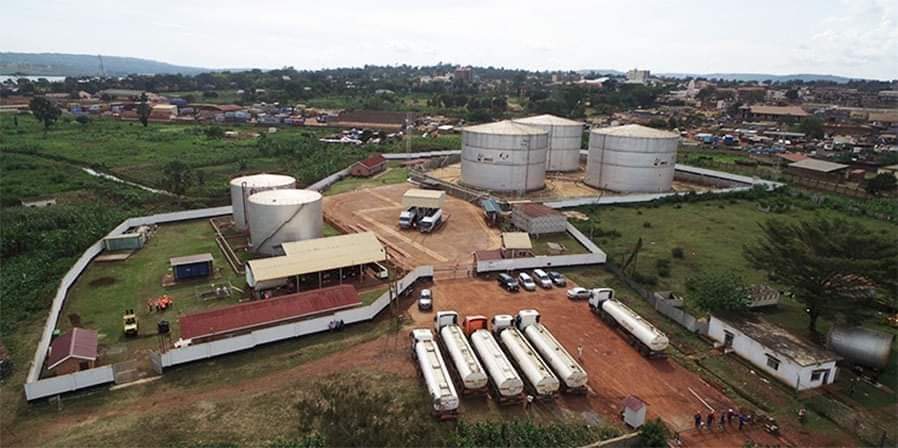
The Uganda National Oil Company (UNOC) has unveiled plans to expand the Jinja Oil Storage Terminal from 30 million litres to 40 million litres, in a move aimed at strengthening Uganda’s strategic fuel reserves and enhancing energy security.
The expansion project will run concurrently with the construction of a new 320-million-litre oil storage terminal in Mpigi District to serve the greater Kampala metropolitan area — a development expected to significantly boost the country’s downstream petroleum infrastructure.
The Jinja Oil Terminal, constructed during the regime of former President Idi Amin, remains Uganda’s largest fuel storage facility.
However, rising national fuel consumption has prompted government to upgrade the facility’s capacity by an additional 10 million litres.
At the same time, the proposed Kampala Oil Terminal will add 320 million litres to the country’s storage capacity, marking one of the most significant investments in Uganda’s petroleum storage infrastructure in decades.
Officials say the combined projects will not only stabilize fuel supply but also reduce vulnerability to regional supply disruptions and price volatility.
To ensure meaningful local participation, UNOC has organized a supplier development engagement in Jinja, targeting Ugandan investors and contractors interested in participating in the projects.
Speaking at the engagement, UNOC Chief Operating Officer Samantha Muhwezi underscored the company’s commitment to advancing national content in the oil and gas sector.
“We have past experience in the Tilenga and Kingfisher projects as well as the East African Crude Oil Pipeline where an enormous number of Ugandans have been employed. We have 87 percent Ugandans employed across these projects, totaling more than 16,000 workers. Ugandan companies have participated and been paid over USD 2.2 billion on these projects,” Muhwezi said.
She added that as UNOC expands its downstream operations in Jinja and other parts of the country, it is keen to onboard more Ugandan professionals and local enterprises.
Building Capacity and Certification
Peter Bintu, UNOC’s Head of National Content, outlined key areas where Ugandan companies can tap into opportunities, including civil engineering works, supply of construction materials, logistics and supply chain services, as well as accommodation and hospitality.
However, he acknowledged that local firms face two major constraints: limited certification and access to affordable financing.
“Ugandan companies are facing challenges of not being certified, but what we are doing as UNOC, together with our partners, is to support them in building capacity,” Bintu explained.
He cited collaboration with the Industry Enhancement Centre and the Stanbic Business Incubator, which are working with local firms to attain internationally recognized ISO certifications, enabling them to competitively participate in high-value oil and gas contracts.
Bintu also pointed to the high capital requirements in the oil and gas sector as a barrier for many local firms.
“Another key challenge has been the cost of financing. For this initiative, government is putting together a National Content Fund which will enable contractors in the oil and gas sector to access affordable financing to execute these projects,” he said.
The proposed fund is expected to ease liquidity constraints and position Ugandan contractors to compete effectively against international firms.
Preparing for the Refinery Project
Beyond the immediate storage expansion projects, UNOC officials say the initiative is part of a broader strategy to prepare local firms for even larger upcoming ventures — including the planned construction of Uganda’s oil refinery.
“As you execute these projects, you build your capacity to tap into much bigger projects. In the coming years, we are going to construct a refinery project, and we hope the expertise built during the storage terminal developments will be leveraged to participate in refinery opportunities,” Bintu noted.
The expansion of the Jinja Oil Terminal and the development of the Kampala facility represent a major step in Uganda’s downstream petroleum development agenda.
By coupling infrastructure growth with deliberate local content strategies, UNOC aims to deepen domestic participation in the oil and gas value chain while reinforcing national energy resilience.
As construction plans advance, the projects are expected to generate employment, stimulate local enterprise growth, and solidify Uganda’s position in the region’s evolving energy landscape.
